
The Overbuilt Inline-Six That Outlived The American Automaker That Built It
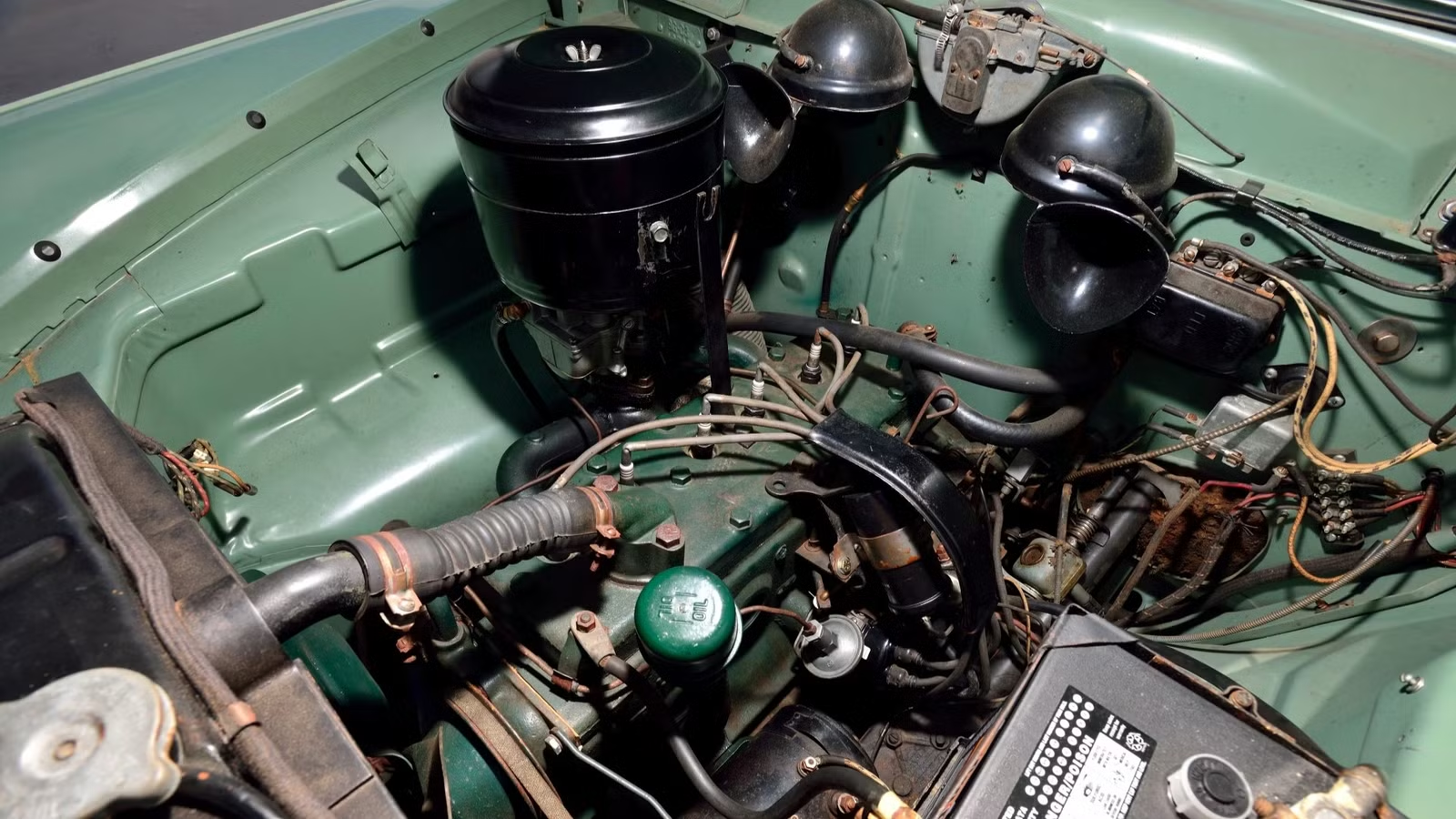
Some automakers die and take their engineering secrets with them. Others leave behind a machine that keeps running decades after the company collapses. Studebaker built an inline-six so overbuilt that period reviewers compared its construction to farm equipment. That engine went to war, powered family sedans through the 1950s, and kept the failing automaker’s trucks moving into the 1960s. Nobody talks about it today, and almost nobody remembers the engine either, but it outlasted every reason anyone had to forget it.
The Independent Automakers America Forgot

The years after World War II turned brutal for America’s independent automakers. Companies like Nash, Hudson, Packard, and Studebaker had survived the Great Depression and wartime production only to face a rebuilt General Motors, Ford Motor Company, and Chrysler Corporation with deeper pockets and wider dealer networks. Independent brands could not match that scale. They fought back the only way they could, by engineering vehicles that punched above their weight in reliability and value, even when styling and marketing budgets lagged far behind Detroit’s giants. Some of those companies vanished within a decade, while a few limped on into the 1960s before folding entirely, their factories shuttered and their nameplates forgotten by all but the most dedicated collectors.
What rarely gets discussed is how much good engineering came out of that desperation. Independent automakers could not afford the constant redesigns Detroit used to sell new cars every year, so their engineers leaned on durability instead, building components meant to run for decades rather than a single model cycle. One of those engines proved so tough that it outlived not just its original car, but the entire company that built it, powering trucks and troop carriers long after the badge on the hood had stopped meaning much to buyers. That engine deserves more credit than automotive history has given it.
An Engine Tougher Than The Company Behind It

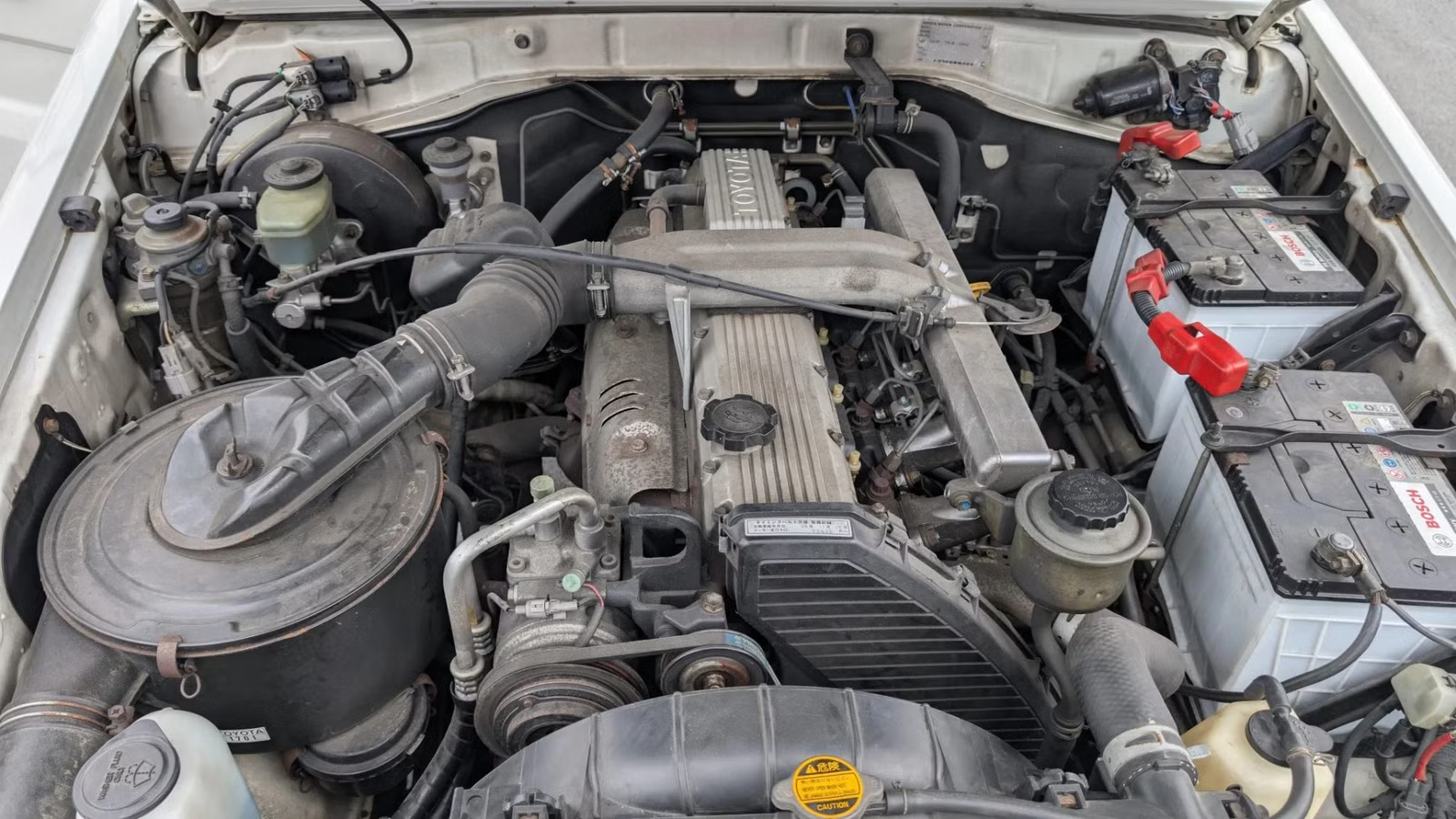
Period mechanics and reviewers who worked on this particular six-cylinder engine kept returning to the same comparison. A respected engine history write-up put it bluntly, noting the block “would put a tractor engine to shame” compared to anything else in its class. The block casting, the bearing sizes, and the general construction all pointed toward an engineering team that expected the design to outlive its original application. That instinct turned out to be correct, since mechanics were still finding examples running with minimal intervention decades after production ended, a track record almost unheard of for a mainstream American engine of its era.
That toughness did not go unnoticed by the U.S. military. During World War II, the same basic engine family found its way into a wartime personnel carrier used across multiple combat theaters, prized for the kind of reliability combat units could not afford to gamble on. Soldiers needed equipment that started every time and kept running under abuse no showroom customer would ever put it through, and this engine delivered. That wartime service gave the platform a credibility no marketing department could manufacture, and it carried that reputation straight into the postwar years, when the same basic six went back to powering ordinary family cars for a company fighting to survive against much larger rivals.
The Studebaker 170 Champion Six Finally Steps Into The Light

That engine was the Studebaker 170 Champion Six, and the automaker behind it was not General Motors or any Detroit conglomerate. Studebaker Corporation operated as an independent automaker headquartered in South Bend, Indiana, competing on its own against giants with far greater resources. The Champion Six debuted in 1939 as a clean-sheet design intended to save the struggling company, initially displacing 164.3 cubic inches and producing 78 horsepower. Engineers grew the block to 169.6 cubic inches, commonly rounded to 170, within a few years, and by the early 1950s the flathead six had settled into a longer production run. The engine’s mid-1950s power rating settled at 85 horsepower at 4,000 rpm, with 138 lb-ft of torque at 2,000 rpm, respectable numbers for a small economy six of that era.
From Flathead Six To Overhead Valve Survivor

Studebaker kept pushing the engine forward as the company’s finances worsened, and the biggest change came in 1961, when engineers replaced the old flathead valve arrangement with an overhead valve design, a conversion that pushed output to somewhere between 110 and 112 horsepower depending on the source, with roughly 154 lb-ft of torque. That upgraded six went into the Champ pickup, a light-duty truck built by grafting the front end of the compact Lark onto a truck chassis on a design budget far smaller than anything Detroit would have accepted. The OHV conversion kept the engine competitive enough to soldier on until civilian truck production ended in 1964, closing out a run that had started 25 years earlier as a Depression-era economy engine.
How The 170 Stacks Up Against Detroit’s Legendary Sixes

Chrysler Corporation and Ford Motor Company each built inline-six engines that became legends among enthusiasts, and both make useful benchmarks for the Studebaker unit. Chrysler’s 225-cubic-inch Slant-Six debuted in 1960 rated at 145 horsepower at 4,000 rpm and 215 lb-ft of torque at 2,800 rpm, noticeably stronger than the Studebaker flathead it competed against. Ford’s 300 cubic inch inline-six arrived five years later in 1965 and carried an original gross rating of 170 horsepower, with roughly 223 lb-ft of torque on tap for hauling duty. The 85 to 112 horsepower Studebaker unit never matched those figures on paper, but it also predated both rivals by two decades and kept running in trucks long after its maker had ceased to exist, a distinction neither the Slant-Six nor the Ford 300 needed to earn.
The collector market tells a similar story of overlooked value. Well-kept 1960 to 1964 Studebaker Champ pickups currently range from about $6,000 in fair condition to $28,000 for a concours example, according to current pickup valuation data. A comparable 1965 Ford F-100 with the 300 six now averages closer to $18,700 in good condition, per rival pickup valuation figures. That gap has little to do with mechanical merit and everything to do with brand survival, since a company that stopped building cars in North America by the mid-1960s simply has fewer people left to champion its history.
A Quarter Century Of Quiet Reliability

From its 78-horsepower debut in 1939 to its final overhead valve form in the Champ pickup, the Studebaker 170 Champion Six spent 25 years proving that durability sells even when styling budgets cannot compete. It survived a world war, three body-style generations of Champion sedans, and a corporate collapse that took the Studebaker name out of the American automotive conversation by the mid-1960s. Detroit’s Big Three built sixes that lasted longer in production and sold in far greater numbers, but none of them had to keep an entire company solvent through their own reliability alone. The 170 did exactly that, for as long as anyone let it.
Studebaker Drivers Club members already know all of this, since keeping these engines running has been their quiet mission for decades. For everyone else, the lesson is simpler. Great engineering does not need a famous badge to matter, and this overbuilt little six proved that a company could disappear entirely while the machine it built kept earning its keep on farms, job sites, and driveways long after the boardroom lights went out.
Sources: Studebaker-Info.org, Hagerty, Mecum.

Related posts



Latest Post


No Comments