
Ford’s Dark Horse SC Dual-Clutch Gearbox Is The Real Story Behind Its Near-GTD Power
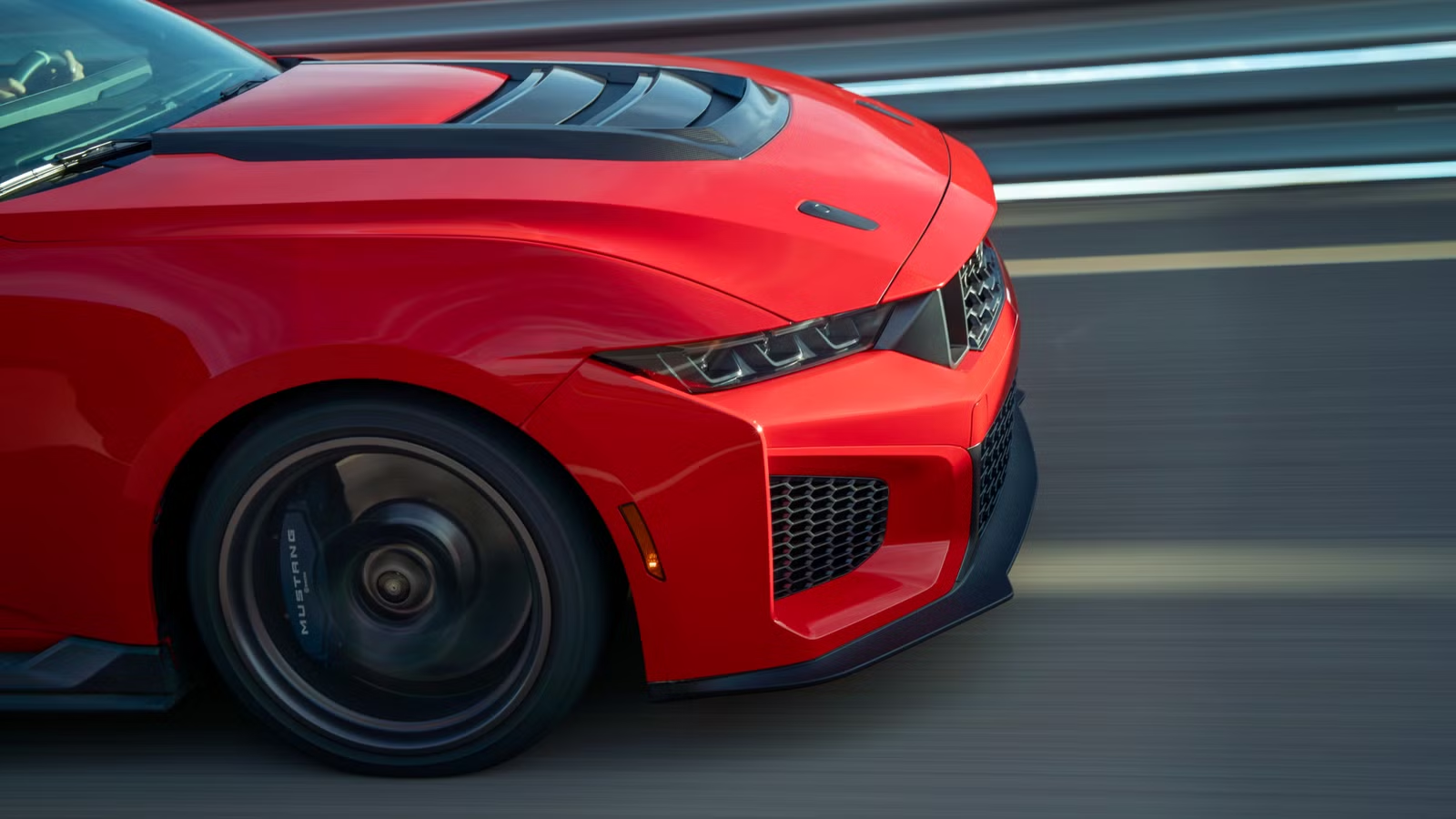
Ford’s Mustang Dark Horse SC first drives hit publication this week, and while the headline number is 795 horsepower, the detail that actually changes how this car drives is buried a paragraph or two down: a seven-speed Tremec dual-clutch transmission, the same architecture underpinning the $325,000 Mustang GTD, now standard equipment on a Mustang that starts around $103,390 before destination.

That’s not a footnote. A dual-clutch gearbox shifts in milliseconds, rev-matches automatically on downshifts, and holds a gear under load in ways a torque-converter automatic or a three-pedal manual can’t match on a hot lap. Reviewers who drove the Dark Horse SC at Sonoma Raceway came away saying the transmission, not the extra power over the standard Dark Horse, is what lets this car behave like a baby GTD rather than just a louder Mustang.
Why The Gearbox Matters More Than The Horsepower Number
The Dark Horse SC’s supercharged 5.2-liter Predator V8 makes 795 hp and 660 lb-ft, up 35 hp and 35 lb-ft over the old Shelby GT500 that effectively sired this car. That’s a healthy bump, but it’s only 20 hp short of the GTD’s 815 hp. The number that actually separates a confident track car from a handful, though, is how fast power gets delivered and how predictably the chassis settles between corners.

The seven-speed Tremec dual-clutch, spinning a carbon-fiber driveshaft into a Torsen limited-slip differential, does both. Road & Track and Motor1’s first-drive reviews both describe instant, cracking upshifts under full throttle at Sonoma, the kind of response that lets a driver stay in the throttle through transitions instead of lifting to manage a slower-shifting automatic. Motor1’s reviewer ran the quarter mile in 10.790 seconds at 133 mph on just his third attempt. Car and Driver clocked similarly quick trap speeds in the low-to-mid 130s. None of that is about peak horsepower. It’s about how quickly that horsepower gets to the pavement and how little drama accompanies it.
The Chassis Tricks Borrowed From GT3 Racing
The dual-clutch isn’t working alone. Ford tested the Dark Horse SC alongside its GT3 and GT4 race programs and brought over upgraded MagneRide adaptive dampers, tuned specifically for the SC rather than carried over from the standard Dark Horse. New forged suspension links shed weight and sharpen steering feel, while the power steering system and tie rods were retuned using data from the GT3 development program.
The SC doesn’t get the GTD’s exotic inboard pushrod suspension or carbon-fiber chassis; it keeps the Mustang’s familiar MacPherson strut front and multilink rear layout. But multiple first drives, including The Drive’s and Road & Track’s, describe a car that soaks up rough pavement without the nervousness that plagued the outgoing GT500, while still tightening up dramatically in Track mode. A new aero package, including a hood vent generating 2.5 times the downforce of the standard Dark Horse’s, and a ducktail trunk design borrowed from the GTD program round out a car built to hold a line, not just go fast in a straight one.
What The $36,500 Track Pack Actually Buys
Buyers chasing the closest thing to GTD behavior will want the optional Track Pack, which brings an adjustable rear wing generating more than 600 pounds of downforce at 180 mph, carbon-ceramic brakes at all four corners, and lighter carbon-fiber wheels wrapped in Michelin Pilot Sport Cup 2 R tires. Combined with a deleted rear seat, Ford says the package cuts roughly 150 pounds, much of it unsprung mass that directly improves how quickly the dampers can react.
That’s not a cheap add, and reviewers have noted the as-tested prices climb fast. A loaded Track Pack car can land north of $150,000, within range of a Chevrolet Corvette Z06. But even a bare SC without the Track Pack keeps the same engine, dual-clutch transmission, and GT3-derived suspension tuning, meaning the core of what makes this car different from a standard Dark Horse doesn’t require writing the biggest check Ford offers.
Why Ford Is Pushing GTD Tech Down The Lineup
The GTD remains the halo, with its carbon-fiber chassis, F1-style drag reduction system, and 6:40 Nürburgring lap, a time that made it the fastest American production car around the Nordschleife until the Corvette ZR1 edged it out. At $325,000 and limited to roughly 2,000 units, it was never going to be the car that defines the Mustang’s reputation for most buyers.
The Dark Horse SC is. By putting the GTD’s traction control software, carbon-ceramic brake hardware, and dual-clutch transmission into a car that costs a third as much, Ford is signaling that race-program engineering doesn’t have to stay locked behind a six-figure velvet rope. It’s the same instinct that led Ford to put GT3-derived suspension bits into the four-cylinder Mustang RTR this fall. The flagship teaches the lineup, and the lineup gets better for it.
The Dark Horse SC isn’t going to out-corner a GTD, and nobody at Ford is pretending otherwise. But for a buyer who wants genuine track capability, a transmission that shifts like a race car’s, and change left over from a GTD’s down payment, the SC is the smarter buy by a wide margin.

Related posts

Latest Post


No Comments