The Luxury Wagon Nobody Bought That’s Now Cheaper Used Than A New Honda Accord
8 minutes reading
Wednesday, 19 Aug 2026 18:01 0 69 autotech
Luxury vehicles are known to depreciate faster than mainstream cars, which may be a financial pain for those who bought their luxury cars new, but it is the exact opposite for those looking for a used bargain. Of course, there’s a catch as to why that’s the case for many luxury cars, but if you know what to look for, a used luxury car can be a good purchase.
One of those affordable used luxury examples includes the topic of today’s article. Unlike other European luxury wagons that gained a lot of hype when they were announced, this model flew under the radar. The question now is: is this luxury wagon that’s now cheaper than a brand-new Honda Accord worth your time and money?
A Brabus 700 Mercedes-AMG E 53 wagon and sedan side-by-sideMercedes-Benz
There was a time when this body style was the choice of every American family, especially after the Second World War. Now, though, wagons are mostly seen as a choice that only enthusiasts would opt for.
When Wagons Were America’s Family Car Of Choice
A static front-quarter shot of a 1969 Dodge Coronet WagonMecum
Wagons became particularly popular after the Second World War. Though wagons (or station wagons) already existed way earlier, the Willys Jeep Station Wagon is credited as the first mass-produced station wagon in 1946. From the 1950s and 1960s, station wagons accounted for one-fifth of the overall new car market. These wagons were also pretty big and had big-displacement engines such as V-8s, which were representative of the post-war economic boom.
The wagon continued to define the muscle car era of the 1960s as well, but when the oil crisis hit, the station wagon recipe had to be drastically altered. Like the muscle cars at the time, wagons needed to downsize their engines, especially as stricter fuel efficiency regulations were introduced. Around this time, the practical advantages of station wagons started to fade as new vehicle body styles were being innovated at the time.
How Two Body Styles Killed The Mainstream Wagon — And Pushed It Upmarket
2012 Toyota RAV4 front quarterToyota
It was the 1980s, and Chrysler invented a new body style called the minivan. The minivan genre utilized a packaging-friendly front-wheel drive (FWD) transverse engine layout, which enabled excellent interior space for a much smaller footprint. The Chrysler minivans weren’t as big as something like a Dodge Sportsman, yet they had a very cavernous interior for their size. Thanks to its ingenious interior packaging, good efficiency, and maneuverable dimensions, the Chrysler minivan was the perfect post-oil crisis vehicle for the average American family.
And then the final ingredient that would ultimately end the popularity of station wagons in the mainstream segment would be the crossover SUV. You see, SUVs at the time had body-on-frame construction that were great for off-roading, but were a bit cumbersome to drive on paved roads—basically the majority of where an average American family drives. The crossover SUV, with its car-like unibody structure but with the aesthetic appeal of an SUV, would prove to be the perfect middle ground. It’s a vehicle with tough looks and simply good enough off-roading capability, perfect for those who drive mostly on paved roads, with just the occasional light off-roading need.
The Affordable Swedish Used Unicorn Wagon
Black Volvo V90 parked in front of a Volvo dealershipVolvo
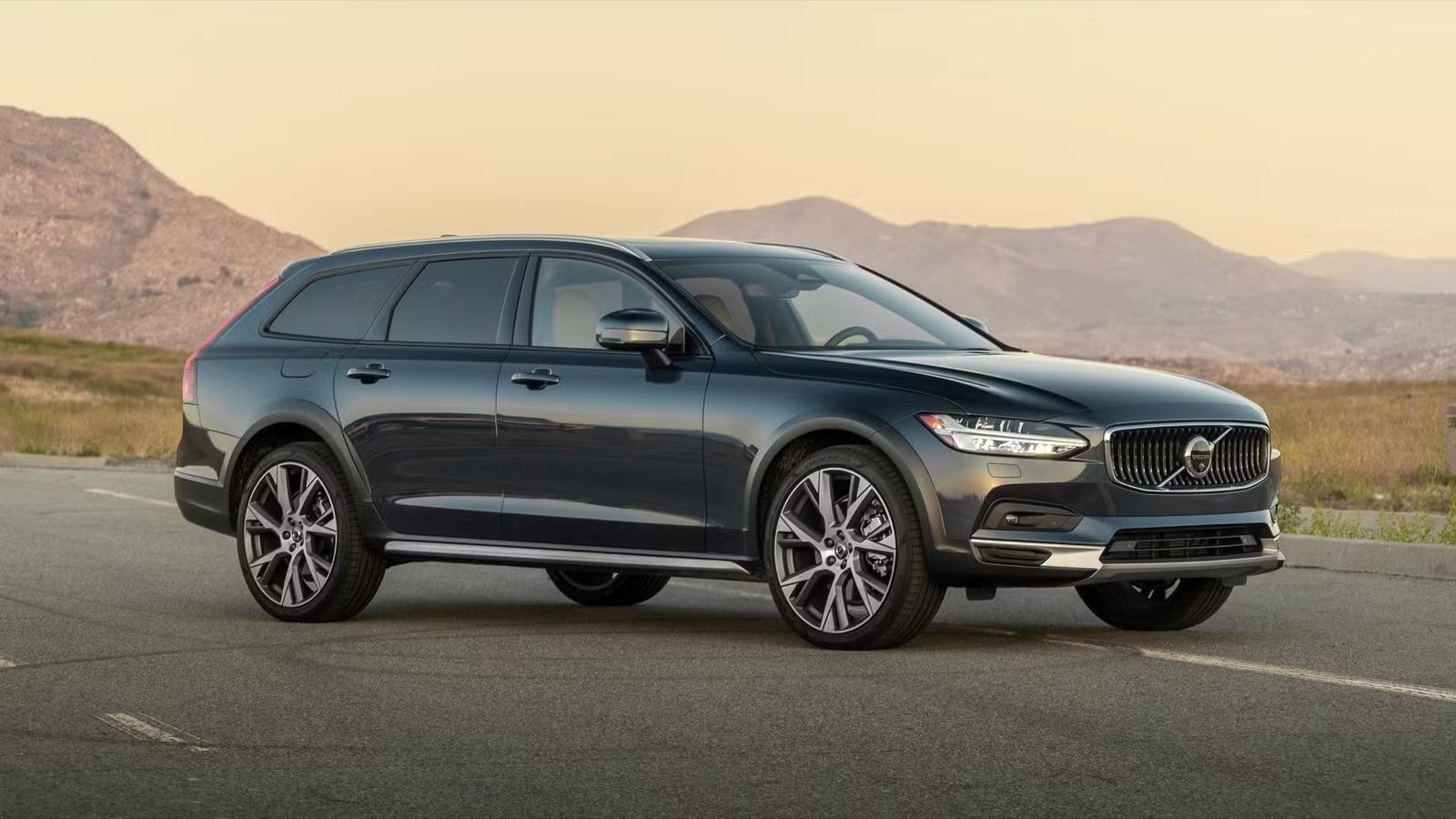
This now leads us to the unicorn wagon that has become a depreciated bargain in 2026—the Volvo V90. The Volvo V90 was sold in the United States from 2017 to 2021, while the Cross Country version remained on sale until the nameplate’s end of life in 2025. Today, the V90 is more attainable than ever, thanks to its heavily depreciated values.
Yours For Less Than $20,000
2020 Volvo V90 rear 3/4 shot parked off-roadVolvo
Yes, you read that right. Early examples of the Volvo V90 have depreciated to well below the $20,000 mark. 2017 was the first model year of the V90 in the United States, and those examples now have an average fair market price of just $19,100, according to KBB. The V90 was initially sold solely in Cross Country form, so if you want a non-Cross Country model, you’ll have to start looking at the 2018 model year. Either way, it has an even lower fair purchase price of $16,000 for the base T5 Inscription variant. The more powerful T6 starts at the $21,000 mark, according to the publication as well.
Apart from the aforementioned Inscription and rugged Cross Country variants, there’s also a sporty R-Design model. This is personally the variant I would go for, due to this version’s sportier bumpers and wheels, as well as the use of less chrome. The R-Design models also come with a slightly sportier suspension tuning, though if outright sportiness is what you’re after, well, your affordable used options are limited. You may consider a used Mercedes-AMG E 63 Estate, but even at their heavily depreciated prices, they still cost more than a V90.
Long-Term Ownership Outlook
2024 Volvo V90 Cross Country front three-quarter view.Ian Wright/CarBuzz/Valnet
The question now is, due to the V90’s low resale values, does it mean that they’ll be a pain to own in the future? Thankfully, not quite, as pointed out by Wanasign. As I always say here in my articles, a mechanically simpler car means fewer failure points and therefore better long-term durability. Opt for the T5 models with their simpler 2.0-liter turbocharged four-cylinders, and you’ll be promised an engine that will be easier to maintain long term. The T5 powertrain produces a strong 250 horsepower and 258 pound-feet of torque, and this is mated to an Aisin-developed eight-speed automatic.
The T6, meanwhile, has more complexity through its additional supercharger. Yes, the 2.0-liter four-cylinder in this case gets both a turbocharger and a supercharger. This means plenty of power—316 horsepower to be precise, along with 295 pound-feet of torque. This engine, however, requires more diligent maintenance, due to the use of two forced induction technologies.
Side profile of a 2021 Volvo V90 InscriptionVolvo
Other potential failure points include the Volvo Sensus infotainment and other electronics, but perhaps more concerning in the long term would be the optional rear air suspension. Nevertheless, RepairPal gives the Volvo brand a 3.5 out of 5 reliability rating, while the V90’s annual maintenance and repair costs of $478 are considered average for the luxury segment.
Why The V90’s Design And Driving Character Still Outclass Cars Twice Its Current Price
A Cabin Designed Before Touchscreens Took Over — And Better For It
2025 Volvo V90 Cross-Country dashVolvo
2025 Volvo V90 Cross-Country interiorVolvo V90
The Volvo V90, in my opinion, is one of the most beautiful wagons to date, especially when a facelift was introduced for the 2021 model year. The lines are simple, with well-balanced proportions. In a sea of wagons opting for a curvaceous look, I highly appreciate Volvo’s desire for a more upright design for the V90. The vertical LED taillights are distinctly Volvo, since this upright silhouette is what defined Volvo wagons throughout the past decades. The length of the V90 is simply a chef’s kiss to a very beautiful wagon that now costs less than a brand-new Honda Accord. Please opt for the non-Cross Country variants, because I think the non-rugged variants are the most beautiful.
It was also during this era that Volvo entered the peak of their interior design stride. The materials used are simply top-notch, from the minute Swedish flag details to the available Orrefors crystal electronic gear shifter. Depending on the trim, you also get a large expanse of open-pore wood, brushed aluminum, or both. The V90’s interior was designed at a time when interior materials dictated how luxurious a vehicle is, not through gimmicky passenger-side screens or the all-out war against physical controls.
Fast But Decadent
The Orrefors crystal shifter of a 2021 Volvo V90 InscriptionVolvo
Our friends from CarBuzz have previously tested a European-spec T8 plug-in hybrid variant, but when setting the electrified powertrain aside, the European V90 is largely the same as the one sold in the United States. Unlike most of the luxury competition, which try to out-German the Germans, the V90 fully embraces its Swedish roots. Not only is this exhibited in its tasteful design, but also in its soft but brisk driving experience.
Whether you opt for the T5 or the T6, both engines deliver great performance. What’s also common on all V90 models, including the slightly sportier R-Design model, is their focus on a soft and stable ride rather than an athletic and sporty driving experience. That’s no bad thing, mind you, because the V90 becomes a plush long-distance cruiser. This is further aided by the available rear air suspension that replaces the leaf springs, but it is worth remembering that this adds complexity to the vehicle. Either way, the V90 is a fast wagon that’s meant for a cosseting driving experience rather than for athletic canyon carving.









No Comments