
Ford Kept This 638-Unit Trans-Am Cougar In The Mustang’s Shadow On Purpose
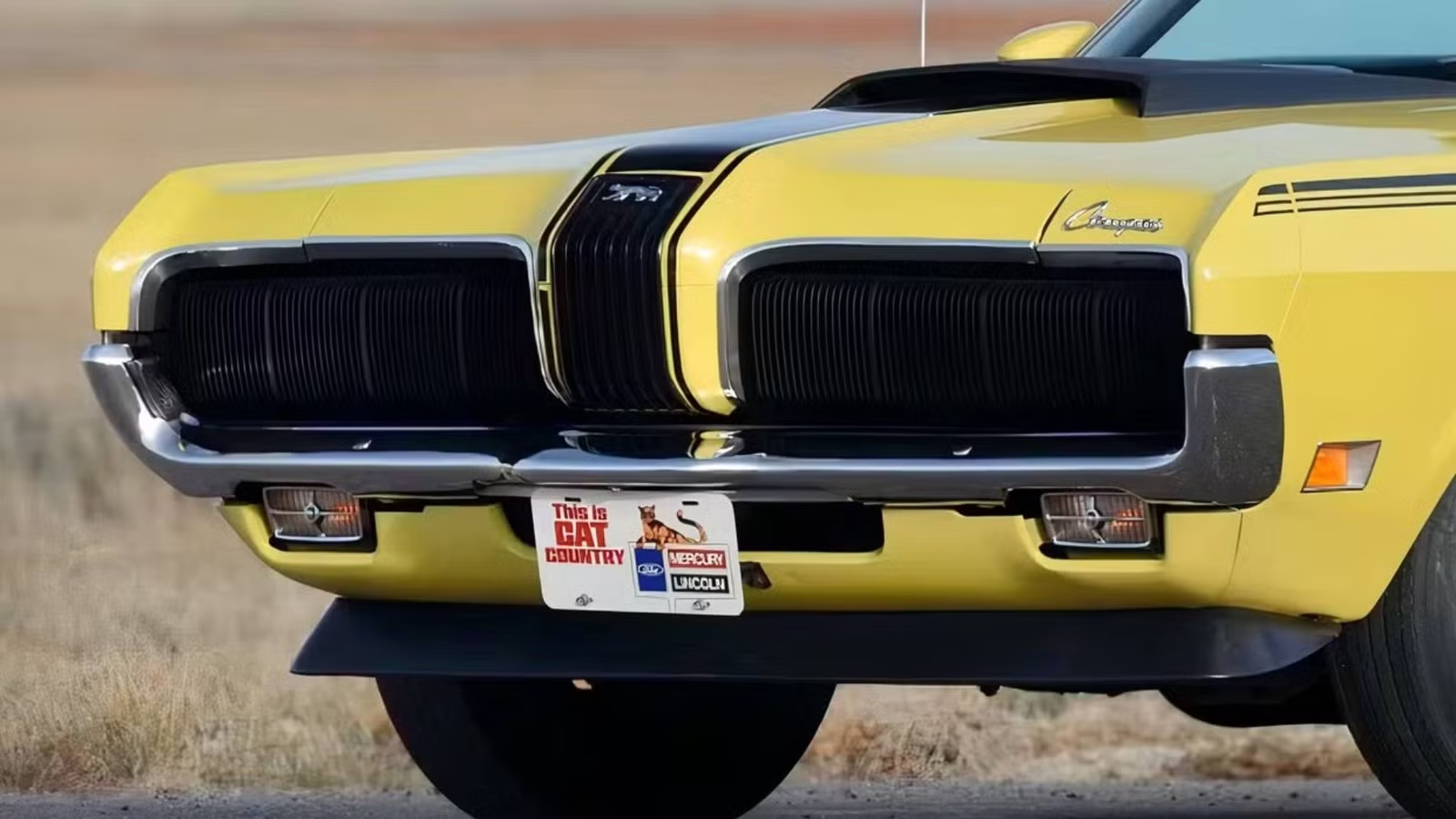
Mercury built just 638 examples of one Mustang-powered muscle car across 1969 and 1970—169 in the first year and 469 in the second. That is a tiny run for anything carrying Ford’s racing-bred Boss 302 V8, but those figures count original production, not survivors.

The stranger part is what happened before the road car arrived. Mercury had already pushed Ford’s favored Mustang program to the edge in Trans-Am, only to lose factory backing after 1967. The engine survived. The factory racing spotlight did not.
Ford Backed The Mustang After A Two-Point Cougar Scare
Mercury pushed Ford all the way to the final race in 1967. Bud Moore’s factory-backed team finished the Trans-Am season just two points behind the Mustangs in the over-two-liter class, with Ford scoring 64 points to Mercury’s 62. Ford’s own account also credits Moore’s team and Carroll Shelby’s Mustang operation with four victories apiece. This was no runaway Mustang season.

In 1968, Mercury’s factory program was gone. Moore later explained the decision in his 2005 Mustang Monthly interview, saying Ford would not let his team run because it had been “out-running the Mustangs.” That is Moore’s account of Ford’s priorities, not an official Ford explanation, but it puts a hard edge on what otherwise looks like a simple program change.
Private entries kept racing, including at Kent in 1968, so Mercury’s Trans-Am presence did not vanish overnight. What disappeared was sustained factory backing. Moore then ran Ford’s Boss 302 Mustangs in 1969 and 1970, winning the manufacturers’ championship in 1970. Mercury had already shown it could make the Mustang sweat. Ford chose where the factory money went next.
Still, The Cougar Got The Mustang’s 290-HP Boss 302 V8
The race program was gone, but Mercury still got the same Boss 302 V8 offered in the Mustang. Mercury’s 1970 brochure rated it at 290 horsepower at 5,800 rpm and 290 lb-ft of torque at 4,300 rpm. Those were period factory ratings, but that 5,800-rpm power peak tells you plenty. This small-block wanted revs.
The hardware backed that up. Canted-valve cylinder heads angled the valves to make room for large ports and valves, helping the Boss breathe at higher engine speeds. Ford’s Boss 302 brochure also highlighted mechanical valve lifters and a four-barrel carburetor. A four-speed manual was mandatory for the Mercury application. There was no automatic version.

Rear gearing gave buyers another way to sharpen the package. The 3.50 and 3.91 ratios used Traction-Lok, while the 4.30 Super Drag Pak brought a Detroit Locker. Higher numerical gearing multiplied torque more strongly at the wheels but raised cruising rpm. The 4.30 pushed that trade-off furthest: stronger acceleration, more engine speed on the highway.
The Unexpected 323-Car Subset Makes This Cougar Rarer

That car was the Mercury Cougar Eliminator with the Boss 302, a sharp turn in the Cougar’s changing identity. For 1970, the Eliminator Registry’s production breakdown records 2,268 Eliminators, only 469 with the Boss 302, and just 323 pairing that engine with the close-ratio four-speed. Roughly one in five 1970 Eliminators had the Boss before the transmission split even starts. That is the rarity-within-rarity detail the broader 638-car total can easily hide at first glance.

The other 146 Boss cars used the wide-ratio four-speed, so the 323-car group was not the rarer gearbox split. It matters because it identifies the exact close-ratio factory combination. The count itself needed a correction, too. The registry says Ford’s original database omitted the Eliminator option from one Boss 302 car; fixing that record in 2016 moved the 1970 totals from 2,267 to 2,268 Eliminators and from 468 to 469 Boss cars.

The close-ratio transmission also made mechanical sense. Tighter spacing reduced the engine-speed drop on upshifts, helping keep a 5,800-rpm power peak closer to where the Boss wanted to work. For anyone authenticating one today, the original engine-and-transmission specification matters. A scoop and stripes can look convincing. Production records tell you whether the car actually left the factory in that 323-car configuration.
Beyond Racing, Mercury’s Luxury Image Hid A Wild Cat

Mercury’s more comfortable image was an odd home for this hardware. The luxury-minded Cougar XR-7 helped build that reputation, but the Eliminator package started with the standard Cougar rather than the XR-7. For 1970, Competition Orange, Blue, Yellow, Green, and Gold were among the available colors, with black stripes and front and rear spoilers supplying plenty of visual intent. The Boss version’s hood scoop was decorative; functional Ram Air belonged to appropriately equipped 428 Cobra Jet cars.
Inside, the Boss Eliminator had an 8,000-rpm tachometer and a rally clock with an elapsed-time function. The tach’s scale was not permission to spin the engine to 8,000 rpm, but it suited the car better than a dashboard concerned only with comfortable cruising. The clock added another performance-minded touch to a car still wearing a Mercury badge.

That is what makes the story frustrating. Mercury had already earned real racing credibility before the Eliminator arrived. A two-point championship loss showed the Cougar deserved another factory-supported shot, even if nobody can honestly say what it would have won. The Boss engine then gave the street car a credible mechanical link to that competition. Ford kept building the Mustang’s factory racing story. The Cougar had earned the chance to keep writing its own.
Sources: Ford, Mercury

Related posts





Latest Post


No Comments