
Oldsmobile’s Secret Hemi-Killer Died Before It Could Change Everything
So many of us love a big-block V8. They’re some of the best and most characterful engines you can find in a classic muscle car. Sadly, many of them were completely strangled or killed off altogether once the early ’70s had passed. There are also some amazing big-block engines that never made it beyond the prototype stage.
The Individual General Motors Brands Once Had Their Own Engineering Identities

These days, all the General Motors brands have very homogenized engineering. That wasn’t how things used to be. During the days when GM wasn’t tightly policing its brands, it let them have their own engineering identities. This included allowing them to develop their own engines. This actually carried on in some ways until as recently as 6 years ago, when production of the Cadillac-exclusive Blackwing V8 ended. But that was the only surviving remnant of this culture. Several decades ago, it was much more common for the individual brands to have their own engines.
One Restored Oldsmobile 4-4-2 Holds An Engine That Was Supposed To DethroneChrysler’s Original Hemi
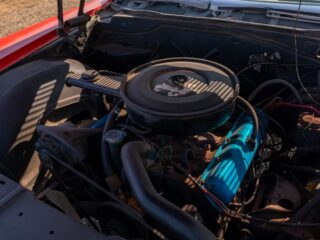
One of those brands that developed their own engines in the past was Oldsmobile. It developed several of its own power plants during the time it existed as a GM brand. That included the fire-breathing W-30, which could genuinely compete against Mopar cars that were equipped with the Street Hemi. There’s one prototype engine that Oldsmobile made, though, that’s generally forgotten about. That’s a shame, as it was genuinely forward-thinking! While it never entered production, an example of this engine has been preserved inside a modified Oldsmobile 4-4-2 that was recently restored. Taking a look at the engine inside this car has shown not only what we could have had from Oldsmobile back then, but also how its design influenced a family of Oldsmobile engines that came later.

Oldsmobile’s W-43 Is A Big-Block V8 That Was Ahead Of Its Time

While it may seem like an old-fashioned big-block engine at first glance, the W-43 is a genuinely advanced engine. Nicknamed “The Killer”, this 455 cubic inch V8 was first developed between 1967–69. It was based on a standard 455 cubic inch production block, and it used pushrods instead of modern camshafts.
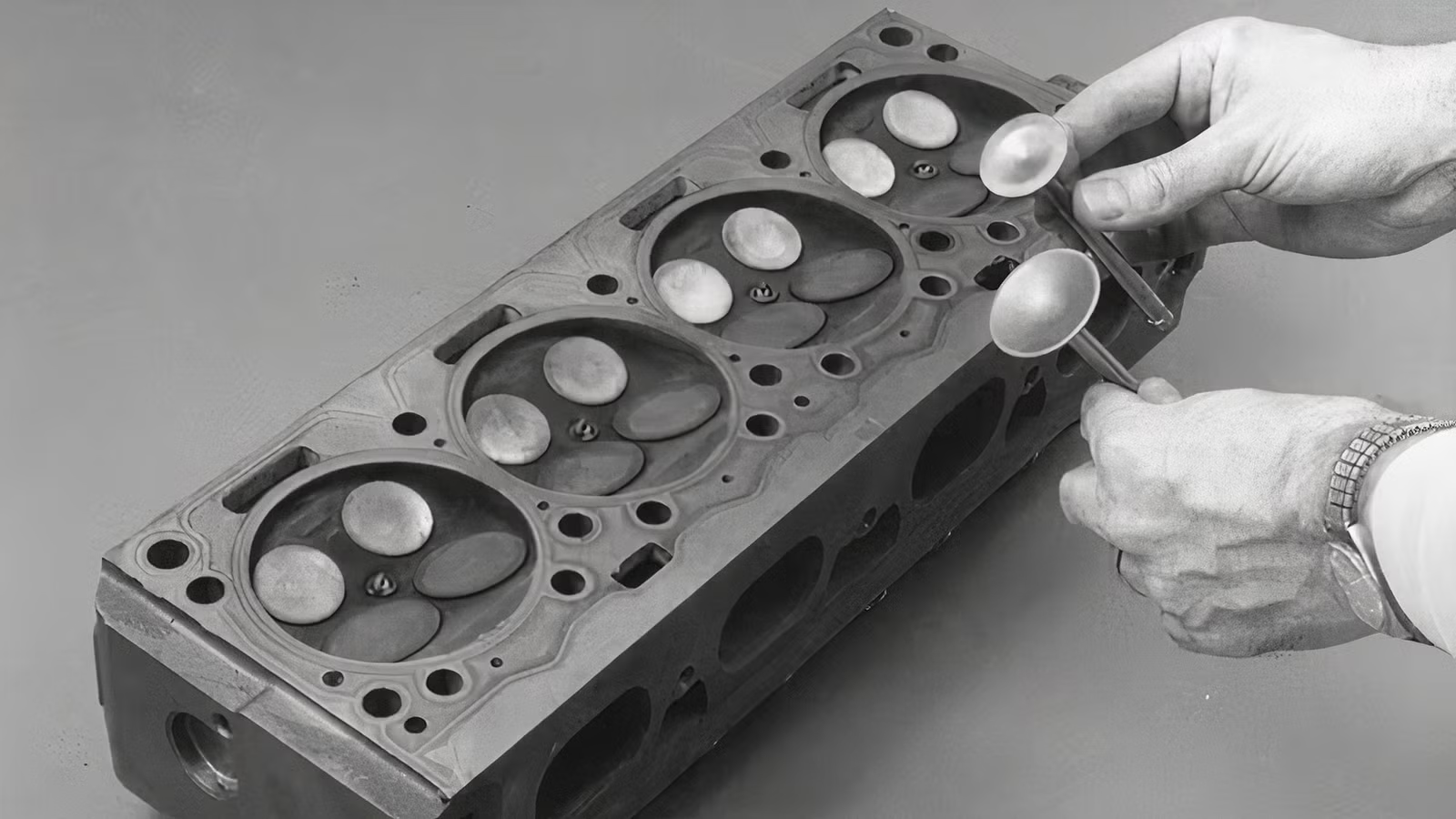
That’s where the old-school engineering ended, though. The single chain-driven driveshaft was an inch higher than what you’d find in a standard big-block V8 from that era. That’s because things had been modified to allow it to have 2 extra valves per cylinder. Moving the camshaft an inch higher allowed for the pushrod geometry to be optimized for 4 valves per cylinder, with the number of pushrods going up to 16 to allow for it. Due to the 4 valves per cylinder design, it couldn’t have a hemispherical combustion chamber like its Chrysler competitor. Instead, it had a pent-roof combustion chamber design, the standard for 4-valve-per-cylinder engines.
Modern Dyno Tests Have Revealed Its True Power

During its early development stages, the W-43 was thought to produce 440 horsepower. Modern dyno tests on the restored 4-4-2 fitted with the engine have proven that this was a gross underestimation. The engine in this car produced 560 horsepower and 540 lb-ft of torque when measured with modern equipment. If the production version of the engine had kept these numbers, it would have been a genuine Hemi-killer.
The Industry Changes Of The 1970s Killed It Off
A lot of engines didn’t survive the changes the American automotive industry needed to make. By the early 1970s, the oil crisis was in full effect. Emissions regulations were also tightening up, and a transition to unleaded gasoline was happening too. While the W-43 engine was genuinely impressive, it just couldn’t adapt to what General Motors wanted. In this new industry climate, a high-compression big-block that was heavier, bulkier, and thirstier than more conventional designs just didn’t make sense at all. So, the W-43 ended up getting shelved, and no production car ever received one. We’re incredibly lucky that at least a couple of prototype engines have survived.
Its Engineering Survived In An Inline-4 From The 1980s

The W-43 may not have survived the industry shifts of the 1970s. But elements of its pioneering design did survive in a later Oldsmobile-developed engine. That’s the Quad 4, a dual overhead cam inline-4 that uses the 4-valve-per-cylinder layout. Two different sizes of the Quad 4 were available (2.3 and 2.4 liters), and it produced 150–190 hp and 160 lb-ft of torque. First introduced in 1987, it managed to last until 2002. It was also the last engine to ever be wholly developed by Oldsmobile.
Oldsmobile aficionados will be very familiar with this engine, for a couple of reasons. Firstly, it was the heart of the seriously underappreciated Cutlass Calais Quad 442. Secondly, its design provided the basis for two immensely powerful engines that were dropped into a technology demonstrator almost everyone’s forgotten.
The Quad 4’s Engineering Powered An Incredible Technology Demonstrator That Smashed Records

That technology demonstrator is the Oldsmobile Aerotech, a 1980s vision of the future with insane amounts of power. The first two Aerotechs used custom-built inline-4 engines based on the Quad 4’s design. The first one had a single turbocharger, while the second one had twin turbochargers. This meant the first Aerotech had an output of 900 horsepower, and the second had 1,000 horsepower. The two different Aerotechs also had different body styles: the first had a short tail and was designed for circuit running, while the second had a long tail and was designed for outright speed.
Thanks to its crazy power and incredible aerodynamics, the Oldsmobile Aerotech was able to absolutely smash speed records. With American racing legend A.J. Foyt at the wheel, the short-tail Aerotech managed to hit a closed-course record of 257.123 mph at the Fort Stockton test track. The long-tail version was even faster, reaching an average top speed of 267.399 mph.
Source: Automotivehistory.org, Hemmings, Oldsmobile

Related posts



Latest Post


No Comments