
This British Sports Car Has A Corvette Heart And Can Humiliate Ferraris
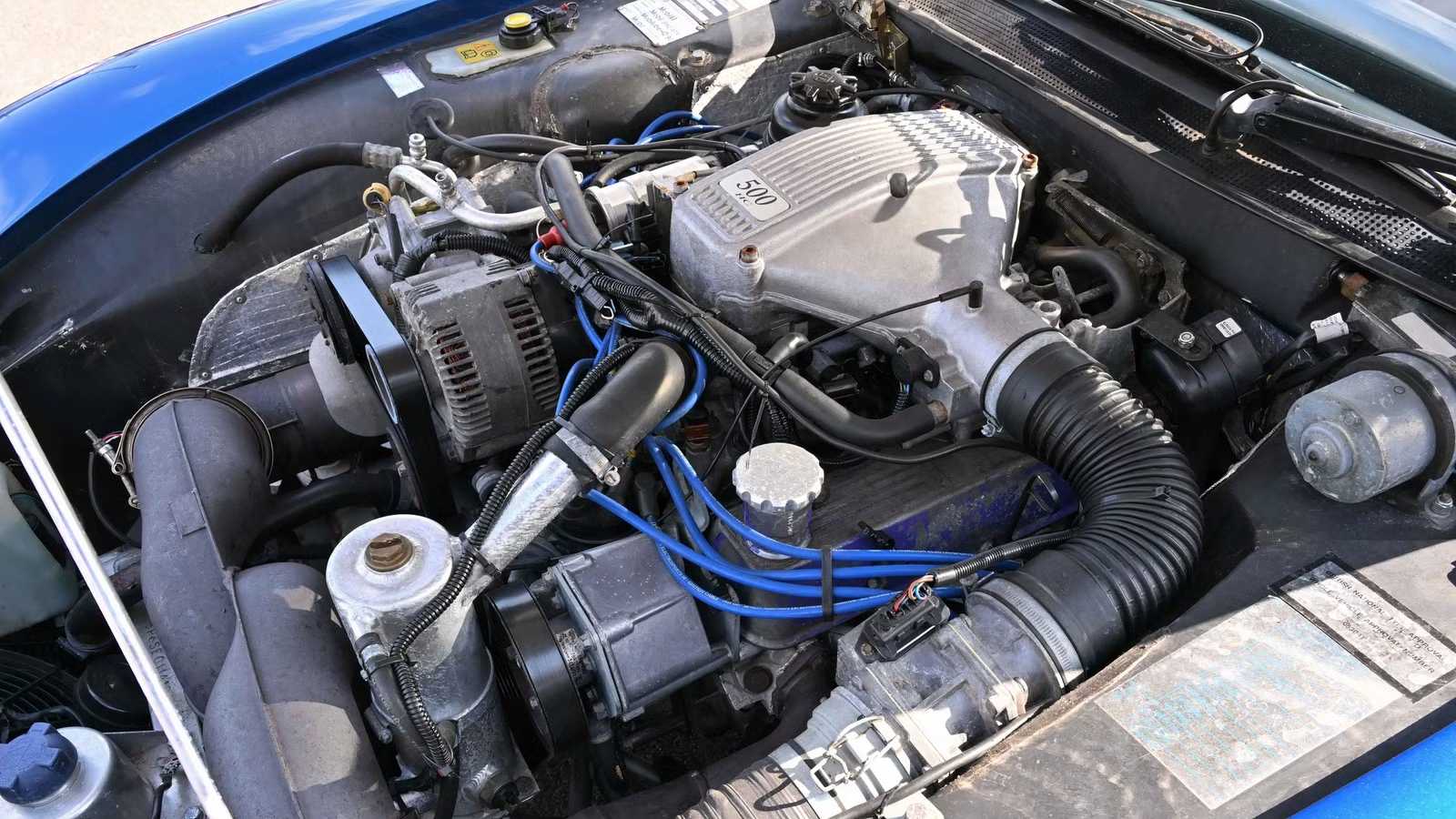
Few cars from the 1990s have aged as well in the imagination as the TVR Griffith. In an era when most performance cars were getting softer, heavier, and more electronically coddled, this compact British bruiser went the opposite direction — stripping out every safety net, bolting in a thunderous V8, and daring its driver to keep up. It remains one of the most viscerally exciting sports cars ever built on a modest budget, and the used market still hasn’t fully caught on.

It didn’t wear a flashy badge. It wasn’t made in Germany or Italy. And it didn’t cost six figures. But this thing had attitude, power, and no time for nonsense like traction control or airbags. Built like a pub brawler in a tailored suit, it punched way above its weight — and it did it all with a borrowed heart that roared like a Corvette.
The TVR Griffith Had A Brilliant Rover V8
1995 TVR Griffith Key Specs
|
Engine |
 21 autotech 5.0-liter V8 |
|
Power |
321 hp |
|
Torque |
361 lb-ft |
|
Transmission |
5-speed manual |
|
Driveline |
RWD |
Source: Ultimate Specs
If there’s one thing TVR understood, it was the art of controlled chaos. And nothing summed that up better than the Griffith 500. Beneath its curvy fiberglass skin sat a 5.0-liter V8 — an evolved version of the old Buick-derived Rover engine that had been massaged, reworked, and pushed to its absolute limit.
This was no lazy cruiser V8. TVR tuned it to produce 321 horsepower and around 360 lb-ft of torque, all routed through a 5-speed manual and sent to the rear wheels. That combination was good for 0–60 in under 4.1 seconds and a top speed of 166 mph — remarkable figures for a car that weighed less than a Miata.
The real beauty was the engine’s character. It rumbled, snarled, and delivered torque from every inch of the rev range. It wasn’t refined in the German sense, but that was entirely the point. It was raw, unfiltered, and loud in every possible way — just the way TVR liked it.
It Was A Proper British Sports Car Icon
The Griffith wasn’t built in a sterile lab. It came from Blackpool — a gritty seaside town better known for its amusement piers than for world-class engineering. And yet, this little company managed to build a car that could keep pace with the best Ferraris of the day.
Driving It Was Very Much You-Against-The-Griffith
The chassis was a tubular steel masterpiece — light, stiff, and elegantly simple. The body was lightweight fiberglass that kept the car’s curb weight around 2,200 pounds. Combine that with the V8 under the hood and you had a power-to-weight ratio that embarrassed almost everything else on the road.
The handling was old-school too. No traction control, no ABS, no electronic safety nets. Just you, the throttle, and a lot of responsibility. In the right hands on the right road, the Griffith 500 could absolutely tear. In the wrong hands on the wrong road, it would bite back without hesitation.
Inside, it was pure ’90s British charm. Leather everywhere, real wood trim, and switchgear that looked like it came from a submarine. But that only added to the appeal. This wasn’t a car built to impress at a valet stand — it was built to be driven hard and often.
The Griffith Even Graced The Gran Turismo Series

If you played Gran Turismo during the PlayStation 1 or 2 era, chances are you remember the TVR Griffith. It was one of those cars that felt totally obscure and insanely fast. You’d buy it on a whim, expecting something quirky — and suddenly you were outrunning supercars in a car you’d never heard of.
The Griffith Became A Virtual Hit Thanks To Gran Turismo
The Griffith quickly became a go-to in the game’s early stages. Affordable, lightweight, and a rocket in a straight line, it handled like a muscle car and sounded like thunder. Plus, it had that cool “wait, what’s a TVR?” factor. Gamers loved it, and so did gearheads once they realized it wasn’t just a virtual fantasy.
That Gran Turismo cameo helped put the Griffith on the map for a whole new generation. For many enthusiasts, it was their first encounter with the TVR name. And once you drove it in-game, you wanted to learn more — or maybe even track one down in real life someday.
Used Griffiths Today Are Surprisingly Affordable For What They Offer

So, how much does it cost to own a British V8 bruiser with Ferrari-challenging speed and Corvette-level torque? Surprisingly little, actually.
According to Classic.com, the market for TVR Griffith 500s remains accessible, with average transaction prices typically well under $60,000 and entry-level examples available for considerably less. That’s pocket change compared to anything Italian or even mid-tier German sports cars with half the soul.
TVR Griffith 500 Values
- Average used price of $27,525
- Highest recorded sale of $53,962
What makes this even wilder is the rarity. Fewer than 2,400 Griffiths were built between 1992 and 2002. That kind of exclusivity usually drives prices up, but because TVR is such a niche brand — especially outside the UK — it’s still flying under the radar.
Now, don’t expect Lexus reliability. These cars need love, maintenance, and preferably an owner who doesn’t mind a bit of British eccentricity. But for the price of a used base-spec 3 Series, you could have something that’ll outrun a 355 and sound better doing it.
It Was TVR’s Boldest Statement Of The ’90s

The ’90s were a strange time for car design. Curves were in, computers were slowly taking over, and most manufacturers played it safe. TVR? Not so much. The Griffith was TVR’s “screw it, let’s go fast” moment — and it worked.
Everything about the car screamed attitude. No airbags. No driver aids. No apologies. The rear end was constantly twitchy, the clutch was heavy, and visibility was… optimistic. But when it all clicked, the Griffith felt alive in a way few cars do.
TVR’s entire identity was built around doing things their own way, and the Griffith was the poster child. It looked gorgeous, sounded feral, and drove like a bar fight on four wheels. It was a proper sports car in every sense — lean, mean, and 100% analog.
It also helped redefine what a British performance car could be. The days of underpowered MGs and sluggish Triumphs were over. The Griffith was here to prove that Britain could build something brutal and brilliant, without needing to call Germany or Japan for help.
Sources: Classic.com, TVR.

Related posts




Latest Post


No Comments