
Ford And GM Are Going To War Over The U.S. Army’s Next Battlefield Pickup
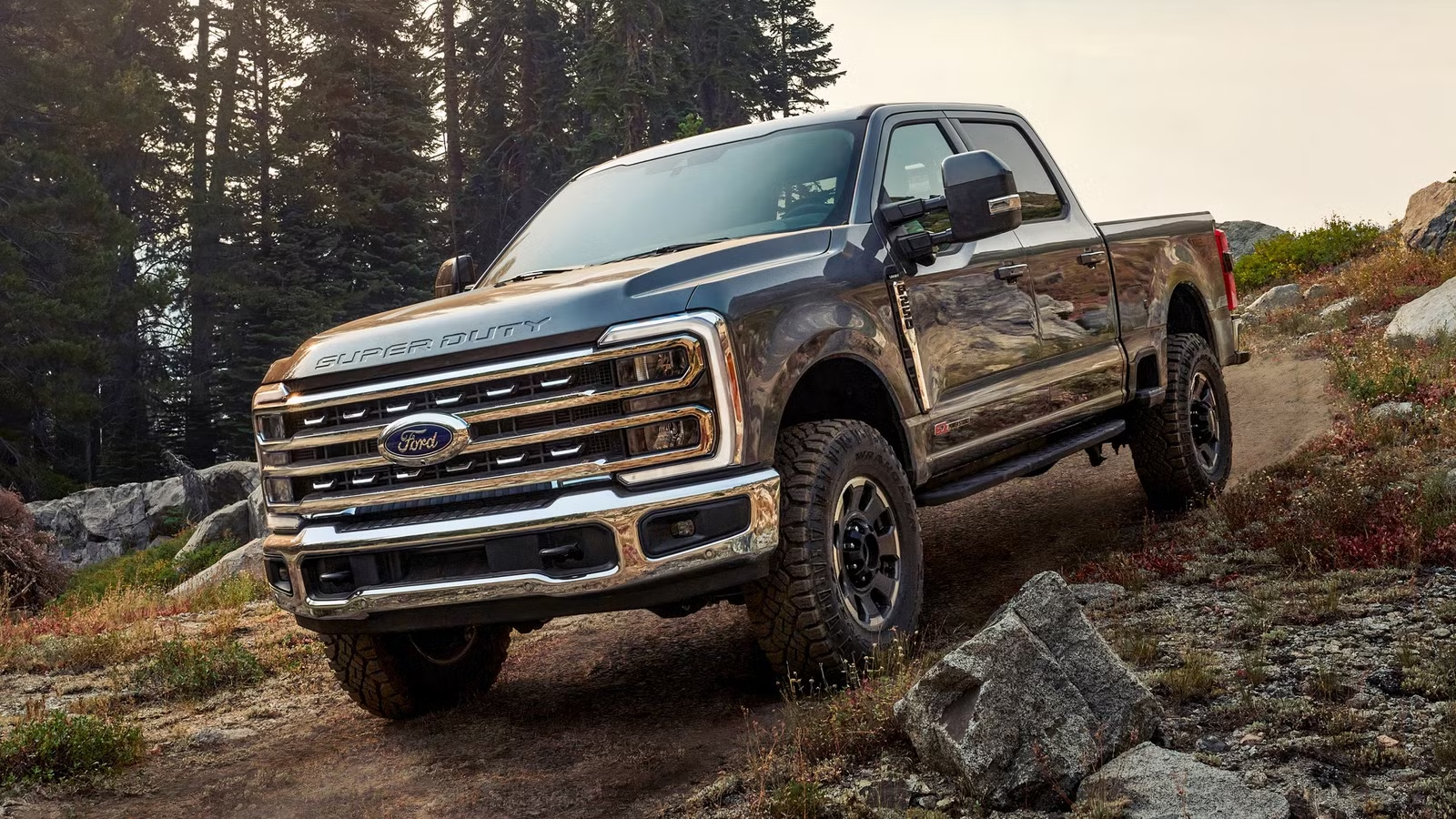
The Ford-versus-Chevy truck war has been raging for decades, but things just became considerably more serious. Forget towing tests, drag races, and commercials involving suspiciously large trailers. Ford and General Motors are now fighting to build the U.S. Army’s next battlefield pickup.

The Army has selected Ford, GM Defense, and custom military vehicle builder BC Customs to develop prototypes for its upcoming Infantry Squad Vehicle Heavy program. Each company will build three vehicles, giving the Army nine heavily modified pickups to test, abuse, and presumably drive through places where your average F-250 would immediately reconsider its career choices.
Ford’s entry will be based on the F-Series Super Duty, while GM Defense is bringing a militarized Chevrolet Silverado 3500HD-based machine called the ISV-Heavy. The Army expects to receive all nine prototypes by March 30, 2027, before putting them through operational assessments and developmental testing.
Ford Is Sending The Super Duty Into Battle

Ford may sell millions of trucks to civilians, contractors, farmers, and people who occasionally need to tow a small house, but this could become the Blue Oval’s biggest military vehicle opportunity since the Cold War.
The company has not revealed complete specifications for its prototype, but Ford confirmed that its contender will be based on the F-Series Super Duty. The civilian Super Duty already offers massive towing capacity, heavy-duty frames, available diesel power, and enough torque to make a mountain slightly nervous.
Of course, the Army version will need more than a lift kit, camouflage paint, and a few MOLLE panels from Amazon.
The ISV-Heavy is being designed to carry six soldiers while also functioning as a mobile power station. Army requirements call for up to 60 kW of continuous high-voltage DC power, along with additional 28-volt DC and 120-volt AC outputs. That would allow the truck to power command posts, communications equipment, sensors, drones, and other hungry battlefield technology.
Basically, it needs to be a troop carrier, off-road workhorse, giant generator, and rolling charging station all at once. No pressure, Ford.
GM Already Has A Battlefield Silverado

Ford may be the new challenger, but GM Defense has been preparing for this fight for years. Its ISV-Heavy prototype is built on the Chevrolet Silverado 3500HD ZR2 platform and combines a 2.8-liter Duramax turbo-diesel engine with a hybrid energy-storage system. GM says the truck can carry up to six soldiers and support missions ranging from electronic warfare to counter-drone operations.
The hybrid system isn’t there so soldiers can brag about fuel economy at the barracks. It gives the ISV-Heavy “Silent Drive” and “Silent Watch” capabilities, allowing it to move or operate equipment with a much smaller noise and heat signature.

That matters when the people trying to find you have drones, thermal cameras, and equipment considerably more dangerous than a police radar gun.
GM has already deployed its prototype during Army exercises with the 4th Infantry Division and the 82nd Airborne Division, meaning the battlefield Silverado has been getting a head start while Ford was still lacing up its combat boots.
GM Has Already Turned A Colorado Into A Military Machine

This is not GM Defense’s first trip to the battlefield. The company already produces the standard Infantry Squad Vehicle for the U.S. Army. That machine is based on the Chevrolet Colorado ZR2, uses around 90 percent commercial off-the-shelf components, and can transport a nine-soldier infantry squad across rough terrain. Despite looking like somebody removed most of the bodywork from a Colorado and installed enough seats for a very dangerous school run, the regular ISV was designed to be extremely light and transportable.
It can be carried beneath a UH-60 Black Hawk helicopter or squeezed inside a CH-47 Chinook. GM Defense received a $214.3 million contract in 2020 to manufacture 649 vehicles, with the program supporting production of as many as 2,065 units with additional authorization.
That gives GM a serious advantage. It already has an Army vehicle in production, an existing relationship with the military, and a Silverado-based heavy prototype that has undergone field exercises.
Ford, however, has something GM should never underestimate. The Super Duty is one of the toughest and most successful heavy-duty truck platforms in America, and Ford knows how to build trucks in enormous numbers without turning every one into a hand-built science project.
The Winner Could Build Around 600 Battlefield Pickups

After testing the nine prototypes, the Army is expected to choose a design for a production program that could involve roughly 600 vehicles. The final cost has not been disclosed, but a contract involving hundreds of specialized military trucks could be extremely valuable.
Ford and GM are also entering the competition at an interesting time. The Pentagon has been pushing American manufacturers to use proven commercial technology to produce military equipment faster and at a lower cost.
Rather than designing every bolt from scratch, the Army can start with trucks that already have established engines, transmissions, electrical systems, supply chains, and service networks. It can then add military hardware without producing something so specialized that every replacement part costs the same as a Florida condo.
There is also a third contender in the fight. BC Customs will submit three prototypes of its own, so this is not technically a two-truck duel. However, Ford and GM bring enormous engineering resources, manufacturing capacity, and more than a century of experience building vehicles for America.
The Ford-versus-Chevy rivalry has already settled arguments at drag strips, construction sites, farms, and family barbecues across the country.
Now, the U.S. Army may finally decide which Detroit truck belongs on the battlefield.

Related posts

Latest Post



No Comments