
The One-Off Ferrari Wagon That Predicted The FF By 43 Years
For decades, the Ferrari ownership experience was not a sensible one. The Italian automaker strictly produced sports cars that prioritized pure performance over everything else, leaving very little room for extra passengers or a quick grocery run. As a result, buyers who wanted to add one of Maranello’s fine creations to their driveway were left with a single choice. They could sacrifice practicality and space in pursuit of their sports car dreams, or they could simply turn around and walk out of the Ferrari dealership.

This left a gap in the market for a practical Ferrari. Instead of shedding weight and carving through corners, this theoretical machine would tackle those same corners while carrying the extra weight of people and luggage. With Ferrari flatly refusing to provide this perfect balance itself, the responsibility was handed to independent coachbuilders who were willing to accept the challenge.
A Station Wagon That Ferrari Would Not Build
With two-door sports cars historically being Ferrari’s forte, a traditional prancing horse rarely offers ample room for a family of four, let alone their luggage. Throughout the 1950s and 1960s, Enzo Ferrari remained razor-focused on fine-tuning the ultimate road-going driving experience, willingly leaving more practical body styles on the table. While 2+2 configurations were eventually introduced to satisfy buyers who wanted to bring two extra passengers along for the ride, these models retained their sloping coupe rooflines, resulting in tight rear seating accommodations and limited trunk space.

The idea of a practical, long-roof Ferrari was appealing for certain affluent individuals who wanted to haul their luggage or golf clubs alongside four comfortably seated adults, but Enzo Ferrari did not share that enthusiasm. The automaker’s identity of motorsport dominance and exotic, high-speed coupes did not leave any room for a utilitarian station wagon. However, one Ferrari dealer in the United States eventually took it upon itself to explore the family-sized gap in the Italian automaker’s lineup.
The 330 GT 2+2 Shooting Brake Was a Prancing Horse for the Family

The ultimate answer to Ferrari’s lack of long-roof practicality began life as a standard 330 GT 2+2 coupe finished in red. It was sold to its original owner at the end of 1965 by Chinetti Motors, a renowned Connecticut-based U.S. Ferrari importer. In 1967, the coupe was reacquired by Luigi Chinetti Jr., the son of the importer’s founder, and the chassis was promptly transformed into a one-of-one Ferrari-badged station wagon.
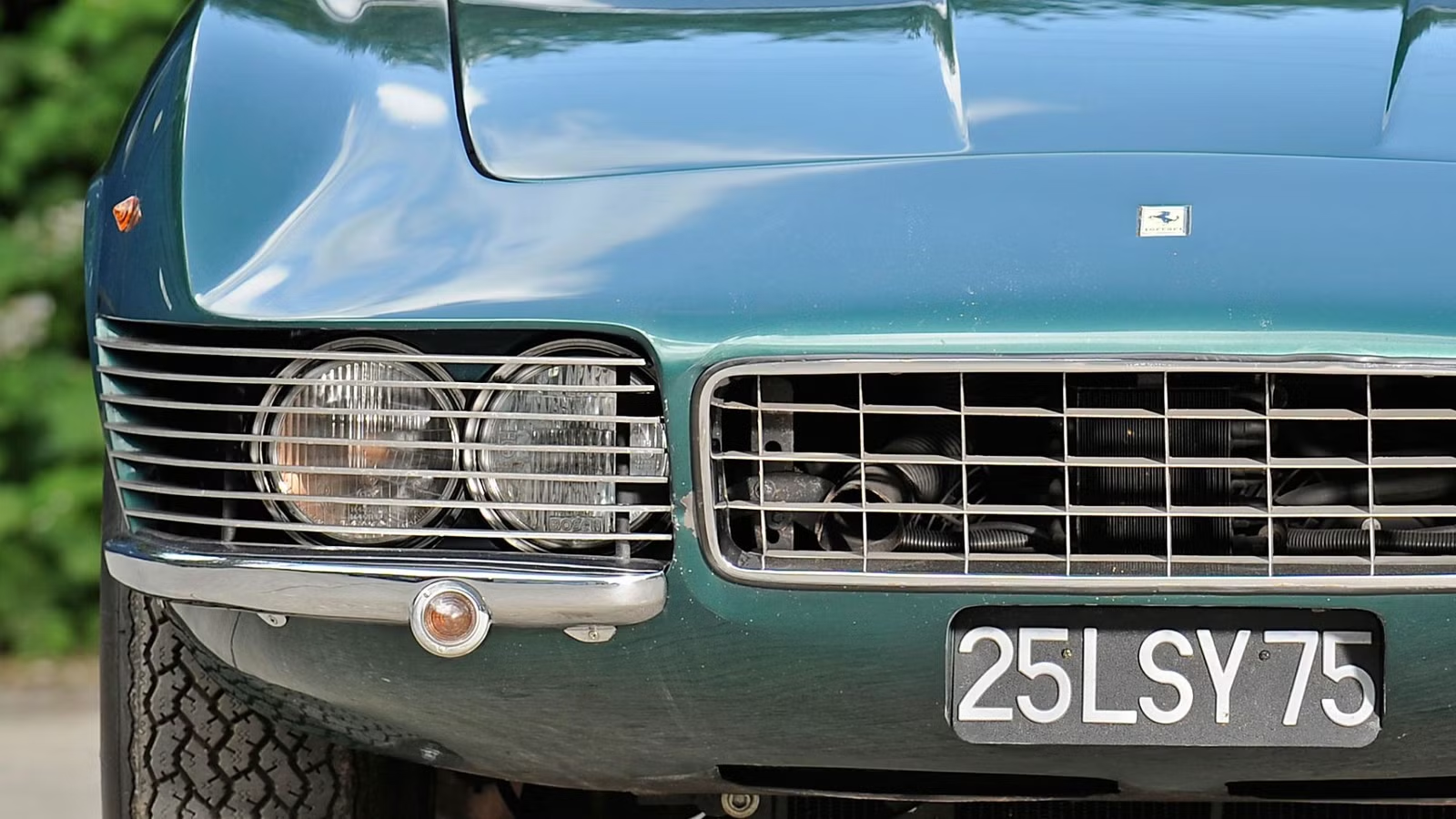
Chinetti’s bold idea ultimately came to fruition as the 330 GT 2+2 Shooting Brake. It featured bespoke bodywork from Italian coachbuilder Carrozzeria Vignale, which added signature details such as a large rear cargo area with a wraparound rear glass design, quad headlights hidden beneath slotted metal grilles, and striking metallic green paint with gold accents.

The coachbuilder’s work also extended to the interior, which featured extended leather in the cargo area, abundant wood trim on the dashboard and steering wheel, and four tan leather bucket seats. Under the hood, the shooting brake retained its factory-spec 4.0-liter Colombo V12 powertrain paired to a five-speed manual transmission. Like its coupe counterpart, the 330 GT 2+2 Shooting Brake was capable of reaching a top speed of slightly more than 150 mph, ensuring that all four passengers and their cargo would be transported with haste in typical grand touring fashion.
An American Vision Meets Italian Craftsmanship

While the idea of the 330 GT 2+2 Shooting Brake was conceived in the mind of Chinetti Jr. in the United States, it did not truly come to life until the chassis was shipped to Turin, Italy, for production. The process was set in motion in 1967 when Chinetti turned to his neighbor, the famous commercial illustrator Bob Peak, to assist him in designing the wagon’s bespoke body. Upon the completion of the sketches, the 330 GT 2+2 coupe was sent across the Atlantic to be rebodied by the coachbuilder Carrozzeria Vignale.
The result was publicly revealed at the 1968 Turin Motor Show, and it immediately divided opinions. While some admired the bold embrace of a more practical body style, others frowned upon the restyled Ferrari’s jarringly untraditional roofline. Chinetti and Peak intended to capitalize on the wagon’s debut by jointly launching a bespoke coachbuilding business for elite clientele. However, the venture was short-lived due to high one-off production costs and difficulty managing logistics with overseas Italian manufacturers.
Shortly after its Turin debut, the 330 GT 2+2 Shooting Brake made its way back to U.S. shores. Chinetti Jr. took ownership of the long-roof
330 GT 2+2 until the mid-1970s, and it passed through the hands of various European and American collectors over the years, including a French collector who funded its restoration during the 1990s, as well as Jamiroquai frontman Jay Kay. The Ferrari wagon was eventually repainted in its current silver-gold color scheme in the middle of the 2010s, before emerging at an RM Sotheby’s auction in 2018, where it sold for an eye-watering $313,000.
The Last Ferrari to Feature Vignale Bodywork

Beyond its distinctive body style, the 330 GT 2+2 Shooting Brake holds a singular place in Italian automotive history, as it is widely accepted to be the last Ferrari to feature bodywork by Carrozzeria Vignale.
During the 1950s, Vignale was among Ferrari’s most notable coachbuilding partners, and it was responsible for crafting iconic variants of the 166 MM, 212 Inter, and 375 America. Compared to the softer, more elegant Pininfarina-styled models from Maranello, Vignale made its mark with far more expressive and theatrical styling.

However, by the end of the 1960s, exotic automakers, including Ferrari, were moving away from the expensive traditional method of outsourcing custom designs from coachbuilders, instead favoring unified, mass-produced designs. Carrozzeria Vignale’s founder, Alfredo Vignale, sold his company to De Tomaso in 1969, just one year after the debut of the 330 GT 2+2 Shooting Brake. Tragically, Vignale died shortly after the acquisition, and De Tomaso converted the coachbuilder’s factory to build the unibody shells of its Pantera sports car. Carrozzeria Vignale was ultimately dissolved in 1974, marking the long-roof 330 GT 2+2 as the final Ferrari to wear the coachbuilder’s bodywork.
Ferrari Revives the Idea Over 40 Years Later

For decades, the concept of a Ferrari shooting brake was limited to private collectors and independent coachbuilders, and occasionally, the imagination of wealthy individuals who paid large sums to commission one-off creations. Meanwhile, Ferrari continued its strict focus on two-door coupes, convertibles, and 2+2 grand tourers.
However, this dramatically changed at the 2011 Geneva Motor Show, with the groundbreaking debut of the Ferrari FF. For the first time, the Italian automaker set aside its longstanding design constraints and tasked Pininfarina with sculpting the first long-roof four-seater ever to be offered directly from Ferrari showrooms. The vehicle’s name stood for “Ferrari Four,” alluding to its four-seat layout and its innovative four-wheel drive setup. The new shooting brake architecture finally allowed for generous rear seat headroom, an accessible rear trunk area, and room for plenty of luggage with the rear seats folded down.
This modern production shooting brake directly mirrored what Chinetti, Peak, and Vignale collectively imagined for Ferrari roughly 40 years earlier. While many once thought the premise of a factory-built Ferrari shooting brake was impossible, it turns out that the 330 GT 2+2 Shooting Brake was simply decades ahead of its time.
Sources: Bonhams, Ferrari, RM Sotheby’s

Related posts


Latest Post


No Comments