
The Mazda Miata Survived 35 Years By Refusing To Become Powerful
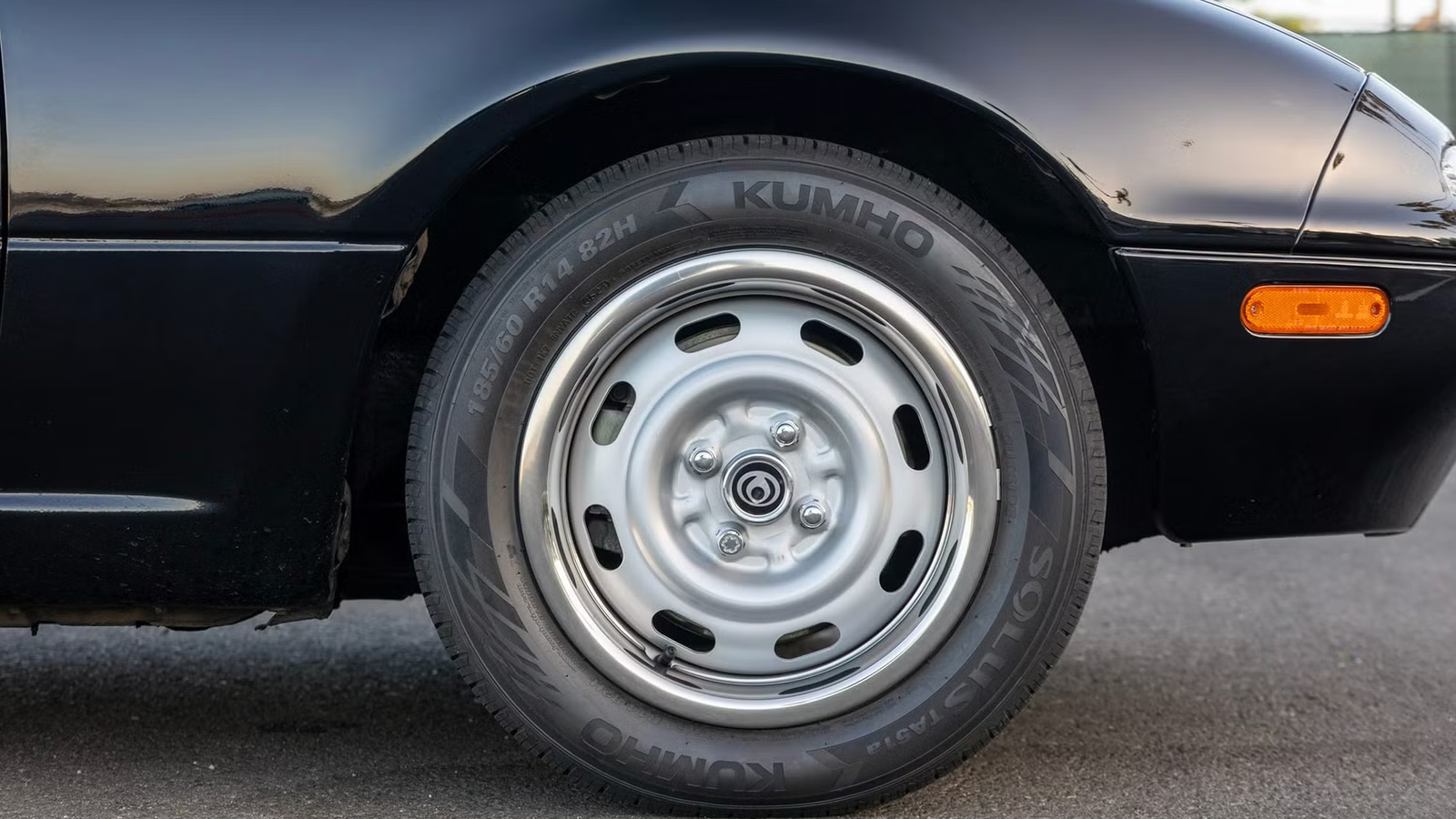
For more than three decades, one Mazda sports car has survived by refusing to follow the industry’s horsepower arms race. Rather than chasing ever higher outputs, its formula has centered on lightweight construction, simplicity, balance and driver involvement.

That approach might sound outdated in an era of increasingly powerful performance cars, yet it has proved remarkably durable. What began as a relatively simple roadster became a global phenomenon, finding fans on roads and racetracks around the world. Its compact dimensions and accessible performance also made it a favorite among owners who modify and customize their cars, all while its power output remained remarkably modest.
The Sports Car That Refused To Chase Horsepower
A sports car does not necessarily need big power to deliver big thrills. That was the thinking behind a roadster conceived in the 1980s, when Japanese engineers deliberately prioritized a low curb weight, rear-wheel drive and precise handling over headline-grabbing performance. They chose a naturally-aspirated four-cylinder engine and even rejected the temptation to add a turbocharger or supercharger, instead concentrating on a linear power delivery and responsive chassis.

That basic formula would then evolve through four generations. Engine capacity, output and weight would all change, but the fundamental approach remained remarkably consistent. The question was whether such a simple recipe could continue to work as expectations for sports cars changed.
The Original Miata Started With Just 116 hp

When the Mazda MX-5 Miata arrived in 1989, its performance figures looked modest even by the standards of the day. The first-generation NA used a 1.6-liter, naturally aspirated four-cylinder producing 116 horsepower and weighing around 2,100 pounds, depending on specification.
But the numbers did not tell the whole story. The engine’s willingness to rev, five-speed manual gearbox and rear-wheel drive layout made the little roadster feel lively without needing huge acceleration figures. Its independent double wishbone suspension at all four corners and near 50:50 weight distribution helped make the chassis predictable and responsive, allowing drivers to exploit its modest power rather than simply overcome it.
The Miata Got More Powerful, but Never Excessive

The second generation, known as the NB, arrived for 1999 with a larger 1.8-liter four-cylinder, producing 140 hp in US specification. It also brought more equipment and structural changes, pushing curb weight beyond that of the original.
By the time the third-generation NC appeared in 2006, the engine had grown to 2.0 liters and produced 170 hp with the six-speed manual. Its added size and equipment, however, came with a substantial weight penalty: the NC tipped the scales between 2,414 and 2,590 pounds, depending on model.
That progression shows how the formula was beginning to change. There was more performance available, but also more mass to carry it. The NC remained a lightweight sports car by modern standards, yet it had moved noticeably further from the remarkably light original.
The ND Got Lighter Instead Of Simply Getting More Powerful

For the fourth generation, Mazda took a different approach, cutting the car’s curb weight by at least 80 pounds to 2,332 pounds with a manual transmission. The reduction came through its SKYACTIV engineering philosophy, which applied weight saving throughout the car while also using more high-tensile steel to maintain structural strength. The engine was positioned lower and farther back, helping the redesigned roadster become smaller and more agile than its predecessor.
Then, for 2019, Mazda increased the 2.0-liter engine’s power output from 155 to 181 hp without simply making it larger. Lighter pistons and connecting rods, revised valve timing and lift, reduced exhaust pumping losses and improved fuel injection allowed the engine to rev to 7,500 rpm.
Why Miatas Became Global Track And Tuning Favorites

The MX-5’s appeal extended far beyond showroom sales. Production reached one million examples in April 2016, a milestone achieved in just 27 years, while the model had already held the Guinness World Record for the best-selling two-seat sports car since 2000. Mazda’s millionth car was subsequently displayed at 35 events across Japan, Europe, North America and Australasia, highlighting the breadth of its international following.
Its popularity in motorsport is equally significant. Mazda has described it as the world’s most road raced production car, helped by affordable running costs and a huge supply of cars and aftermarket parts.
That accessibility has also made it an ideal basis for modifications, from grassroots club racers to extensively reworked track machines. The factory-backed MX-5 Cup further demonstrates the platform’s racing potential, using more than 250 competition-specific parts.
35 Years Later, The Formula Has Barely Changed

The 2025 MX-5 Miata 35th Anniversary Edition demonstrates just how closely Mazda has stuck to the original formula. Its naturally aspirated 2.0-liter four-cylinder produces 181 hp and 151 lb-ft of torque, while the manual soft top weighs 2,366 pounds.
The special edition adds exclusivity rather than chasing extra performance. It is finished in Artisan Red Metallic, a three-layer color created using Mazda’s Takuminuri paint process, and features a beige soft top, 17-inch wheels and tan Nappa leather upholstery.
Sportier hardware includes Bilstein dampers, shock tower bracing and an asymmetric limited slip differential. Mazda initially planned 300 examples for the US, but demand prompted an additional 50, bringing production to 350.
The Miata Proved You Don’t Need Big Power
Across four generations, the numbers tell a surprisingly restrained story. The original Miata arrived with 116 hp, the second generation reached around 140 hp, and the third generation climbed to 170 hp. The fourth generation initially stepped back to 155 hp before Mazda raised output to 181 hp for 2019.
That means the latest car has gained only 65 hp over the original, despite 35 years of engineering development. Even today, the 2.0-liter engine remains naturally aspirated, with its 181 bhp arriving at 7,000 rpm and a 7,500 rpm redline.
The achievement is not that Mazda kept the Miata slow. It is that the company kept finding ways to make modest performance rewarding. By resisting the horsepower race, it preserved the character that made the car special in the first place.
Sources: Mazda

Related posts



Latest Post


No Comments