
The Rarest Car Tuned By ASC/McLaren Wasn’t A GNX At All
Some cars become legends because of what they achieve. Maybe that was performance on the road, dominance on the track, or incredible sales numbers. Some create a legacy of technological advancement, making everything else outdated on launch. But there are some cars that go down in history not because of what they did accomplish, but because of what they didn’t. Cars that showcased a new, bold way of thinking and were cut down before they could even hit the road. This muscle car is one example, and it remains one of the greatest “what ifs” of its era.
Why ASC/McLaren Became One of the Most Fascinating Names of the 1980s Performance Boom

American Sunroof Corporation (ASC, later American Specialty Cars) and McLaren Engines were an unlikely pairing in the 1980s. One was an American engineering company founded by former members of Bruce McLaren’s racing operation to bring Formula 1-derived expertise to the partnership, while the other was known for making sunroofs. No prizes for guessing which is which. But from these humble, and not-so-humble, beginnings, the two carved out a unique niche by transforming production cars into limited-run performance machines. These weren’t pure McLarens or ASCs. Instead, the two companies worked closely with automakers to create factory-backed cars that combined everyday usability with a significant jump in performance and exclusivity.
This approach of blending performance, usability, and rarity was appealing to people who wanted something a little more exciting than what the showroom had to offer. To that end, the duo’s cars would often have upgraded powertrains, revised suspension systems, and improved interiors that made them noticeably different from the cars they were based on. Cars like the Fox body ASC/McLaren Capri became shining beacons of this philosophy, showcasing how considered engineering and genuine manufacturer support could create something greater than either company could have achieved on its own. And while the Capri was an example of this, arguably the greatest car to come from it was the Buick GNX.
The Buick GNX Became ASC/McLaren’s Defining Legend, But It Wasn’t The Company’s Rarest Creation


Coming in 1987, the Buick GNX was the car that most embodied this spirit of engineering excellence. The GNX was an ASC/McLaren-reworked Buick Grand National, of which just 547 were built. Both cars had a 3.8-liter turbocharged V-6, both had a four-speed automatic, but the GNX had an extra 31 hp (officially 245 hp versus the Grand National’s 276 hp), slightly more torque (355 lb-ft versus 360 lb-ft), and a larger turbo. But the power figures alone aren’t what set the GNX apart.
The Grand National that the GNX was based on was already one of General Motors’ last great rear-wheel-drive muscle cars. So pushing that even further was impressive in itself. But the GNX’s larger turbo, revised suspension, aggressive tuning, and improved cooling gave it a 0-60 mph time of 4.7 seconds (0.2 seconds faster than the Grand National) and a quarter mile of 13.5 seconds (0.4 seconds faster than the Grand National). This put it in the same performance league as the Ferrari Testarossa, Lamborghini Countach 5000 QV, and even the Porsche 911 Turbo (930). Yet as remarkable as the GNX was, ASC/McLaren had another project that could have been even more ambitious.
Meet The Forgotten 1980 Ford M81 McLaren Mustang Prototype

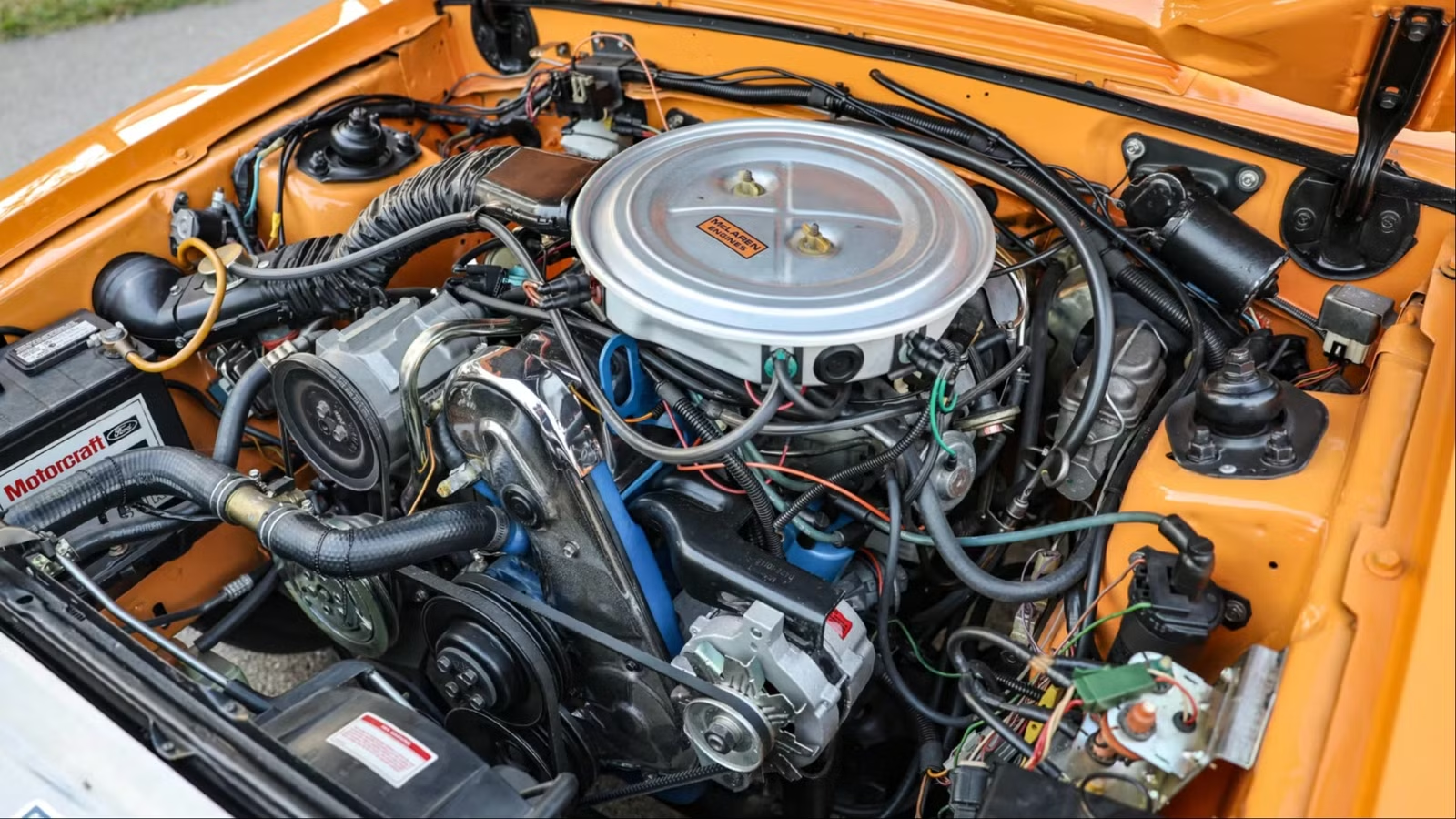
While the Buick GNX was the partnership’s most well-known machine, there was another that could have done even better. And, what’s more, it was the pair’s first car together. The car was going to be the M81 Mustang. Coming at the end of the 1970s performance slump known as the “Malaise Era”, caused by oil crises, emissions regulations, and general power reductions across the board, the M81 had Ford’s backing to make the Mustang exciting again. With that in mind, it had a turbocharged 2.3-liter, four-cylinder engine good for 175 hp rather than the thirsty V-8s that the Mustang had become synonymous with. It also had more than a couple of aesthetic changes, including a distinctive aero package that had a new front fascia, wide flared arches, integrated fog lamps, a revised rear, and special badging to denote it as one of the 250 M81s that were planned.
In all, it made for a much more impressive car, and the truly striking car that Ford hoped would become its new halo. Not only was the car intended to be a hit on the road, but Ford had also hoped it would help support its return to motorsports, having cut back its racing program in 1970 due to soaring costs and tighter regulations. With a racing return being part of the car’s purpose, its design also took inspiration from the IMSA championship, insofar as the car was supposed to look and feel like a race car for the road. The styling, along with the Fox body proportions, played into this, with the turbocharged engine (turbocharging being relatively novel in the early 1980s) providing the performance. The goal was to produce a car that was a balanced sports coupe rather than simply being fast. This all sounded great in theory, but not in practice.
For a start, the price was too high. A hand-built Mustang with a custom interior, a turbocharged engine, suspension and brake upgrades, and all the other elements put into it meant an expected cost of $25,000 in 1981 (or over $90,000 today). A Porsche 911 SC was around $29,000 at the time, a DeLorean was $25,000, and a Datsun 280-ZX Turbo could be had for $17,500. Even a Mustang Cobra Turbo could be had for just under $9,000, making the M81 a very deliberate choice. And on the subject of turbos, though the technology was interesting, it still wasn’t perfect.

Ford had only released its first turbocharged car in 1979, so it was very much still working through teething problems. Turbo lag, heat management, inconsistent performance, and reliability concerns were still present, so presenting the bold new future of the Mustang only for it to turn into an expensive, temperamental failure wouldn’t have done the brand any favors. You’ve also got to factor in that, to many, the Mustang is a V8 machine and anything else is sacrilege. Ford would release a turbocharged Mustang in the SVO in 1984. However, this was a limited-run car made by Ford’s Special Vehicle Operations division rather than a proper production Mustang.
The project was ultimately abandoned after just ten cars were made. Surviving models can still be found, as one 8,000-mile example sold for $67,000 in 2025; however, the project itself came to a halt. But that’s not to say that its legacy ended right then and there.
Built To Preview A Different Future For The Fox Body Mustang

The M81 McLaren Mustang was more than just an experiment; it was a look into a different direction that the Fox body Mustang could have taken. When American cars were still recovering from the dearth of exciting cars in the 1970s, the M81 presented a more sophisticated approach by looking at technology, handling, and exclusivity—something the muscle car industry still hadn’t truly uncovered.
The M81 didn’t chase performance by sticking a bigger engine up front; it did so by refining its chassis and working on the emerging turbocharging formula. The car was going to be lightweight and responsive, capable of inspiring people to take a chance, and announcing Ford’s return to the racing scene. Whether buyers were ready for that is up for debate, but many of the ideas seen in the M81 can be found in later models. Things like a focus on aerodynamics, handling, and factory-backed, specialized machines are all commonplace now, but were more groundbreaking in the early 1980s.
The M81 Prototype Became One Of ASC/McLaren’s Greatest “What Ifs”

We’ll never know what the automotive present would have looked like if the M81 came to fruition. It certainly would have heralded a new approach for the time, and, if the GNX is anything to go by, it could have been a radical one. But the very limited production that the M81 enjoyed is all we have to go on. But perhaps that’s what makes the M81 so interesting.
The McLaren Mustang represents a fork in the road for Ford. A point when it was willing to experiment and take a chance with an old favorite that had seen better days. It was clearly onto something, too, as the legacy of the M81 still lives on even if the car itself doesn’t. It remains as a car that most haven’t even heard of, let alone one that people can appreciate.
While the GNX is undoubtedly the more famous, it’s the M81 that was the more ambitious. A forgotten prototype that never got the chance to define a world it helped create.
Sources: ISeeCars, Ford

Related posts





Latest Post


No Comments