
Chevy Built A 450-HP Family Car Before Anyone Was Ready
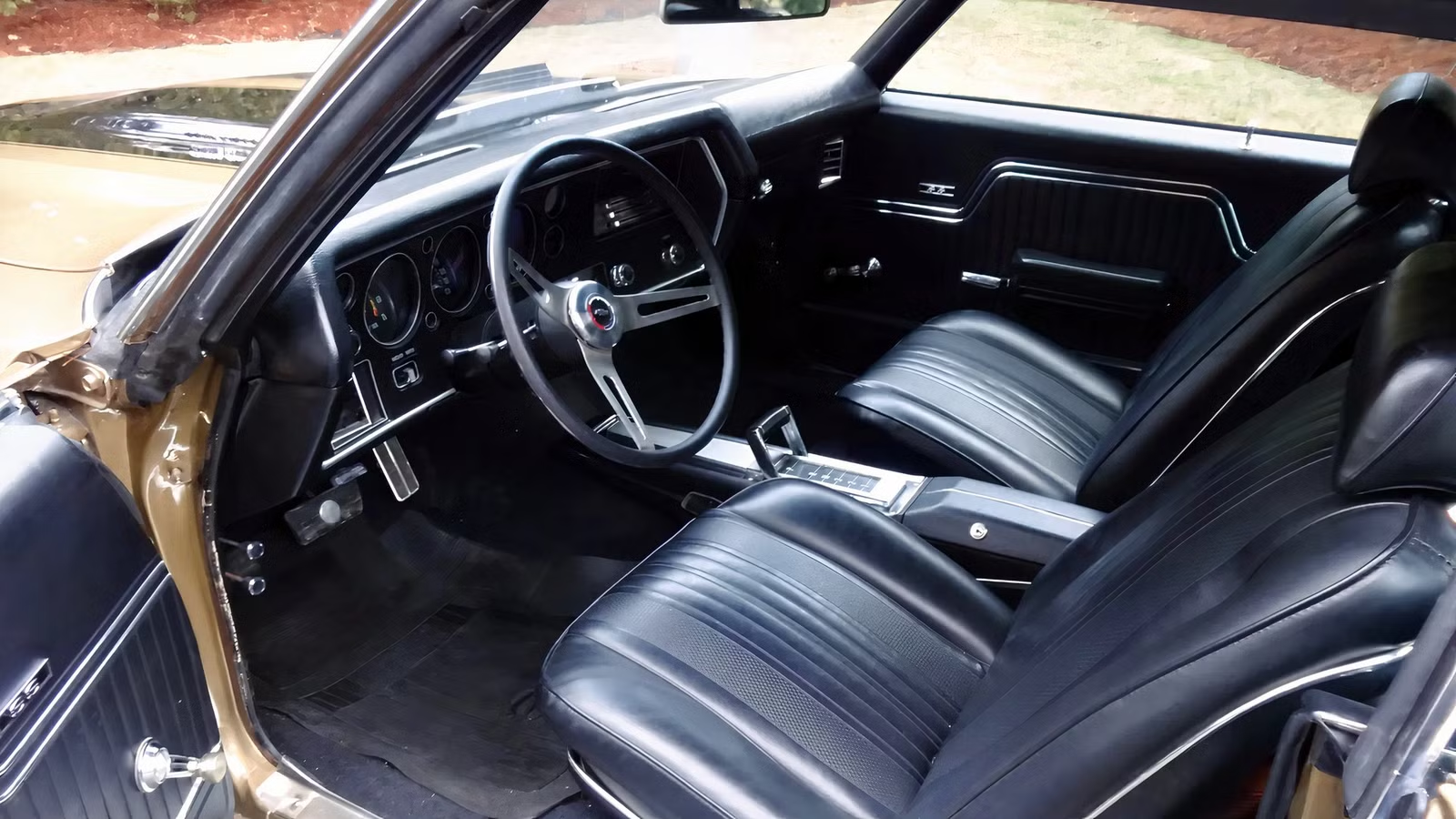
Few machines from the muscle car era carry a more improbable résumé than the 1970 Chevelle SS LS6. On the outside, it was a mid-size family car — available as a coupe, convertible, or sedan — the kind of thing a suburban dad might park in the driveway next to the station wagon. Under the hood, Chevrolet had installed the most powerful engine it had ever offered in a production car: a 454-cubic-inch big-block rated at 450 horsepower and 500 lb-ft of torque. Nothing else GM sold that year could match it, not the Corvette, not the Camaro. The LS6 Chevelle was, by every measurable standard, Chevy’s ultimate performance machine — and it wore family-car sheet metal to the grocery store.

That contradiction is exactly what makes it one of the most fascinating factory combinations of the muscle car era. For one brief model year, a mainstream mid-size platform carried more power than anyone had a right to expect, the product of a corporate policy change, an arms race with Detroit’s rivals, and engineers who seized the moment before regulators and insurance companies slammed the door shut.
Why Chevrolet Had To Wait Before Going All In On Big-Block Power
The late 1960s were the Wild West of Detroit’s horsepower wars. Automakers were stuffing ever-larger V8s into everything from sleek coupes to family wagons, all in a race to claim the fastest quarter-mile time and the biggest bragging rights. On paper, it seemed like engineers had free rein to build whatever they could dream up. Yet one major limitation remained inside General Motors. Since 1963, GM had enforced a corporate policy that prohibited engines larger than 400 cubic inches in its intermediate cars, reserving bigger engines for full-size models and Corvettes.

The idea was to keep its divisions from cannibalizing one another, preserve the hierarchy between intermediate and full-size models, and help distance the company from factory-backed racing as public scrutiny mounted. It was a sensible business decision, but it came at the worst possible time. As the muscle car craze accelerated and rivals rolled out ever-larger engines, Chevrolet was forced to watch from the sidelines with one hand tied behind its back. That changed in 1970, when GM finally lifted the self-imposed ban, opening the door for Chevrolet to drop its largest and most powerful engine yet into its
midsize Chevelle
The Chevelle Was Chevy’s Everyday Mid-Size Before It Became A 450-HP Monster

As some gearheads may remember firsthand, Chevrolet introduced the mid-size Chevelle into its lineup in 1964. At the time, it wasn’t something that sang to a gearhead’s soul. It wasn’t conceived as a performance statement. Its job was simply to fill a practical gap in Chevy’s lineup between the compact Chevy II and the full-size Impala — a mid-size platform positioned as a family-friendly car built for primary transportation, not niche enthusiast use.
Available as either a two-door coupe, four-door sedan, convertible, or even a station wagon, the Chevelle’s versatility defined its role as a family-minded rig. The wheelbase of the classic 1964 Chevelle measured 115 inches, shorter than Chevy’s full-size cars but long enough to deliver stable ride quality and usable interior space. That balance made the Chevelle popular with families who wanted something easier to maneuver and cheaper to own than a full-size sedan.
Pushing It To The Extreme

|
Engine |
Power |
Torque |
Transmission |
|---|---|---|---|
|
454ci V8 |
450 hp |
500 lb-ft |
3/4-speed manual |
Early powertrains reflected that mission. Base engines included an inline-six — such as the 194-cubic-inch unit rated at 120 horsepower — while optional small-block V8s like the 283-cubic-inch V8 provided modest upgrades without transforming the car’s personality. Even as larger engines like the 327 V8 became available later in the decade, the Chevelle still lived in mainstream use. These were engines chosen for reliability, drivability, and everyday performance rather than outright speed.
By the late 1960s, the Chevelle had become one of Chevrolet’s best-selling nameplates, firmly established as a mid-size family platform. And that’s where the story gets genuinely compelling. After six years in production as the go-to mid-size family rig, Chevy gave the Chevelle an elevation, offering buyers the opportunity to opt for the SS trim package on their family haulers. The transformation that followed didn’t change the Chevelle’s origins so much as push them to an extreme.
How The LS6 Turned A Family Platform Into Chevy’s Most Powerful Production Car

By 1970, Chevrolet’s SS package had a clear purpose: to give buyers access to the biggest engines, strongest drivetrains, and most aggressive hardware available without sending them to a Corvette showroom. The SS was not a separate model. It was a performance option layered onto the Chevelle’s A-body, a chassis already proven in everyday use. The Chevelle remained the same underneath — the only change was the scale of what Chevy was willing to install under the hood.
As seasoned gearheads may recall, that willingness peaked with the LS6 454. It’s worth clarifying that not all 454-powered Chevelles were created equal. The vast majority of big-block Chevelles left the factory with the LS5 454, which was far more common and rated at 360 horsepower. The LS6, by contrast, was a separate high-performance option built around higher compression, more aggressive internals, and a completely different intent. While several Chevy models in the early ’70s could be ordered with a 454, the 450-horsepower LS6 specification was exceptionally rare, and it’s this extreme version that pushed the Chevelle into uncharted territory.
Displacing 454 cubic inches (7.4 liters), the LS6 was built with serious intent. Its compression ratio was 11.25:1 — aggressive even by 1970 standards — with factory ratings of 450 horsepower and 500 lb-ft of torque. No other production car carried a higher factory horsepower rating in 1970.
The Corvette’s big-block options for the 1970 model year topped out below the LS6’s figure, and the Camaro never received an engine of this magnitude from the factory. In raw output, the LS6-equipped Chevelle sat at the top of Chevy’s entire lineup — as unlikely as that sounds for a car that doubled as a kid hauler.
LS6 Vs. LS5: Same 454, Completely Different Mission

In 1970, Chevelle SS 454 buyers had two versions of the same 454-cubic-inch big-block to choose from. Most buyers left the dealership with the 360-horsepower LS5, which was the standard engine included with the SS 454 package. Those willing to spend another $263.30 could upgrade to the legendary LS6 — an entirely different beast. On paper, the difference was 90 horsepower. In reality, Chevrolet had transformed the engine from the inside out.
The LS5 was built for effortless street torque, using a hydraulic-lifter valvetrain, oval-port heads, a cast-iron intake, and a Rochester Quadrajet carburetor. The LS6 took a far more aggressive approach. Chevrolet replaced the LS5’s hydraulic cam with a solid-lifter camshaft capable of sustaining higher rpm, while a forged steel crankshaft, forged steel connecting rods, forged aluminum pistons, and a four-bolt-main block improved strength under extreme loads. Rectangular-port cylinder heads flowed significantly more air than the LS5’s oval-port castings, while an aluminum intake manifold and 800-cfm Holley four-barrel carburetor let the engine breathe far more efficiently. Add in a jump from 10.25:1 to 11.25:1 compression, and the result was Chevrolet’s most powerful production engine of the era.
Go Big Or Go Home

Production numbers underline how extreme the combination was. Documentation suggests that approximately 4,475 LS6 Chevelles were produced for the 1970 model year, making it a low-volume option even at the height of the muscle car era. Serious buyers could pair the engine with heavy-duty suspension, upgraded brakes, and either a four-speed manual or Turbo-Hydramatic automatic. Still, regardless of the upgrades, the underlying car remained a Chevelle.
That contrast is what makes the LS6 significant. Chevrolet didn’t create a new platform to house its most powerful engine — it installed that engine into a mainstream mid-size and let the numbers speak for themselves. After all, the muscle car era isn’t remembered for being wacky and excessive for nothing.
Torque Of The Town

A comparison against its immediate rivals helps put things in context. Numerous publications at the time tested it, with Hot Rod recording a 13.4-second quarter-mile run at 108.17 mph. Car Craft managed an even faster 13.1-second run at 107.01 mph — supercar-quick for 1970, especially for a mid-size car carrying full interior trim and street gearing.
For comparison, many rival muscle cars of the era struggled to match that pace. A 440 Six Pack Challenger or a Ram Air IV GTO could run similar times, but few combined that level of acceleration with the sheer torque delivery of the LS6. Even Chevy’s own big-block Corvette often posted slower straight-line results depending on gearing and traction. In real-world terms, the LS6 Chevelle was one of the quickest factory cars money could buy in 1970, regardless of body style or badge.
Other Forgotten LS6 Family-Friendly Body Styles

What often gets overlooked is that the LS6 wasn’t limited to stripped-down coupes. Buyers could order it in body styles that leaned even harder into the family-car irony. Convertibles, for example, combined open-top cruising with one of the most violent drivetrains Chevy ever sold. On paper, it was a relaxed summer car. In reality, it could out-accelerate nearly everything else on the road.
Even more surprising was how discreet the combination could be. Aside from SS badging and subtle visual cues, an LS6 Chevelle didn’t scream for attention the way purpose-built performance cars did.
Why 450 Horsepower Was Too Much For The Era To Handle

Planting 450 horsepower in the engine bay of a family hauler wasn’t without its complications. In 1970, that kind of output existed in a very different automotive world. The LS6 arrived before modern tire technology, before sophisticated suspension tuning, and long before electronic driver aids became standard. On paper, 450 horsepower was staggering; in practice, the surrounding hardware simply hadn’t caught up, making the car genuinely challenging — and in the wrong hands, dangerous.
Mechanically, the LS6’s difficulty off the line came down to how brutally it delivered torque. Peak torque arrived early and aggressively, instantly overwhelming the rear tires. The combination of a heavy iron big-block, a nose-heavy weight distribution, and relatively soft rear suspension geometry made controlled launches a challenge even for experienced drivers.
Living On A Prayer

Add in tall factory gearing and clutch setups designed more for durability than finesse, and the margin for error became razor thin. Wheelspin wasn’t gradual; it was immediate. Getting an LS6 Chevelle off the line cleanly required careful throttle modulation, mechanical sympathy, and a fair amount of nerve. In the hands of an unprepared driver, it was downright dangerous. In the hands of someone who knew what they were doing, it was devastatingly quick.
Braking technology lagged as well. While front disc brakes were available, rear drums remained common, and stopping distances reflected that reality. The Chevelle platform was robust, but it had been engineered originally for moderate power levels, not sustained abuse from a 500 lb-ft big-block.

Beyond hardware, the external environment was shifting fast. Insurance companies began cracking down on high-horsepower cars — precisely the ones younger buyers with thinner wallets wanted most. Premiums soared, and some models became difficult or impossible to insure affordably. At the same time, federal emissions regulations were tightening, pushing manufacturers toward detuned engines almost immediately after 1970.
Fuel quality was another factor. High-compression engines like the LS6 depended on premium fuel that was becoming less consistent and more expensive. Reliability under real-world conditions became harder to guarantee as regulations and fuel standards changed.
The result was a perfect storm. The LS6 wasn’t retired because it failed — it disappeared because the industry around it was no longer willing or able to support engines like it. Within just a model year, the environment that had allowed 450 horsepower in a mid-size car was effectively gone.
The LS6 Era Ended Almost As Soon As It Began

The 1970 Chevelle SS’s reign was brief because the conditions that allowed it to exist collapsed almost immediately. After 1970, the industry landscape changed faster than Chevrolet could adapt without fundamentally rethinking its engines. For 1971, Chevrolet retained the LS6 designation on paper, but the engine was dramatically altered, with compression dropping to 9.0:1, bringing output down to 425 horsepower and 475 lb-ft of torque. The engine was no longer the same animal — the window for factory-installed, high-compression big-blocks had effectively closed.
Emissions regulations tightened throughout the early 1970s, forcing automakers to prioritize cleaner exhaust over maximum output. At the same time, insurance companies continued penalizing high-horsepower models, shrinking the buyer pool even further. Performance cars didn’t suddenly evaporate, but the appetite for extreme factory combinations — especially among younger buyers watching their insurance bills — faded quickly.
With Time, It’s Blossomed

By 1972, Chevrolet’s big-block offerings were significantly detuned across the board. Horsepower ratings dropped throughout the lineup, and performance branding shifted toward appearance packages and handling upgrades rather than raw output. The Chevelle itself would soon grow heavier and softer, reflecting changing market priorities rather than outright performance ambitions.
The 1970 Chevelle SS existed at the peak of the muscle car era, just before regulatory pressure, insurance costs, and fuel concerns forced the industry to evolve in an entirely new direction. Chevrolet didn’t abandon the LS6 because it failed — this option simply disappeared because the environment that had allowed a 450-horsepower mid-size car no longer existed.
What It Takes To Own Chevrolet’s Ultimate Big-Block Today

That brief production run has had lasting consequences in today’s collector market. With only a few thousand built and far fewer surviving in correct, documented form, LS6 Chevelles have become blue-chip muscle cars. Pristine examples will easily set you back six figures. Hemmings pegs the average value for a ’70 Chevelle SS 454 LS6 coupe at $173,000.
The truly elite cars, however, are the convertibles. While production records remain incomplete, many historians believe roughly 20 LS6 droptops left the factory in 1970. That tiny production run has made them significantly more valuable than their hardtop counterparts, with the price gap showing no signs of narrowing. The best recent example came at Mecum Kissimmee 2026, where a highly documented LS6 convertible changed hands for $770,000, setting a new benchmark for the model.

Those eye-watering prices have fueled a thriving market for clones, making documentation just as important as matching numbers. Buyers should insist on original paperwork — including the build sheet, Protect-O-Plate, window sticker, and correct partial VIN and engine stampings — before signing on the dotted line.
Ultimately, buyers aren’t just paying for 450 horsepower. They’re paying for the story. The LS6 represents the absolute limit of what Detroit was willing to sell the public before emissions rules, insurance costs, and changing priorities brought the muscle car golden era to an end. That combination of rarity, performance, and perfect timing is why it remains one of the most coveted American muscle cars ever built.
Sources: Heacock Classic, Hemmings, Over-Drive Magazine, Mecum Auctions

Related posts
Latest Post


No Comments