
The Luxury Mercury Sedan That Hid A Mach 1 Mustang Big-Block
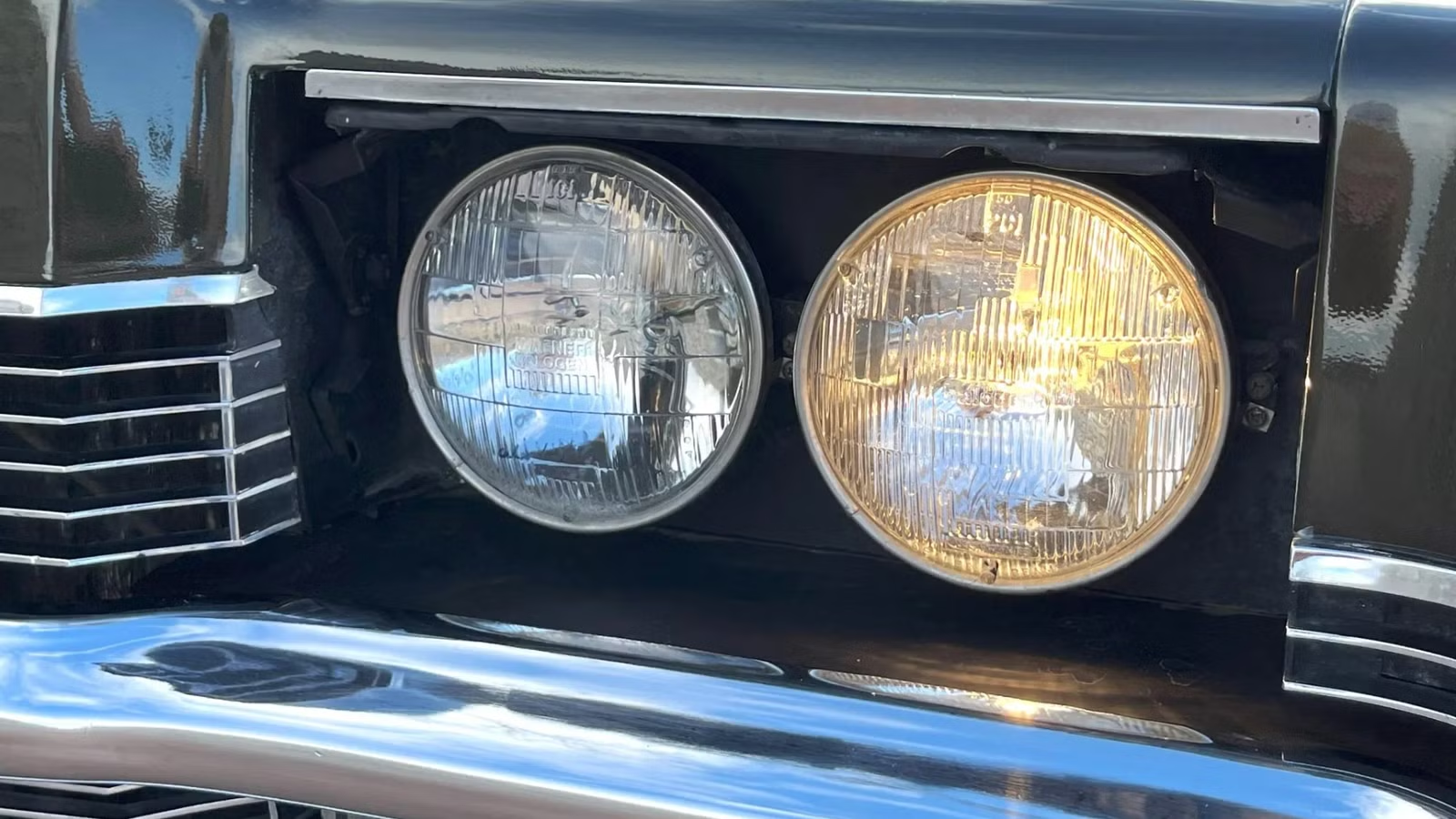
The late 1960s was the horsepower era. Muscle cars grabbed all the headlines, while luxury sedans quietly created their own niche. Theoretically, sedans were built to float over bumps, isolate passengers from the outside world, and make long drives feel effortless. Mercury, Ford’s upscale division, had this formula in mind when it was developing its own luxury sedan.

But somewhere during the development process, someone at Ford apparently looked at the engine bay and thought, “You know what this thing needs? A really big V8.” While this sedan was initially powered by Ford’s FE-series V8, it later graduated to the big-block engine family that once powered the Mustang Mach 1: the legendary 385-series V8.
The Same 385-Series V8 That Powered Ford Performance Cars
Ford’s 385 series engines used to come in two options: 429 and 460. Since Ford manufactured them at its Lima plant in Ohio, these blocks became widely known as the Lima V8s. Although both V8 blocks shared the same 4.362-inch bore, the real difference lay in the stroke; 3.590 inches for the 429 and a longer 3.850 inches for the 460, giving the latter a fatter torque curve. Both V8s were fitted with nodular iron crankshafts to cope with heavy low-end torque loads.

Ford primarily developed the 385 series engines to plonk it under the hood of heavy American cruisers like the Lincoln Continental, Ford Thunderbird, and Ford Galaxie. And why not? Lima V8s offered a strong low-end torque. Out of the two, the 429 was also utilized for high-performance models. On the other hand, the bigger 460 prioritized smoother power delivery over sportiness. Take the Lincoln Continental Mark III, for example. Weighing a hefty 4,866 pounds, it needed an engine capable of moving all that mass with ease. That’s exactly what the 460 delivered, producing 365 horsepower and 500 lb-ft of torque.
Cobra Jet And Super Cobra Jet Powered The Mustang Mach 1

Coming to 429, little did Ford know that the engine was capable of far more than what it was originally built for. The drag strip had other plans, and it didn’t take long for enthusiasts to realize the 429 was hiding serious performance potential, with tuned examples producing up to 400 horses and as much as 500 lb-ft of torque. Ford took notice. In 1970, the 429 V8 block received better cylinder heads, giving birth to the Cobra Jet and Super Cobra Jet engines. The Cobra Jet churned out 370 hp/450 lb-ft with an 11.3:1 compression ratio, while the Super Cobra Jet had 11.5:1, producing 375 horses, without adding any extra torque. These engines exclusively powered Ford’s iconic Mustang Mach 1 in 1971.
Boss 429: Ford’s NASCAR Racing Heritage

Every great racing legacy has its “what if” moment, and for Ford, it was the 427 SOHC Cammer FE V8. People will always remember how NASCAR killed this engine, saying it violates the homologation requirements. Well, Ford wasn’t about to wave the white flag, the answer was the 429 V8 block from the 385 series family. For racing duty, it was given aluminum cylinder heads with crescent-shaped semi-hemi combustion chambers, with 2.38-/1.90-inch valves, and 2.36- x 2.36-inch intake ports. This engine was essentially called “Boss 429”.
Ford Hid A Mustang-Grade Big-Block Inside Mercury’s Plushest Sedan

Coming back to Mercury, the Marquis was the plushest sedan from the brand, first launched in 1967. Notably, the first-generation model didn’t arrive with Ford’s 385-series big-blocks. Instead, it was powered by the FE-series 410 and 428 V8s between 1967 and 1968. Engine output ranged between 330 hp and 345 hp, and 444 lb-ft and 462 lb-ft, respectively. For a full-size family mover, those numbers were still astounding in the late 1960s. The setup was paired with a 4-speed manual transmission, while buyers also had the option of a 3-speed automatic.
The second-generation Marquis was launched in 1969, along with the more upscale “Marquis Brougham”, which served as the premium version of the standard Marquis. That’s when it got the Mustang-grade 385 Series 429 V8 engine, available in both 2-barrel and 4-barrel carburetor versions. The former was rated at 320 horses, while the 4-barrel version made a whopping 360 horses that time.
Mercury continued to refine the Marquis with each successive model year, and in 1974, the lineup received Ford’s larger 460 big-block V8. Surprisingly, it was making a lesser 200 to 224 horses compared to the 429 block. But outright horsepower was never its mission. It was the kind of engine that barely broke a sweat at highway speeds, turning long-distance cruising into second nature. However, the Lima V8s couldn’t serve the Marquis for long, and amid stringent emissions norms and rising fuel economy concerns, the 358 series engines were phased out by 1978.
Luxury Came First, Even With All That Big-Block Power

The Marquis Brougham wasn’t just another fancy badge in those times; this sedan actually lived up to its name. “Marquis” meant French nobility, while “Brougham” traced its roots to an enclosed horse-drawn carriage once favored by the wealthy. It was reflected in every inch of the car. From its sweeping body lines and generous chrome detailing to its seemingly endless hood, the Marquis carried itself with the quiet confidence of a luxury flagship. The Marquis wasn’t limited to one body style. It was available in both a 4-door full-size sedan and a 2-door coupe.
Despite all that big block V8 power and low-end torque under the sheet, the Mercury Marquis never felt like a compromise in terms of space and luxury. Stretching nearly 220 inches from bumper to bumper, along with a 124-inch wheelbase, it was noticeably larger than its Ford counterparts. The dimensions helped it to offer a lounge-like seating space inside. The Marquis truly justified its luxury-car credentials with soft-touch surfaces, thick carpeting, and plush materials.

Mercury spared no effort, packing the Marquis with all the bells and whistles expected from a top-tier luxury cruiser of the era. Amenities included power windows and automatic air conditioning, and a stereosonic sound system. The Grand Marquis and Marquis Brougham variants also got vinyl roof options, along with split bench seats. Burled wood trim and diamond-pleated door panels added another layer of sophistication, giving the cabin an upscale feel.
The Mercury Marquis Brougham Is Still A Bargain Big-Block Classic

Although the Mercury Marquis has gone into the history books, it’s impossible to forget a luxury sedan that casually packed a 429 or even a 460 cubic-inch big V8 block under its sheet metal. It wasn’t trying to be a performance icon, and simply happened to carry one of Ford’s biggest V8s while doing what it did best: turning every journey into a first-class cruise. That’s exactly what made the Marquis so memorable.
Do you want to relive the era of big-block American luxury? You’re in luck. Well-maintained Marquis Broughams continues to change hands for anywhere between $10,000 and $20,000. This makes it one of the best ways into the bygone era without spending enormous amounts of cash.
Sources: Ford, Mercury, Classic.com

Related posts



Latest Post


No Comments