
Cadillac XLR-V: Why a $100K Supercharged Rarity Sells for $27,500
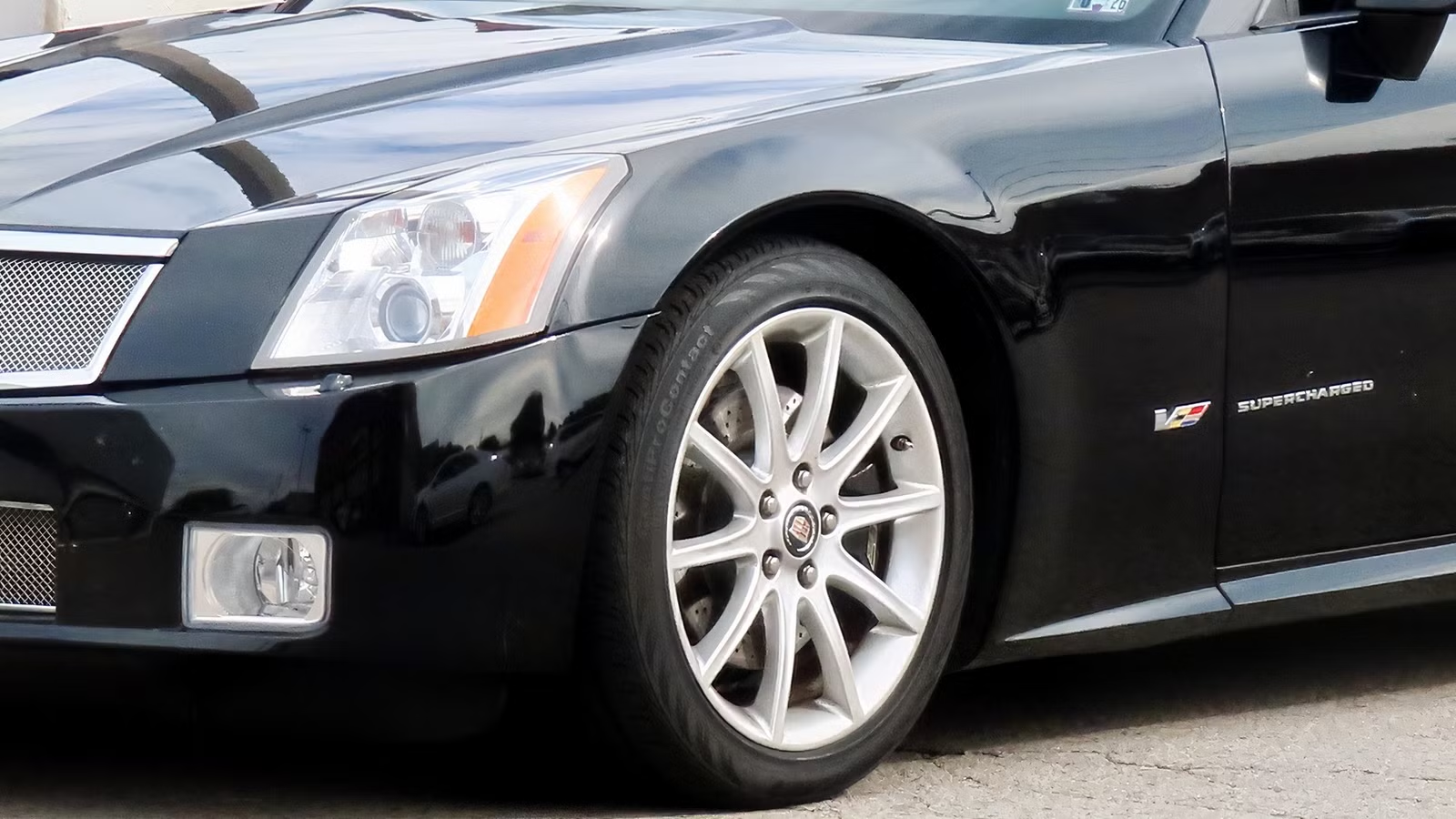
The Cadillac XLR-V should already be collector bait: tiny production, a 443-hp supercharged V8, a folding hardtop, and GM performance-car architecture from the same Bowling Green factory as the Corvette. Yet Hagerty values a good 2006 example at just $27,500. Cadillac built only 2,188 XLR-Vs from 2006 through 2009, putting it among the sort of underrated American performance cars collectors usually start chasing once the supply gets this thin. But rarity isn’t the problem. The market simply hasn’t decided this is an obvious collector car.
A $100,000 Cadillac V8 Roadster Is Now Worth $27,500

Cadillac did not price the XLR-V like an experiment. For 2006, it announced a $100,000 U.S. MSRP including destination. That bought a hand-assembled 4.4-liter supercharged Northstar V8 making 443 hp and 414 lb-ft, a six-speed automatic, Magnetic Ride Control, bigger brakes, 19-inch wheels, and a power-retractable hardtop. Each supercharged Northstar was assembled by one craftsman at GM’s Performance Build Center. Cadillac was serious about this thing.
Then look at how few it made. Production fell from 1,147 cars in 2006 to 410 in 2007, 392 in 2008, and 239 in 2009—just 2,188 cars in four years. Yet the current price guide puts a #3 Good 2006 XLR-V at $27,500, barely more than a quarter of its original sticker. That’s enough depreciation to make today’s buyer smile and the original owner avoid the calculator.
Actual sales show collectors are picky, not asleep. A 66,822-mile 2006 XLR-V sold for $27,500 at Mecum in January 2026, while lower-mile examples have brought considerably more. Condition, history, originality, and presentation still matter. A one-off build can become a record-setting Pantera restomod when the car and its story align. The XLR-V already has rarity. What it still lacks is the kind of instantly understood collector identity that makes rarity expensive.

Yet The Corvette Z06 From The Same Factory Is Worth More

The XLR-V’s value problem gets harder to ignore beside the 2006 Corvette Z06. Both came from Bowling Green, but Chevrolet gave the Z06 a collector story that takes seconds to understand: a 7.0-liter LS7 V8, 505 hp, an aluminum chassis, bigger brakes, track-focused suspension, and a six-speed manual. It was the hard-edged Corvette. No decoding required.
Now the numbers bite. National Corvette Museum production data shows Chevrolet built 6,272 Z06s in 2006 alone—nearly three times the entire four-year XLR-V run. Yet the current guide value for a good 2006 Z06 is about $38,700, roughly $11,200 more than the Cadillac. The Z06 also started at $64,890, more than $35,000 below the XLR-V. The more common car cost less new and is worth more now.
That gap is really about identity. The Z06 gives collectors a naturally aspirated 427-cubic-inch V8, a manual gearbox, and a focused sports-car mission. The XLR-V mixes its supercharged Northstar with an automatic, folding hardtop, heated and cooled seats, and grand-touring manners. One tells collectors exactly what it is. The other asks them to think about it—and in the collector market, hesitation has a price.
The Unexpected Cost Is Everything Around The V8

The engine is not the only thing you are buying, and that matters more on an XLR-V than the horsepower number suggests. The retractable hardtop alone is a system of hydraulics, sensors, linkages, windows, tonneau panels, and electronic controls. Cadillac’s own owner’s manual includes a multi-step emergency procedure for manually raising the roof after a loss of power, including accessing the hydraulic pump under the trunk carpet and unlocking tonneau linkages. That does not prove the roofs are unreliable. It proves they are complicated.

Parts availability adds another layer. Some XLR-specific GM components are already discontinued; for example, GM part 20756025, the left tail-lamp assembly used on 2004–2009 XLRs, is listed as discontinued by a genuine-GM parts retailer. That is one part, not evidence that the whole car is unsupported, but it shows why a low-volume body can make seemingly simple damage more annoying than it would be on a Corvette. Magnetic Ride Control, the roof system, and two decades of luxury electronics also give a buyer more to verify before money changes hands. A cracked lamp or damaged trim piece can turn into a hunt.
The Cheap One Can Become The Expensive One

This is where the XLR-V starts to resemble another V8 retractable-hardtop bargain: the Lexus SC430. Depreciation can make sophisticated luxury convertibles look like ordinary used cars long before their complicated hardware becomes ordinary to repair. With the Cadillac, the sensible pre-purchase inspection goes well beyond listening to the V8. Cycle the roof repeatedly, test every switch and light, have a specialist scan the electronic modules, check the suspension for warnings, and make sure the service history is more than a hopeful stack of oil-change receipts.
Most of all, inspect the XLR-specific stuff. Engines and transmissions are expensive on any performance car, but a rare trim panel, lighting assembly, roof component, or damaged body piece can create a different kind of headache. A five-grand discount is not much of a win if you spend the next year searching for one unavailable part. On an XLR-V, condition is not simply a nice collector bonus. It is part of the value equation.
At $27,500, The Right XLR-V Finally Makes Collector Sense

At $100,000, the XLR-V had to justify itself against serious European luxury roadsters while the Corvette offered another GM performance path for less. At $27,500 in #3 Good condition, that argument changes completely. Now you are looking at a 443-hp, supercharged V8 roadster with only 2,188 examples built, not a six-figure Cadillac trying to steal buyers from established European badges. The depreciation already did the painful part for today’s buyer.
The XLR-V is also stranger than the easy “Cadillac Corvette” nickname suggests. Cadillac developed it on GM’s performance-car architecture and built it at Bowling Green, but gave it its own Northstar V8, body, interior, luxury mission, and retractable hardtop. The V added the supercharger, bigger brakes, 19-inch wheels, and sharper suspension tuning. It shares family DNA with the Corvette, but it was never simply a C6 with a Cadillac badge.

That does not mean values are guaranteed to climb. Collector tastes are not a spreadsheet, and rarity alone has not pushed the XLR-V into obvious blue-chip territory. The stronger case is what the car offers right now. For enthusiasts who follow rear-drive GM performance, the XLR-V is the oddball branch of the family: fast, scarce, comfortable, and unusual enough to feel special. If values rise later, great. That should be the bonus, not the reason to buy one.
So yes, the right XLR-V makes collector sense today around $27,500. But “right” is doing plenty of work. Skip the bargain with a roof that will not cycle properly, warning lights, missing trim, or mystery history. Pay more for a documented car whose electronics, suspension, lights, drivetrain, and folding top all work as intended. Cadillac already supplied the rarity. Your job is to make sure you are buying the car, not inheriting the previous owner’s repair list.

Related posts


Latest Post


No Comments