
Pontiac GT-37: The Muscle Car Built to Beat Insurance
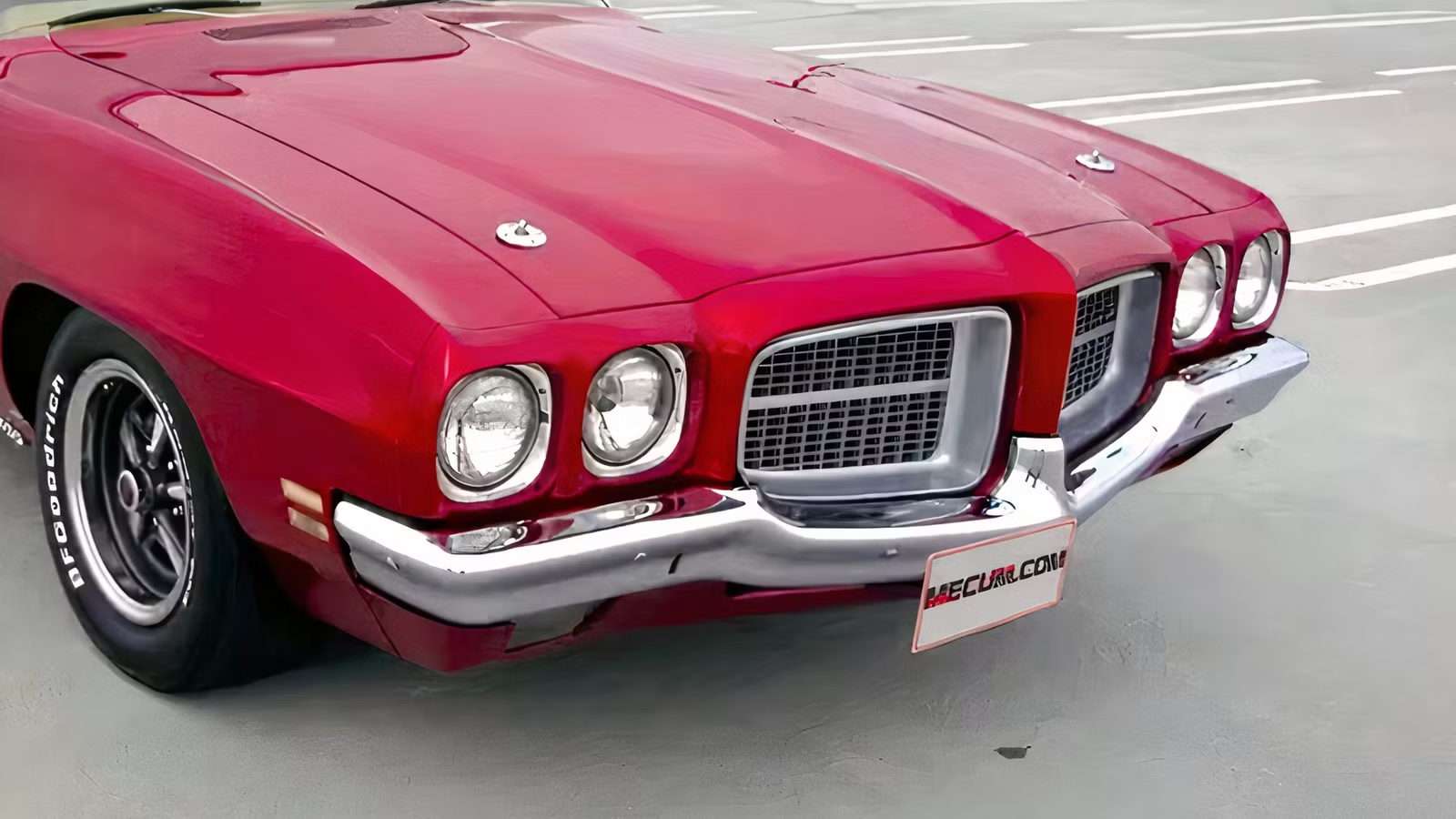
The muscle car wars of the late 1960s and early ‘70s were often thought to be a time of complete, unrestricted access to giant engines, high horsepower, and tolerances for low safety. For the most part, that line of thinking is true. Certainly, the US Government of the period wasn’t going to step in and bring a stop to the fun. At least, not yet. It was the wild west for American sports cars, except for one facet in particular, one not beholden to governments or OEMs. With that said, there was at least one workaround, and it involved a level of sneakiness seldom seen in the auto industry.
Insurance Companies: The Ultimate Buzzkill

Car insurance is more expensive in 2026 than at any point in the past half century-plus. Still, during the muscle car wars, insurance companies managed to be one of the only limiting factors to the American muscle car, at least in the days before emissions and fuel economy laws. The logic was simple: an entire generation of newly 20-something baby boomers was pouring into dealerships across America, putting down payments on Challengers, Torinos, Javelins, and GTOs, then racing around like men possessed for not all that much in insurance costs.
Inevitably, this led to more than a few expensive payouts when folks wrapped these cars around trees or put them in ditches. From the insurance provider’s perspective, this was completely unsustainable. As such, it wouldn’t take long for the industry at large to put countermeasures in place to try and prevent some of these catastrophic total loss insurance write-offs. Dubbed the 10-to-1 rule, the decree dictated that any vehicle with fewer than ten pounds of gross vehicle weight per horsepower was subject to massive insurance surcharges. Under the understanding that anyone driving a car of that caliber was liable to crash it, national insurers like GEICO and State Farm used this rule to add huge costs to big muscle cars for basic liability coverage.
Ostensibly, this was a watertight rule. Muscle cars were stout and powerful, plus way too fast in the hands of most people who craved them. They were far more prone to being broken into, vandalized, and having parts ripped out of them to be sold at chop shops. As a conservative estimate, that meant muscle cars were as much as 117 percent more expensive to insure than basic commuters. With that said, American automakers did occasionally try to find a workaround. So far as GM was concerned, its efforts there focused around one platform in particular.

The A-Body: The Perfect Platform for a Budget Car Turned Stealth Muscle Car

Forgive people in the day for having a messed up idea of what a mid-size budget car was really like. Honestly, the ’60s definition of what an intermediate platform was sounds far cooler than what we have today. It’s on this very A platform, the same that championed the Chevy Chevelle and Oldsmobile Cutlass, that Pontiac would find a solution to the pencil pushers and insurance adjusters. Enter the Pontiac T-37. Based on the larger overarching Tempest, the T-37 was produced so Pontiac could have a cheaper entry-level hardtop coupe than Chevrolet. Unfortunately for them, they were undercut by the base Chevy Chevelle just a few short weeks after the T-37 was introduced.
Its base engine was a 250-cubic-inch straight-six engine, which certainly wouldn’t arouse suspicion from the geeks at the insurance company. At least the interior was as bland as could be, with minimalist door panels, bench seats, rubber floor mats, or the most bare-bones carpets GM made at the time if you felt like splurging. It was also light enough, unlike the rest of the Pontiac range, to avoid the 10 to 1 rule in the majority of instances. Being so much lighter and lesser-equipped than the rest of the range made this rule easier to skirt around, and it paid real dividends for Pontiac at the time.

Ultimately, these are the exact traits that made the T-37 the perfect Trojan horse to sneak muscle car credentials right under the noses of GEICO, State Farm, or whatever other provider decided they didn’t want to cover the sons of World War II GIs poking around in muscle cars. With the right set of options, visual packages, and the right hardware under the hood, an insurance adjuster who did little more than check VIN codes and jot notes on clipboards really would be none the wiser. When it was done, Pontiac had accidentally made one of the most interesting footnotes in the history of the first muscle car era.
The Pontiac GT-37: Take That, Pencil Pushers!

All Pontiac had to do to make its stealth muscle car a reality was take the T-37, make it look like a GTO without actually being a GTO, and give buyers the option of a larger engine than the straight-six if they wanted it. You could trim the car with a 350, 400, or 455-cubic-inch Pontiac V8 if you liked, but it definitely defeated the purpose of buying a budget vehicle. Yet, so long as the numbers on the VIN matched the humdrum straight-six runabout the T-37 claimed to be, most bean-counters wouldn’t take a second glance at it.
This gave Pontiac room to install muscle-coded hardware — twin exhausts, hood pins, striping along the sides, and even iconic Rally II wheels — just without trim rings to keep the base price down. Dubbed the GT-37, it was nearly everything the equivalent GTO was in 1970. If you didn’t know any better, you might even be fooled into thinking the GT-37 WAS a GTO. They sure looked similar from a distance, with those trademark quad headlights and Pontiac-coded front grille. Most GT-37s were 350 V8s with two-barrel carburetors, often paired with a four-on-the-floor manual instead of the more typical three-speed, plus 4.10:1 rear gearing for aggressive acceleration.

You’d get roughly 265 horsepower out of this configuration, which doesn’t sound like much today, but was enough to have some fun. For those who wanted more, the 400-cubic-inch Pontiac motor upped the power past 300 hp, and the flagship 455, be it the LS5 or L75, pushed torque figures well past 450 lb-ft along with a marginal gain in power. The quarter-mile? Consider it done in the low 12s. Less than 100 GT-37s received the 455, 54 with the high-output LS5 and only 15 with the L75. Ironically, that makes the less aggressive of the two one of the rarest and most sought-after Pontiac muscle cars of the 1970s. Modern listicles routinely swap the two numbers, but the lesser of the two motors really was the true phantom.
No GTO Notoriety, But It Still Has Value

Let’s put it this way, you hardly ever see a GT-37 roll past an auction block anymore, let alone find someone intimately familiar with one. When they do pop up for sale, the going price is heavily dependent on the powertrain. The vast majority of the 6,589 examples produced in 1970 and ‘71 were 350s, and normally sell for anywhere from $15,000 to $35,000, depending on originality and numbers-matching parts. Meanwhile, larger 400-engined examples can touch $45,000 without much effort.
As for those unicorn 455s? Well, they’ve been buried in private collections or museums for the better part of half a century, and there they will stay. One custom GT-37, retrofitted with a stroked 455, sold at auction back in 2013 for $22,500, but it’s just not the same. While the GTO gets all the praise, the GT-37 served a similar purpose for folks who didn’t want to spend the king’s ransom on car insurance every month. Suffice it to say, the GT-37 deserves its time in the limelight, even five-plus decades since it gave Pontiac fans a choice they’d never had before.
Sources: GM, Barn Finds, Mecum

Related posts





Latest Post


No Comments