
Behind Toyota’s 2UZ V8: The Engine That Refuses To Die
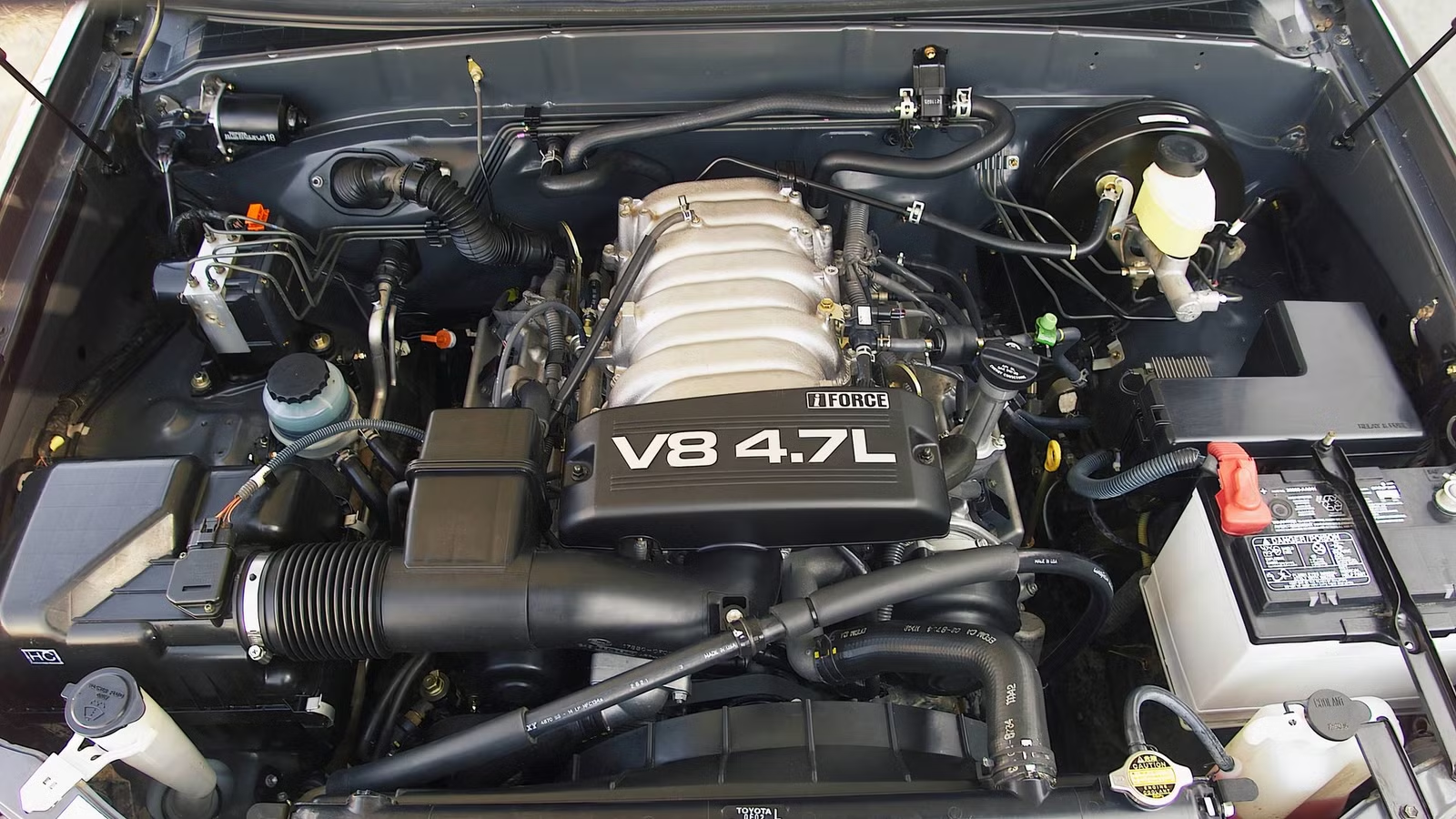
Some engines chase horsepower numbers. The 2UZ-FE chased none of that. Toyota’s 4.7-liter V8 spent thirteen years under the hoods of Land Cruisers, Tundras, and Lexus SUVs doing one thing exceptionally well: refusing to break. While rival V8s pursued output figures and turbocharged efficiency gains, this cast-iron workhorse settled into a reputation few engines ever earn: the one mechanics recommend to buyers who never want to think about their engine again. Here’s why it lasted, where it lived, and what was lost when Toyota finally let it go.
The 4.7-Liter V8 That Turned High Mileage Into A Selling Point

On the IH8MUD forums, where Land Cruiser owners compare notes on trucks most people would have scrapped decades ago, one entry stands out from the usual chatter. A 2000 Lexus LX 470 sitting at 469,000 miles, still running, still daily driven, still on its original 2UZ-FE. It’s not an isolated brag. The same thread is full of 100-Series trucks well past the 300,000-mile mark, treated less like miracles and more like the expected outcome of buying one of these.
Where 300,000 To 500,000 Miles Becomes The Biggest Selling Point

That’s the real story of the 2UZ-FE. Production ran from 1998 to 2011, split between plants in Tahara, Japan, and Alabama, USA, and the engine quietly became shorthand for a specific kind of durability, not flashy, not powerful by modern standards, but engineered to keep running long after the vehicle around it should have been retired.
Owners of Land Cruisers and Lexus LX models built around this V8 routinely report 300,000 to 500,000 miles of heavy use with nothing more than routine oil changes and timing belt replacements. In an era chasing turbocharged efficiency, that’s the kind of longevity that turns into a used-market selling point rather than a footnote.

Naturally Aspirated Simplicity Is The 2UZ-FE’s Secret Weapon

The 2UZ-FE’s durability wasn’t an accident; it was a design philosophy. Toyota built it as a 4.7-liter, 90-degree V8 with a cast-iron block, a material choice its siblings in the UZ family skipped. The 1UZ-FE and 3UZ-FE both used aluminum blocks for weight savings; the 2UZ-FE traded that lightness for bore stability under sustained towing loads, the kind of abuse Land Cruisers and Tundras were built to absorb.
Early versions kept things deliberately simple: a conventional throttle body before Toyota’s electronic throttle control arrived in late 2002, and no variable valve timing until the VVT-i update landed partway through the engine’s run. That update, introduced around 2005, bumped output into the 271-282 horsepower range with 315-325 pound-feet of torque, but it never abandoned the engine’s low-compression, low-stress tuning philosophy. Every version relied on Toyota’s Direct Ignition System, with individual coils on all eight cylinders and iridium spark plugs backed by dual knock sensors, technology aimed at protecting the engine from itself rather than extracting every last horsepower.
The Trade-Off Was Maintenance

A timing belt, not a chain, needing replacement roughly every 90,000 to 100,000 miles, and an interference design that punishes anyone who skips it. But that’s a scheduled cost, not a random failure. Toyota nailed the engineering fundamentals — but did those design choices actually hold up across hundreds of thousands of real-world miles, in the hands of owners who weren’t always diligent? The answer lives in the forum threads.
The Toyota Trucks And SUVs That Built The 2UZ’s Reputation

The 2UZ-FE’s reputation was built across a specific lineup, and knowing which years carried it matters for anyone shopping the used market. It debuted in 1998 in the Land Cruiser 100-Series and the first-generation Lexus LX 470, running through the 2007 model year before Toyota moved that flagship SUV to the 200-Series and its new 5.7-liter V8.
The first-generation Tundra carried the 2UZ-FE from 2000 through the mid-2000s, while the Sequoia, essentially a Tundra-based SUV, used it from its 2001 launch onward. The fourth-generation 4Runner picked it up as an optional V8 starting in 2003, and Lexus fitted the same engine to the GX 470 that same year.

Toyota kept refining the applications rather than the core architecture, and by the mid-2000s the VVT-i version had spread across most of these nameplates. The engine’s final chapter closed out around 2011 in its last North American applications, with a handful of Hong Kong-market vehicles reportedly carrying it into 2012. That’s a 13-plus year production run without a fundamental redesign, vanishingly rare in an industry where engines get reworked every few years to chase efficiency mandates.
What 400,000 Miles Reveals About The Engine’s Real-World Durability

Four hundred thousand miles isn’t a marketing claim with the 2UZ-FE, it’s a documented pattern across forums, fleet records, and independent mechanics who’ve serviced these trucks for two decades. What’s notable isn’t just that individual examples survive that long; it’s how unremarkable the survival has become among owners who expect it.
Stack that against the competition and the picture sharpens. Heavy-duty diesels like the Cummins 5.9L and early Duramax units have their own legendary reputations for six-figure-plus mileage, but they get there through displacement, low-rev torque, and mechanical simplicity purpose-built for towing, not dissimilar in spirit to what Toyota did here, just with different fuel and far higher upfront costs. Modern turbocharged V6s, by contrast, generally can’t make the same claim yet. They’re newer, so long-term data is thinner, but turbocharging adds heat cycling, boost-related wear, and more failure points than a low-compression, naturally aspirated V8 that was never pushed hard from the factory.
Why That Reliability Halo Directly Shapes What These Trucks Cost Today

A 2UZ-powered Land Cruiser 100-Series with 150,000-plus miles and clean service records commands a premium well above what its mileage alone would suggest. Dealers and private sellers both know buyers are paying for the drivetrain, not the interior trim. Tundras and Sequoias from the same era see a similar, if slightly smaller, bump. The math only works if the engine’s reputation holds up under inspection, and by every documented account, it does.
Why Toyota Replaced The 2UZ-FE And What Used Buyers Lost

Toyota didn’t retire the 2UZ-FE because it failed; it retired it because the market wanted more. The 3UR-FE 5.7-liter V8 that replaced it uses an aluminum cylinder block instead of iron, shedding weight while adding displacement, and it swapped the 2UZ’s timing belt for a timing chain, eliminating that one scheduled maintenance risk entirely. On paper, that’s a straightforward upgrade.
But the swap came with real costs. The 3UR-FE is a heavier, more complex engine to manufacture and service, built around modern emissions and output targets rather than the 2UZ’s conservative, low-stress tuning.

The 5.7-liter’s biggest drawback has been fuel efficiency, and its extra displacement and power come with the maintenance overhead of a more modern engine: more sensors, tighter tolerances, less forgiveness for deferred service. It’s a genuinely capable engine with a strong reliability record of its own, but it doesn’t carry the same reputation for shrugging off neglect that the 2UZ-FE built over 13 years.
What used buyers lost, in other words, wasn’t outright reliability, it was margin for error. The 2UZ-FE earned its legend partly because it tolerated imperfect ownership and still kept running. That’s the real takeaway for anyone shopping this era of Toyota truck. If you find a 2UZ-powered Land Cruiser, Tundra, Sequoia, or GX 470 with documented timing belt service and no major red flags, you’re not just buying an old SUV. You’re buying into one of the most forgiving, over-engineered V8s Toyota ever built, and a used-market price tag that increasingly reflects it.
Sources: Toyota, Lexus, RepairPal, IH8MUD

Related posts

Latest Post



No Comments