The Hybrid SUV That Makes Expensive EVs Look Like A Compromise
7 minutes reading
Wednesday, 16 Sep 2026 01:01 0 6 autotech
Electric cars weren’t always popular. Tesla is really the brand that popularized them. There are a lot of benefits to having an electric vehicle. While most of them output the same carbon footprint as gas-powered ones do in production, electric vehicles end up making zero emissions once they leave the plant. This is also dependent on what kind of electricity source you are getting your energy from, but by and large, it’s a cleaner way to drive from A to B. Not to mention, there is instantaneous torque and a lot of power to be had.
It’s not all perfect, though, and a lot of people still don’t want to touch electric vehicles with a 10-foot pole. There are also no more tax incentives in order to purchase these, so the market itself has cooled off a bit. Hybrids offer great gas mileage, but lack the power a full electric motor can offer. The middle ground is a plug-in hybrid electric vehicle with a small engine and a small electric motor that, combined, usually delivers incredible power and fuel efficiency.
Front action shot of 2026 Tesla Model Y driving on roadTesla
Gas-powered vehicles are great for highway driving. Stop-and-go situations aren’t the best for them because they constantly have to rev the engine at a higher rate, causing more fuel consumption. Electric vehicles, on the other hand, were made for inner-city and traffic-heavy situations. You can regenerate power instantaneously and barely use any of it in stop-and-go situations. Unfortunately, long-range travel in electric vehicles is difficult, especially in the continental United States. The infrastructure just isn’t there for this kind of driving, as battery depletion is much greater at highway speeds for extended periods of time.
Electric Range Double-Edged Sword
An image of a 2026 Hyundai Ioniq 5 in motionHyundai
Driving electric vehicles in the city employs regenerative braking and instantaneous energy recovery, giving these vehicles 110 to 120 MPGE in the city. Mathematically, it recovers between 20 and 30% kinetic energy back to the lithium-ion battery. That’s not all that affects the battery either. Climate conditions can also negatively impact its strength. That’s why all electric vehicles employ the use of battery conditioning so that you can get the best range out of your electric vehicle. Therefore, you should always be wary of what manufacturers market as their vehicles’ top range, as it is usually measured under the best possible conditions.
Gas Anxiety
2025 Mercedes-AMG GLC63 S E PerformanceLyndon Conrad Bell – Photo
For the longest time, there was a smorgasbord of electric vehicle ports and chargers. There was the CHAdeMO, the J-1772, and the level three CCS1 that incorporated the J-1772. Tesla had their own charger port called NACS. Thankfully, the NACS is now the standard and all fully electric vehicles come with it after the 2025 model year. It’s also just inconvenient to fill up an electric vehicle. Not everybody has a level two charger at their house, and with the charger-to-electric-vehicle ratio at 30:1, public chargers are often incredibly busy and will take between 20 and 45 minutes to charge from 10 to 80%, depending. If you don’t have a level two charger, it takes days to charge fully.
The Toyota RAV4 PHEV Offers The Best Of Both Worlds
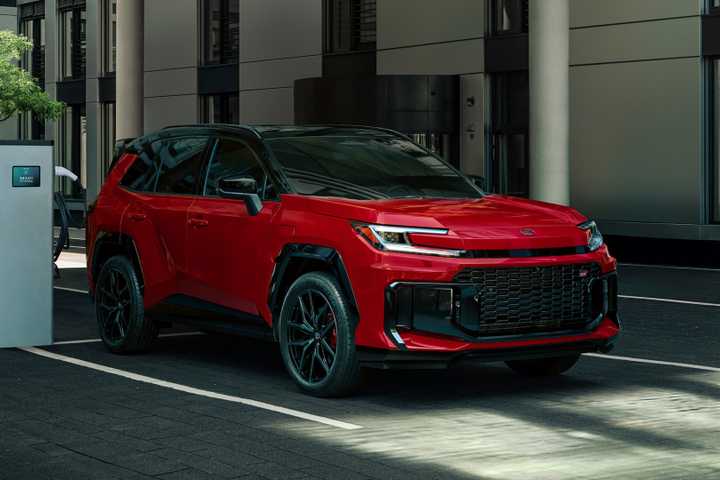
Front 3/4 shot of red 2026 Toyota RAV4 PHEV parked in parking lotToyota
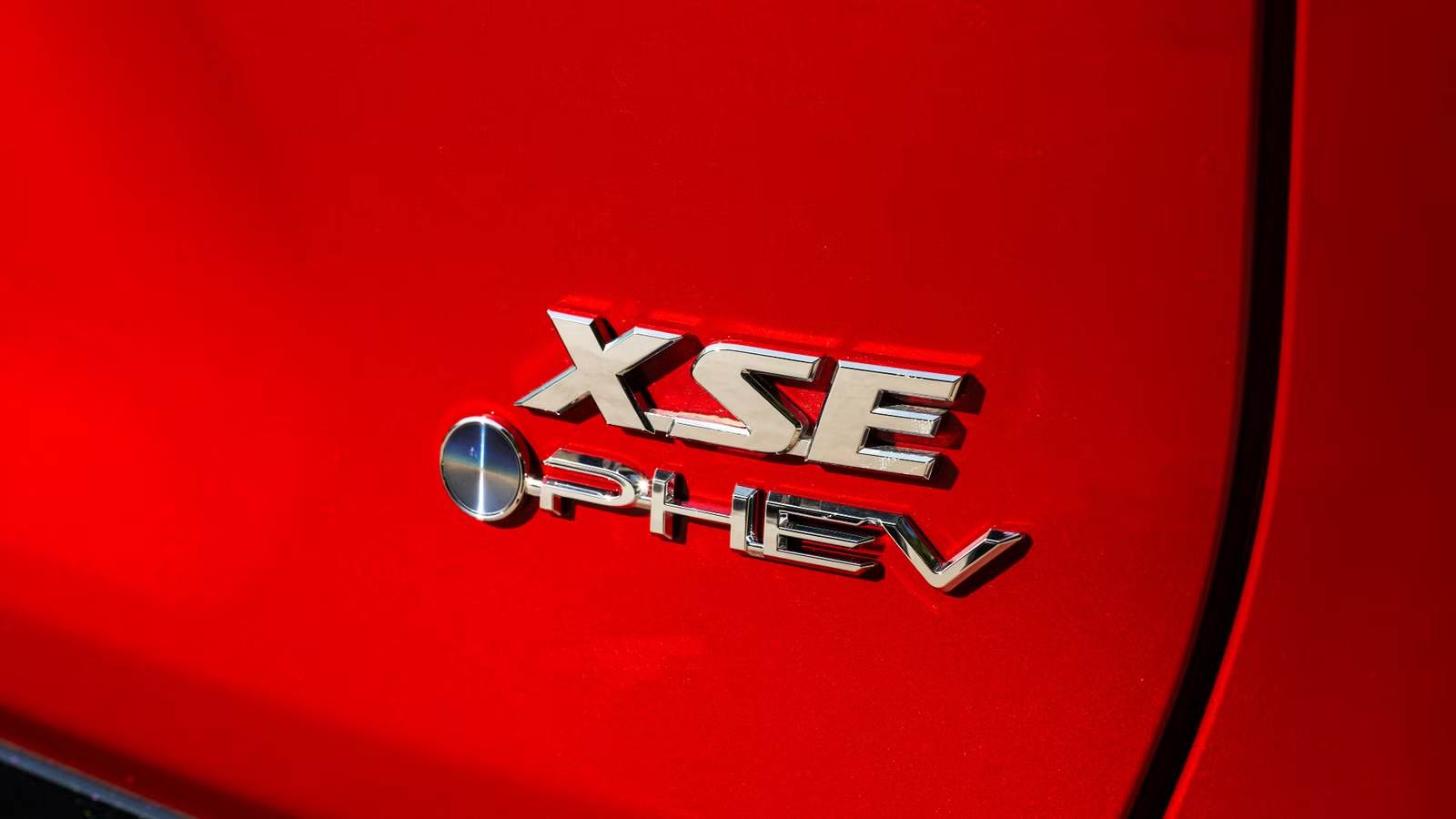
That’s where the Toyota RAV4 plug-in hybrid electric vehicle comes into play. The Toyota RAV4 was redesigned in 2026. The hybrid powertrain was so popular that it’s the only powertrain available for this new generation. The new generation plug-in hybrid is so powerful, in fact, that they made a GR Sport trim. The previous generation had 302 hp to speak of, while this has 320 hp. It has an estimated total range of 600 to 630 miles, depending. Additionally, the RAV4 plug-ins have dropped the “prime” badge and instead now go for the PHEV badge. This is to fall in line with their new HEV logo so they can put the “P” in front of it and make it more seamless.
A PHEV Is The Middle Ground
A shot of three trims of the Toyota RAV4 PHEVToyota
Plug-in hybrid electric vehicles offer the best of both worlds, and the Toyota RAV4 is no different. This plug-in variant even has more of a range between 48 and 55 miles (trim dependent) compared to the Prius plug-in that has 39 to 45 miles on electricity alone (also trim dependent). Because of this partial electricity, when you run out of electric energy, the engine will kick on as a backup and, truthfully, there’s no real loss at all. It also only takes about 2.5 hours to charge on a level two home charger, or 12 hours on a 120V wall plug.
Power And Practicality
A shot of the Toyota RAV4 PHEV engine bayToyota
The previous generation Toyota RAV4 compromised a lot of space in the trunk because of the hybrid battery placement. This generation has a flat-mounted lithium-ion battery under the floorboards, giving the passengers full legroom and not compromising on cargo space with 33.5 cubic feet to speak of. It even has up to 3,500 pounds of towing capacity, which is pretty decent, especially for a compact SUV.
Double The Powertrain, Double The Performance
2026 Toyota RAV4 PHEV GR Sport rear 3/4 shot parkedToyota
It’s incredible that one of the quickest vehicles in Toyota’s lineup is a compact SUV and the Toyota RAV4 at that. The plug-in hybrid achieves a 0 to 60 mph time of just 5.2 seconds, which is sports car-level performance.
Pure Electric Commuting
Front 3/4 shot of 2026 Toyota RAV4 PHEV Woodland parked off-roadToyota
The EPA estimated electric range makes it easy for a daily commute on electricity alone. You would rarely have to go to the gas station. Plus, with the two electric motors, the Toyota RAV4 PHEV makes the all-wheel-drive system more robust and silent. You can get up to highway speed with a whisper and still be able to traverse the snow.
Hybrid Performance
Front 3/4 shot of Toyota RAV4 Plug-in Hybrid.Toyota
On the gas side of things, the Toyota RAV4’s PHEV is powered by a naturally aspirated 2.5 L inline four-cylinder engine that outputs a combined 320 horsepower. There’s also an eCVT that doesn’t elicit any sort of drag.
Ownership Costs
2026 Toyota RAV4 PHEV GR Sport front shotToyota
One of the other misconceptions that we forgot to mention at the beginning of this article is that charging at different charging stations isn’t always inexpensive. You can end up spending close to the same amount on a gas-powered vehicle as you would on an electric one. The biggest savings come from charging at home. If you charge overnight when the electricity is off-peak, you’re at the biggest advantage. Plus, if you charge a plug-in hybrid, you won’t need as much electricity.
Charging And Gas
A shot of the Toyota RAV4 PHEV’s infotainment systemToyota
In looking at the math, when you drive 15,000 miles per year, that would cost between $550 and $650 in electricity annually. A normal gas-powered vehicle averages between $1700 and $2000 if it gets 25 miles to the gallon. That is a massive savings, especially when off-peak residential charging is about $.16 per kilowatt-hour, depending on your area. And doing the math, that works out to around $3.60 for 52 miles of electric range. That’ll save you about $1100-$1400 annually in fuel costs.
Reliability And Maintenance
Rear three-quarter tracking shot of a Toyota RAV4 PHEVToyota
Another cost savings that isn’t talked about a ton is savings on brakes. Another big letdown with electric vehicles is the tires. You end up having to spend more on tires because the instantaneous torque ends up burning them a lot sooner than a gas-powered vehicle. A plug-in hybrid, on the other hand, doesn’t deliver nearly as aggressive torque as a full electric motor and won’t require tire or brake pad replacements as often. In fact, regenerative braking handles at least 80% of the deceleration forces. This helps extend your mechanical brakes well past 100,000 miles. This, coupled with Toyota’s 10-year, 150,000-mile hybrid battery warranty, should put your mind at ease when considering the 2026 Toyota RAV4 plug-in hybrid electric vehicle.












No Comments