
Pistons Cast From Gas Pipe Took Burt Munro’s Indian To 190.07 MPH One-Way
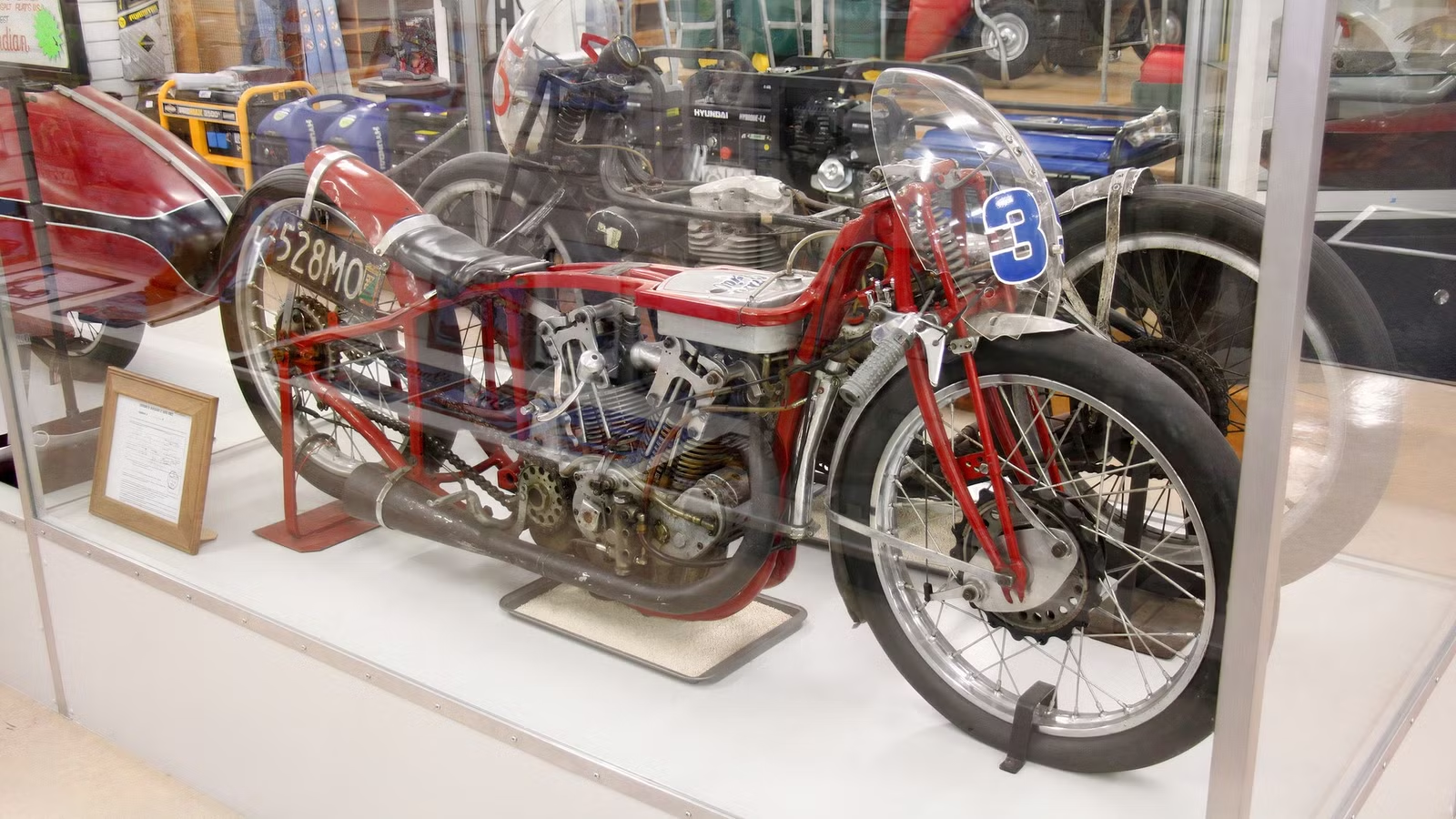
The record that made Burt Munro an enduring legend was shortened by 0.501 mph. Yet, for 36 years, a home-brewed motorcycle with pistons cast from discarded gas pipes and hand-carved connecting rods from a Ford truck axle still holds the class speed record on the Bonneville Salt Flats. Most mainstream pop culture paints Munro’s exploits as a feel-good underdog fairy tale. Beneath its cinematic charm, however, lies an incredible engineering masterclass in backyard metallurgy. Burt Munro’s land speed record onboard his backyard-built Indian motorcycle is permanent proof of just how precise, gruelling and fiercely earned that achievement was.
The Junkyard Alchemy Behind The 1920 Indian Scout Munro Special

When Burt Munro acquired his factory-stock Indian Scout in 1920, the motorcycle was a modest commuter capable of reaching a mere 50 to 55 miles per hour. Driven by relentless ambition and operating on a shoestring budget in Invercargill, New Zealand, Munro spent decades porting, boring, and fundamentally reinventing every component of the humble machine. He famously discarded the factory-limited components, hand-carving custom connecting rods out of discarded Ford truck axles to handle violent internal stresses. When he needed new pistons, he cast them himself using old cast-iron gas pipes, burying them underground to season the metal before machining them to tight tolerances in his shed.
This backyard alchemy transformed a gutless side-valve engine – originally putting out a dismal 18 horsepower – into an engineering monster pushing roughly 100 horsepower. Munro fabricated his own flywheels, designed custom barrel oil pumps, and hand-filed his own camshafts to convert the engine’s layout to overhead valves. While factory racing teams spent vast sums of money for exotic aerospace alloys and computer-aided design, Munro relied on a primitive lathe, an oxy-acetylene torch, and sheer mechanical grit. The resulting Munro Special was an erratic, vibrating marvel of improvised engineering that punched far above its weight class.
Munro Special: Navigating The Engine Displacement And 190.07 MPH Record Discrepancies


Pinpointing the exact specification of the Munro Special during its historic 1967 Bonneville run requires sifting through decades of conflicting historical documentation. Automotive historians and technical archives disagree on the final engine displacement, with reports varying between 950cc, 953cc, and figures rounded up to 1,000cc depending on the specific class criteria Munro targeted. Furthermore, while popular stories and global speed archives confirm his legendary one-way qualifying speed at a blistering 190.07 miles per hour – making it the fastest officially recorded speed achieved on an Indian motorcycle – that explosive run was never meant to stand as the official two-way average speed record.
The official record bookkeeping has faced its own historical correction. For decades, the American Motorcyclist Association officially logged Munro’s two-way average speed at 183.586 miles per hour. That administrative record changed permanently in 2014, thirty-six years after Munro’s passing, when his son John meticulously audited the original documentation. John Munro discovered a mathematical calculation error on the vintage certificate, prompting the AMA to officially correct the two-way average up to 184.087 miles per hour. It was a vindication of sorts and proof that Munro’s machine was even faster than the official record books originally acknowledged.
Why Burt Munro’s Sub-1,000cc Bonneville Class Record Remains Unbroken

Burt Munro’s historic land-speed record continues to cast a massive shadow over modern factory engineering teams visiting the Bonneville Salt Flats. Even as contemporary racing technology produces terrifyingly fast machines – such as Tyler O’Hara piloting a modern Indian Challenger RR to a staggering 194.384 miles per hour – that modern feat was accomplished within a vastly different 2,000cc displacement class.
The sheer longevity of Munro’s sub-1000cc benchmark highlights the incredible efficiency he extracted from an air-cooled V-twin designed at the tail end of World War I. While modern factory teams bring full diagnostic trailers, engineers, and telemetry readouts to the salt flats, Munro worked alone with a suitcase of spare parts and hand tools. To this day, no manufacturer or independent builder has managed to eclipse his certified two-way average speed in the same displacement category using a vintage-derived overhead-valve layout, proving that raw engineering ingenuity can withstand decades of technological progress.
What The Legendary Munro Special Leaves Behind In Land Speed History

The original 1920 Indian Scout Munro Special is currently housed at E.Hayes & Sons hardware store in Invercargill, New Zealand, featuring chassis and frame sections that stayed behind in America while Munro packed only the precious engine home in his luggage. While it’s easy to contrast the primitive welding on the Munro Special against the smooth finish of factory prototypes, you simply cannot discount the terrifying speed that home-brewed contraption achieved, or its permanent place in land-speed history.
Burt Munro’s legacy isn’t about speed certificates. It represents an incredible victory of human perseverance over technological limits. Pushing a makeshift, gas-pipe-piston motorcycle across blinding white salt flats at 190 mph remains the ultimate testament to what a single relentless mechanic can achieve in a shed at the edge of the world.

Related posts






Latest Post


No Comments