
American Supercar Concepts That Never Saw The Light Of Day Despite Massive Demand From Fans
American automakers have always captivated the motoring public with radical supercar concepts designed to showcase cutting-edge technology and bold design philosophies. These proposed halo vehicles generate immense public enthusiasm, dominating auto show floors, magazine covers, and enthusiast discussions.

Despite overwhelming demand from brand loyalists eager to purchase these operational performance powerhouses, the vast majority remain strictly experimental prototypes. Consequently, these impressive engineering marvels remain relegated to museum displays and historic automotive lore as tantalizing visions of unfulfilled performance potential.
1981 Dodge M4S
Designed by Dodge chief designer Bob Ackerman in collaboration with PPG Industries, the 1981 Dodge M4S (Mid-engine, 4-cylinder, Sport) was created as a high-performance technological demonstrator and PPG Indy Car pace car. The mid-engine drivetrain featured a 2.2-liter Chrysler inline-four engine block equipped with a 16-valve, dual-overhead-cam Cosworth cylinder head and twin Garrett T25 turbochargers.

Paired with a Liberty-modified five-speed manual transaxle, this powertrain produced 440 horsepower, driving the rear wheels to propel the coupe to a top speed of 194.8 MPH. Dodge never produced the M4S commercially because it was strictly intended as an experimental engineering showcase rather than a production vehicle. Mass manufacturing would have proven prohibitively expensive due to its specialized race-car chassis, bespoke Cosworth architecture, hand-built construction, and high projected retail price.
1985 Buick Wildcat Concept

Designed by Buick exterior designer David P. Rand under General Motors design vice president Irv Rybicki, the 1985 Buick Wildcat Concept was created as a high-tech experimental showcase to display advanced futuristic engineering and performance potential. Its mid-engine powertrain featured a naturally aspirated 3.8-liter V-6 modified by McLaren Engines, featuring dual overhead camshafts, 24 valves, and sequential-port fuel injection to generate 360 hp and 398 lb-ft of torque.
Power was routed through a modified four-speed automatic transmission to a permanent torque-splitting four-wheel-drive system. Buick never intended to commercialize the Wildcat because it was built purely as a functional rolling laboratory and auto show display piece. Its non-traditional construction, featuring a carbon-fiber and fiberglass body, a forward-tilting glass canopy with no doors, a stationary steering wheel hub, and complex electronics, was far too expensive, radical, and unfeasible for serial automotive manufacturing.
1986 Chevrolet Corvette Indy


Designed by GM director of design Tom Peters under design chief Chuck Jordan, the 1986 Chevrolet Corvette Indy was created as an ultra-high-performance concept car to preview future sports car technology. Its mid-engine chassis housed a twin-turbocharged 2.6-liter Lotus-designed double-overhead-cam V-8 engine based on the Ilmor-Chevrolet Indy Racing powerplant, producing 600 hp.
Power was transferred to the pavement via a permanent four-wheel-drive system paired with three-mode electronic four-wheel steering and an active hydro-pneumatic suspension system. Chevrolet never brought the Corvette Indy to commercial production because its exorbitant development costs, race-derived V-8 architecture, full carbon-fiber and Kevlar monocoque construction, and complex electronic drive systems were commercially unviable for assembly line manufacturing.
1988 Pontiac Banshee IV


Designed by GM designer Rick Ceppos under Pontiac design chief Ned Nickles and GM design vice president Chuck Jordan, the 1988 Pontiac Banshee IV was created as an aerodynamic technological prototype to signal the future design direction of American muscle cars.
Its front-engine, rear-wheel-drive platform featured an all-aluminum 4.0-liter fuel-injected SOHC V-8 engine that delivered 230 hp through a five-speed manual transmission. Buick and Pontiac engineers incorporated advanced features, including a fiberglass body with a 0.23 drag coefficient, flush glass, head-up dashboard displays, and electronic climate controls integrated into the steering wheel.
1995 Ford GT90


Designed by Ford designer James Hope under the direction of global design vice president Jack Telnack, the 1995 Ford GT90 was created as a modern spiritual successor to the legendary GT40 while serving as the inaugural showcase for Ford’s “New Edge” design language. Its mid-engine drivetrain featured a 5.9-liter quad-turbocharged DOHC 48-valve V-12 engine, producing 720 hp and 660 lb-ft of torque.
A five-speed FFD-Ricardo manual transaxle borrowed from the Jaguar XJ220 drives the rear wheels. The aluminum-and-carbon-fiber prototype achieved a theoretical top speed of 253 MPH. Ford never built the GT90 for commercial sale because it was conceived as a rapid six-month technology demonstrator rather than a production-ready model.
1996 Ford Indigo


Designed by Ford exterior designer Claude Lobo under the direction of design vice president Jack Telnack, the 1996 Ford Indigo was created as an open-wheel concept car to showcase Ford’s IndyCar racing technology and advanced structural engineering. Its mid-engine drivetrain featured a naturally aspirated 6.0-liter 48-valve DOHC V-12 engine, generating 435 hp and 405 lb-ft of torque.
Power was sent to the rear wheels through an Indy Racing League-derived six-speed longitudinal manual transmission with a pneumatic paddle-shift system. Its minimalist, open-wheel track design lacked essential road-legal components like full fenders and doors, while its carbon-fiber and aluminum-honeycomb monocoque structure made mass manufacturing financially unviable.
2002 Cadillac Cien


Designed by Simon Cox at General Motors’ Advanced Design Studio in England under the direction of GM design vice president Wayne Cherry, the 2002 Cadillac Cien was created as a high-performance concept car to celebrate Cadillac’s 100th anniversary and showcase its “Art and Science” design philosophy. Its mid-engine drivetrain featured a naturally aspirated 7.5-liter 60-degree all-aluminum Northstar XV12 engine equipped with direct injection and Displacement on Demand variable cylinder deactivation, generating 750 hp and 450 lb-ft of torque.
Power was routed to the rear wheels via a paddle-shifted six-speed semi-automatic transaxle. GM decided against serial production of the Cien because the high development and manufacturing costs of its carbon-fiber composite monocoque chassis, custom V-12 powertrain, and active aerodynamics made a low-volume supercar commercially unviable.
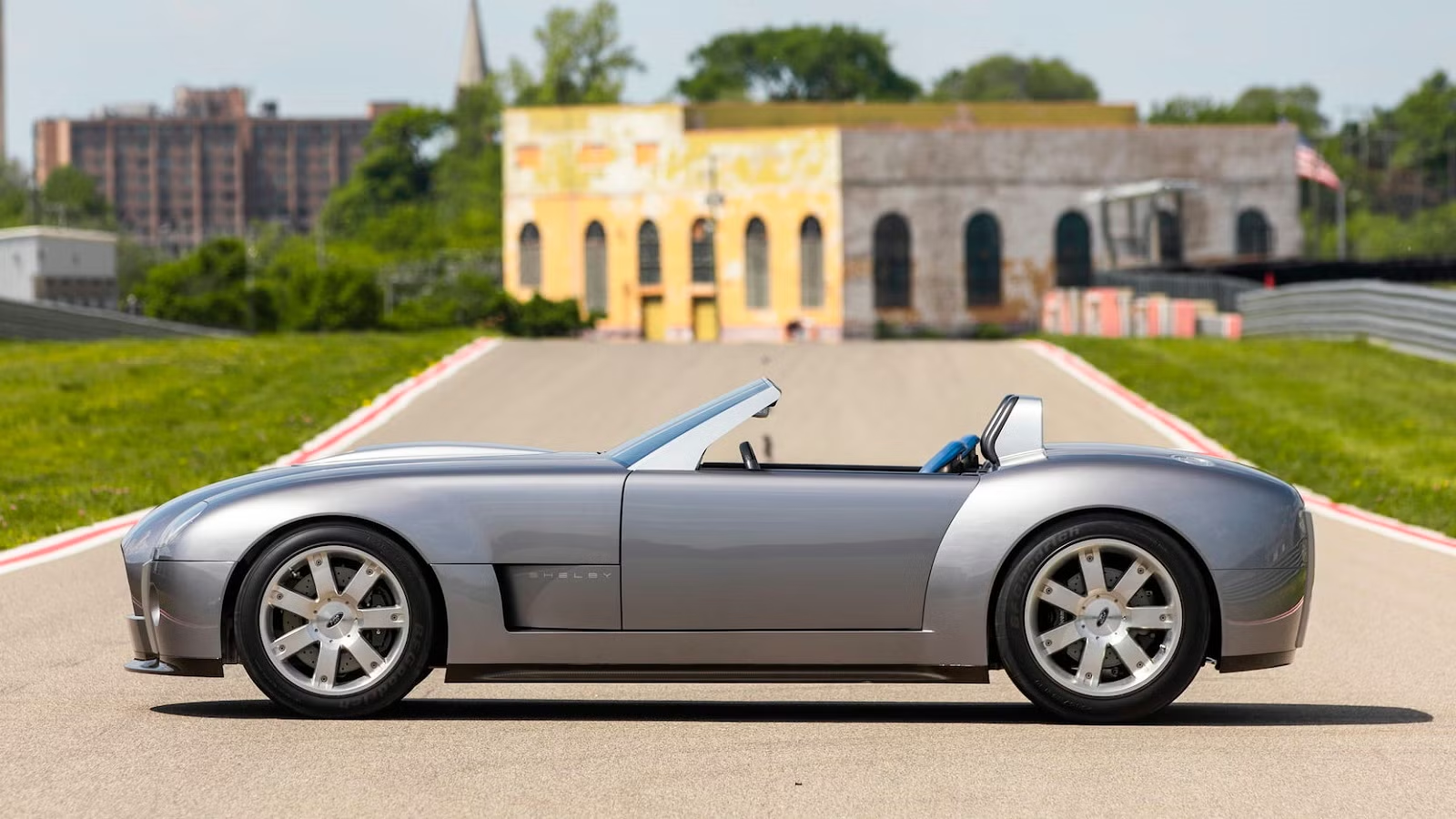
2004 Ford Shelby Cobra Concept


Designed by Ford Advanced Design studio chief Camilo Pardo under the direction of group vice president of design J Mays and with input from Carroll Shelby, the 2004 Ford Shelby Cobra Concept (codenamed “Daisy”) was created as a modern interpretation of the iconic 1960s AC Cobra. Its front-mid-engine drivetrain featured an all-aluminum, naturally aspirated 6.4-liter DOHC 32-valve V-10 engine that produced 605 hp and 501 lb-ft of torque.
Power was routed to the rear wheels through a rear-mounted Ricardo six-speed manual transaxle adapted from the Ford GT development program. Ford never produced the Cobra Concept for retail sale because the company faced severe financial pressures in the mid-2000s, leading executives to prioritize cost-cutting and high-volume product lines. Additionally, the open-top roadster lacked functional side windows, a convertible top, or standard safety structures, requiring extensive redesign costs that made a limited-run production model financially unfeasible.
2004 Chrysler ME FourTwelve


Designed by Chrysler exterior designer Brian Nielander under the direction of Chrysler Group design senior vice president Trevor Creed, the 2004 Chrysler ME Four-Twelve was developed as an ultra-high-performance supercar engineering demonstrator. Its mid-engine powertrain featured a quad-turbocharged 6.0-liter all-aluminum AMG V-12 engine that generated 850 hp and 850 lb-ft of torque.
Power was delivered to the rear wheels through a Ricardo-developed seven-speed dual-clutch semi-automatic transmission, propelling the composite prototype to a projected top speed of 248 MPH. Chrysler never moved the ME Four-Twelve into serial production because parent company DaimlerChrysler faced intense internal friction and budget constraints. Chrysler leadership could not establish a profitable business case for its high-cost carbon-fiber honeycomb monocoque construction.
2017 Tesla Roadster


Designed by Tesla chief designer Franz von Holzhausen under chief executive officer Elon Musk, the 2017 Tesla Roadster concept was unveiled as an all-electric halo supercar to showcase the performance potential of battery-electric vehicles. Its trimotor all-wheel-drive powertrain paired one front electric motor with two rear electric motors, drawing energy from a massive 200 kWh lithium-ion battery pack.
The 2+2 glass-roofed coupe targeted a 0 to 60 MPH acceleration time of 1.9 seconds, a top speed exceeding 250 MPH, and an electric driving range of 620 miles. Tesla never produced the original 2017 concept for commercial sale because repeated engineering delays, battery supply constraints, and shifting corporate priorities pushed production back continuously. Tesla eventually abandoned the 2017 design entirely, replacing it with a heavily re-engineered geometric concept.

Related posts


Latest Post


No Comments