
The Forgotten Suzuki Thumper That Took On BMW at Dakar
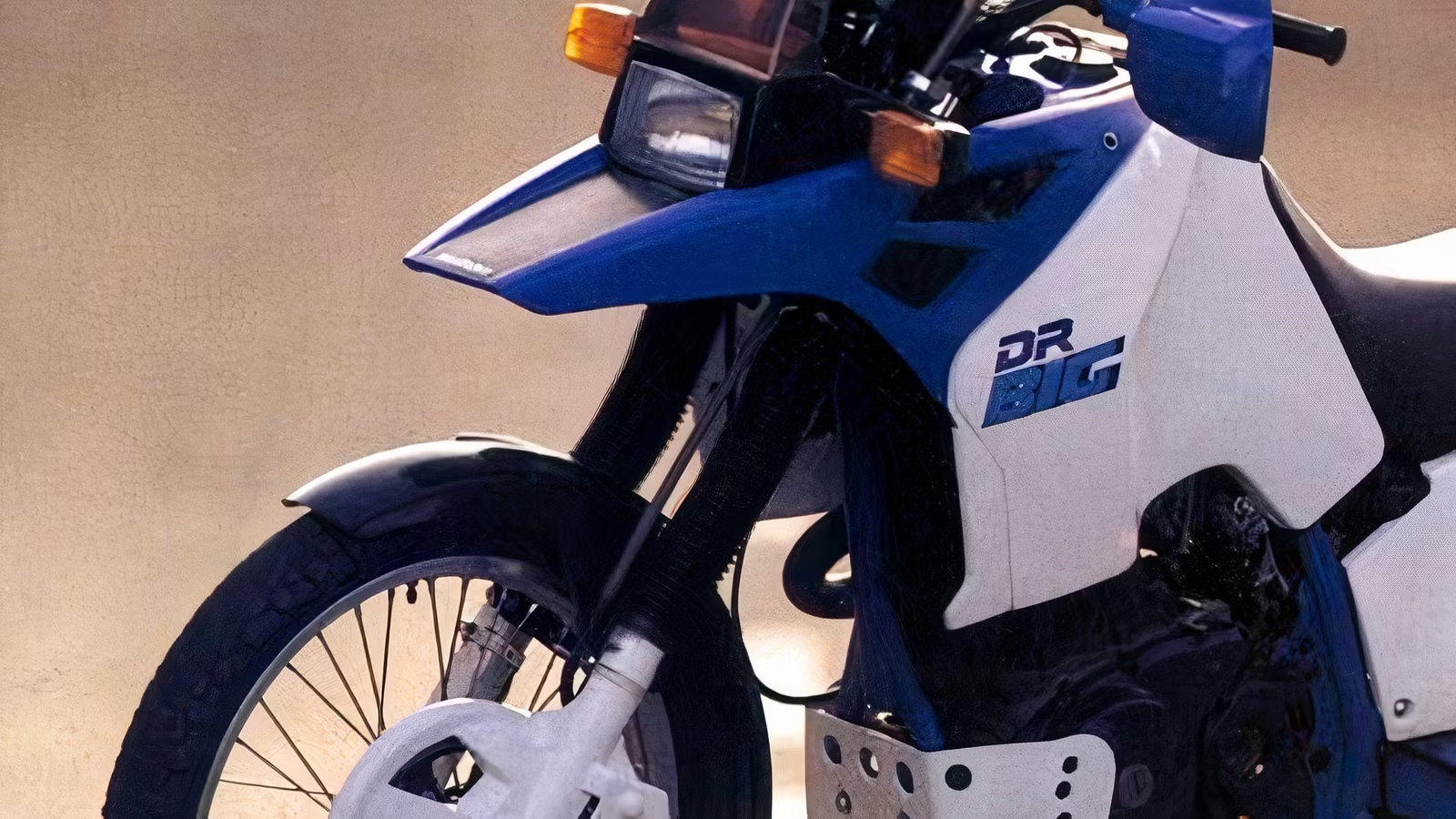
One cylinder or two, now THAT is the question. At least, if the subject is early ‘80s Paris-Dakar rally racing bikes you could buy at the dealership. The choice between one cylinder or two wasn’t some throwaway choice back then. Instead, it was the difference between two philosophies originating from very different parts of the world. As it turned out, the answer to this question would be found exactly where you’d expect it to. That being, out there in the sand, the heat, and the crushing crucible of the biggest off-road race in the world.
Two Warring Philosophies, One in Germany and One in Japan

For a medium that’s just your basic adventure bike at the end of the day, the debate between team single cylinder and team twin is way deeper than you might think. One side originates in Germany, where the ubiquitous BMW Motorrad championed the multi-cylinder end of the spectrum via their in-house developed line of air-cooled boxer twin motors. Peppy and rev-happy, these motors found their way into icons of the dunes, such as the timeless R80G/S. Complete with a hilariously overbuilt chassis sporting a single-sided Monolever rear swingarm and a shrouded driveshaft, these rigs blitzed the Paris to Dakar race.
With icons like Gaston Rahier and Hubert Auriol behind the handle bars, BMW secured four victories in its class in five years between 1981 and 1986. In that time, Bimmer proved definitively that the complexity of a twin engine wasn’t enough of a detriment to cost them races. Other manufacturers, most notably Honda, mirrored this sentiment with their own-air cooled two-cylinder bike engines, a V-twin in that instance. Still, the general consensus was that twin motors were a quintessentially German-coded paradigm, one that seemed superior to single-pots on paper.
Then again, paper is paper, and reality is something far different. Just ask the R&D team at Suzuki in the early-to-mid-’80s. At that time, Suzuki was fresh off what could arguably be called its golden era of sanctioned racing. The firm managed to win seven consecutive 500cc Grand Prix World Championships on the road racing side of things. In 1985, Suzuki began selling the GSX-R750, an aluminum frame beast derived directly from racing that blurred the line between a sport bike and a superbike. Suffice it to say, Suzuki was every bit the equal to BMW in Germany, and they were about to challenge the two-cylinder aristocracy with something altogether different. When they did, they shook the industry to its core, because of course they did.

Single Cylinder Thumper? Yes, Toe-To-Toe With the Twins

As a factory backed team in the top tier of the sport, Suzuki was fairly new to the realm of Dakar racing in the 1980s. Previously, when the race was more of a bohemian amateur getaway than an OEM-backed Cold War on two wheels, people indeed rode Suzuki bikes with varying levels of success. Wild and eccentric privateers had raced into the Ténéré on field-modified DR500s and DR600s in the past, but nothing anywhere near on the same level as what BMW, and even native competition from Yamaha were capable of in those days.
Through most of the 1980s, it stayed that way for Suzuki. Only in 1988, after BMW had established itself as the team to beat in the class, did Suzuki throw the full weight of the OEM behind the Dakar operation. Their answer to BMW looked similar to the uninitiated, but underneath the two couldn’t be more different. Instead of adding cylinders, Suzuki opted to go in the opposite direction. One would think that two cylinders is always better than one, but Suzuki engineered around this problem by casting the largest single-cylinder motorcycle engine the world had ever seen.
In doing so, Suzuki cut back on mechanical clutter, cut back on the bike chassis’ footprint through soft, hot sand, and created a machine that operated much the same as a diesel tractor engine. I.e, big bore cylinders, lots of low-end torque, and a simplicity factor that made a real difference in the raging desert sand storms. In every way imaginable, what Suzuki came up with was the polar opposite of BMW or Honda. In many ways, it was flat out better at blitzing through the dunes without breaking.
The Suzuki DR750S & DR800S: Less Cylinders, More Durability

When Suzuki formally introduced the DR750S in 1988, and then the updated DR800S in 1990, they effectively flipped two big fat birds to the established Dakar racing aristocracy. The DR750S’s 727cc air/oil-cooled thumper was powered by two beefy carburetors, and made an iconic and distinct rumble as it blitzed along the sand right alongside two-cylinder bikes. As if to add insult to injury Suzuki even poach-hired BMW’s hot shot rider Gaston Rahier to race at Dakar.
It was proof that Suzuki’s single-cylinder concept was tempting enough to attract legit stars of the sport, what resulted when Rahier took to the handle bars shouldn’t come as a surprise. With around 65 horsepower to work with in the heat, Rahier’s factory 820cc DR-Zeta prototype was down about 15 horsepower over twin-cylinder bikes. Even so, his single-cylinder thumper weighed as much as 60 lbs less than bikes with two cylinders. Combined with a healthy fuel tank of 7.7 gallons of 29 liters, pit stops for fuel were bound to be few and far between.What Rahier lacked in flat-out top speed, he clawed back, slow and methodically, in flat-out endurance and excellent agility over complex dune sections. In the end, the bike’s first Dakar race in 1988 resulted in a ninth place finish.

For a completely untested and unknown concept vehicle, that’s pretty remarkable. Better still, the bike won the 1988 Rallye des Pharaons, a separate and less prestigious race, but a win it still was nevertheless. The journey of this remarkable bike continued with the arrival of the DR800S in 1990. Now sporting a 779cc and a chunky 105 mm bore, the engine now resembled a downsized Cummins diesel engine rather than an adventure bike motor. Its new power figure of 54 horsepower and 44 lb-ft of low-end torque certainly gave that impression. Out at Dakar, the DR800S placed 13th, racking up stage wins along the way. For Suzuki, the DR750S and DR800S didn’t net instant racing glory, but it did pay dividends at the dealership.
Compete on Sunday, Sell on Monday

Even without a podium finish at Dakar, Suzuki’s two single cylinder bikes had enough charm and appeal to sell at dealerships across the world. With respective MSRPs of under £4,000 in the UK or just over $7,000 in American money, these single-cylinder Suzuki bikes were considerably cheaper than the equivalent BMW. In the same way a Suzuki Kizashi is considerably cheaper than a BMW 3 series, the difference in price really was staggering.
It really is a pity they were never properly sold in the United States, though a few have managed to trickle in stateside. Still, with no sales data to go off of, it’s hard to say what a bike like that would be worth on the open market. If you ask us, a genuine example with a classic Marlboro livery should be a $10,000 bike all day long. Sadly, it’s a privilege reserved almost entirely for the European market, the one it helped to disrupt in a very meaningful way.
Source: Global Suzuki

Related posts

Latest Post


No Comments