
A Burly V8 Cruiser Motorcycle That Can Make Harley-Davidsons Seem Vanilla
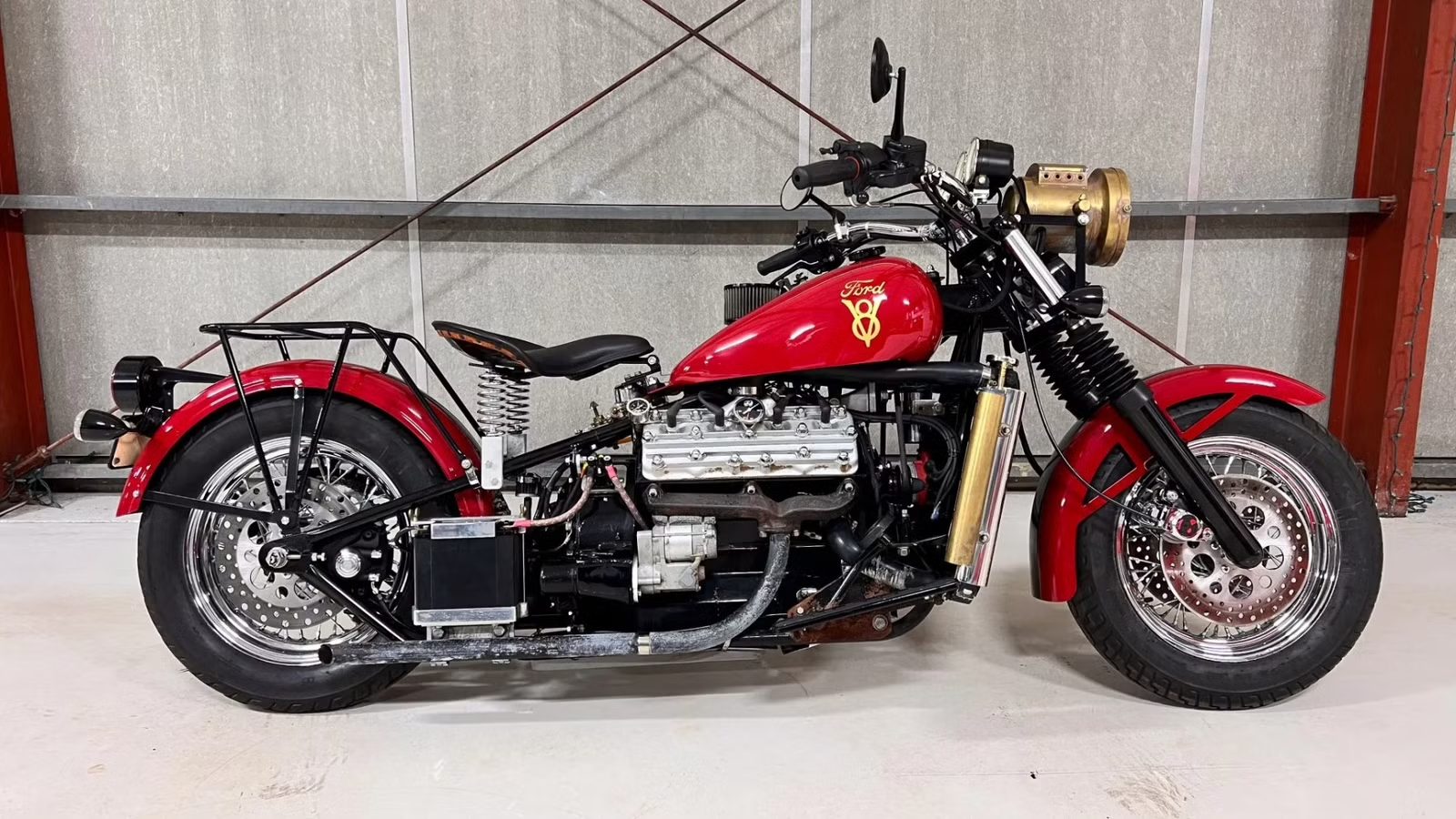
Cruiser motorcycles have always occupied a special place in the American imagination — low slung, laid-back, and built for the long haul. Yet even within that storied tradition, every so often a machine appears that makes everything else look ordinary. The Olson Flathead V8 is exactly that kind of machine: a hand-built American cruiser that drops a Ford flathead V8 between its frame rails and dares you to call it excessive. Harley-Davidson and Indian Motorcycles fans, prepare to be jealous.
The Olson V8 Flathead Motorcycle Features A 2,228cc, Eight-Cylinder Powerhouse
An Engine Built By Ford Between 1937-1940

From an inline-four and inline-triple to V4 and V-twin, we’ve seen bikemakers plonk all kinds of engines into cruisers. Heck, Honda even produced the six-cylinder Valkyrie in the early 2000s. But the cruiser in context here charts an entirely different path. It employs a liquid-cooled, eight-cylinder (V8) engine that displaces 2,228 cubic centimeters (136ci).
As mentioned above, the engine comes straight from Ford. It then underwent a thorough rebuild to meet motorcycle dimensions and fitment requirements, among other changes. For instance, you can spot four cylinders on each side, which converge into two custom four-into-one side-mounted exhausts. Olson also throws in an electric fuel pump, plus a Holley 94 carburetor for feeding the fuel. The output sits at a modest 60 horsepower, paired with a torque figure of over 100 pound-feet.
Interestingly, there’s no one-down-five-up transmission — instead, it uses a single-speed chain system. So just let the clutch out, and you’ll instantly have all the power at your disposal. Top speed is said to exceed 100 miles per hour. Yes, the output is considerably lower than your typical H-D offering, but this is anything but a typical product.

Aside from the exclusivity, the flathead V8 is one of the most significant engines in the history of American automobiles. It was the first mass-produced mill of its kind and powered the first affordable V8 car in America: the 1932 Ford. Such engines still enjoy a devoted cult following today.
|
Engine |
2,228cc, eight-cylinder, liquid-cooled |
|
Power |
60 horsepower |
|
Torque |
Over 100 pound-feet |
|
Transmission |
Single-speed |
|
Top speed |
>100 miles per hour |
There Are Plenty Of Custom Parts On The Olsen V8 Flathead
Making It A One-Off Two-Wheeler

Like the engine, the cruiser has plenty of standout details elsewhere. It’s built around a hand-made, fully custom hardtail chassis carved from tubular steel, topped by telescopic forks and a set of 16-inch spoke wheels. The latter are shod with chunky tires and wear dual disc brakes up front.
To enjoy these, you sit aboard a single saddle suspended on dual springs, with no room for a passenger between you and your cruiser. Once aboard, your feet rest on front-set floorboards while your hands settle onto an uber-wide tubular handlebar. A four-pod instrument cluster — displaying oil pressure, speed, tachometer, and odometer readouts — serves as the centerpiece of the cockpit. The gauges are all sourced from AutoMeter, while the switchgear comes straight from Harley-Davidson cruisers.
The Olson Flathead V8 Motorcycle Has A Simple Yet Charming Design
In typical American cruiser fashion, the Flathead appears muscular, long, low, and old-school. The retro character comes courtesy of round lights (tail lamp, headlight, and turn signals), spoke wheels, chrome springs, and chrome cylinder heads. A closer look reveals a distinct split-fuel tank — likely a first for an American cruiser. The split design exists to make room for the intake manifold, carburetor, and air cleaner. It might seem unusual from the saddle, but it gives the motorcycle a striking presence when standing still. Olson can also help you personalize the bike; the brass finish on the headlight and radiator shown here are both non-standard inclusions.
The Origin Of The Olson’s V8 Flathead Motorcycle Company
Headed By A Flathead Cruiser Expert

Next, allow us to give you a lowdown about the company. It’s spearheaded by Dave Olson, a resident of Maple Park, Illinois. He’s a customization expert who has built all kinds of motorcycles since the 1960s and Ford-powered flathead cruisers for over 20 years. Sadly, there’s no current news about whether the company is still operating. What is known is that only a handful of these machines exist worldwide. Whoever has one keeps it as a prized possession — which is why you’ll rarely find one with a ‘for sale’ tag. And if you do, be prepared to pay a significant premium for a clean used example.
The Olson Flathead V8 Isn’t The Only V8 Cruiser
It Competes With An Eight-Cylinder American-Made Cruiser

Lastly, we look at other motorcycles powered by a V8 engine. Kicking things off is the first V8 bike ever built by Glenn Curtiss, who brought the Curtiss V8 to life at the start of the 20th century. It had a V8 engine that he designed himself, although it resembled a bicycle frame more than a motorbike. There have been a few notable names since, such as the Norton Nemesis, Aurora Hellfire OZ26, and Larazeth LM 847, but none of them are based on a cruiser platform — except one.
Olson Flathead V8 vs. Boss Hoss Classic Cruiser
|
Olson Flathead V8 |
Boss Hoss Classic Cruiser |
|
|
Engine Capacity |
2,228cc |
6,200cc |
|
Power |
60 horsepower |
445 horsepower |
|
Torque |
Over 100 pound-feet |
445 pound-feet |
|
Transmission |
Single-speed |
2-speed semi-automatic with reverse |
The Boss Hoss Classic Cruiser is one such V8 motorcycle that remains available today. And it, too, comes from an American company. It runs a Chevy eight-cylinder engine and is offered in three variants: the GM LS 3, the 383 Stroker, and the 454 Small Block, with engine capacities of 6,200cc, 6,300cc, and 7,439cc respectively. Every trim generates staggering power, ranging from 445 horsepower and 445 pound-feet of torque in the smallest engine to 563 horsepower and 545 pound-feet of torque in the largest.
This output dwarfs what the Olson Flathead V8 is capable of — though it’s hardly a fair comparison, given that the Ford V8 in the Olson was only produced from 1937 to 1940. Nevertheless, it goes to show that if you’re in the market for a V8 cruiser, you won’t be left wanting. As for the appearance, the Boss Hoss features a traditional long-flowing cruiser look with plenty of chrome touches throughout. There’s even a claimed top speed of 221 MPH on paper.
Sources: Bring A Trailer, Silodrome, Boss Hoss

Related posts


Latest Post


No Comments