
Suzuki Samurai: How The Tiny 4×4 Became A Cult Icon
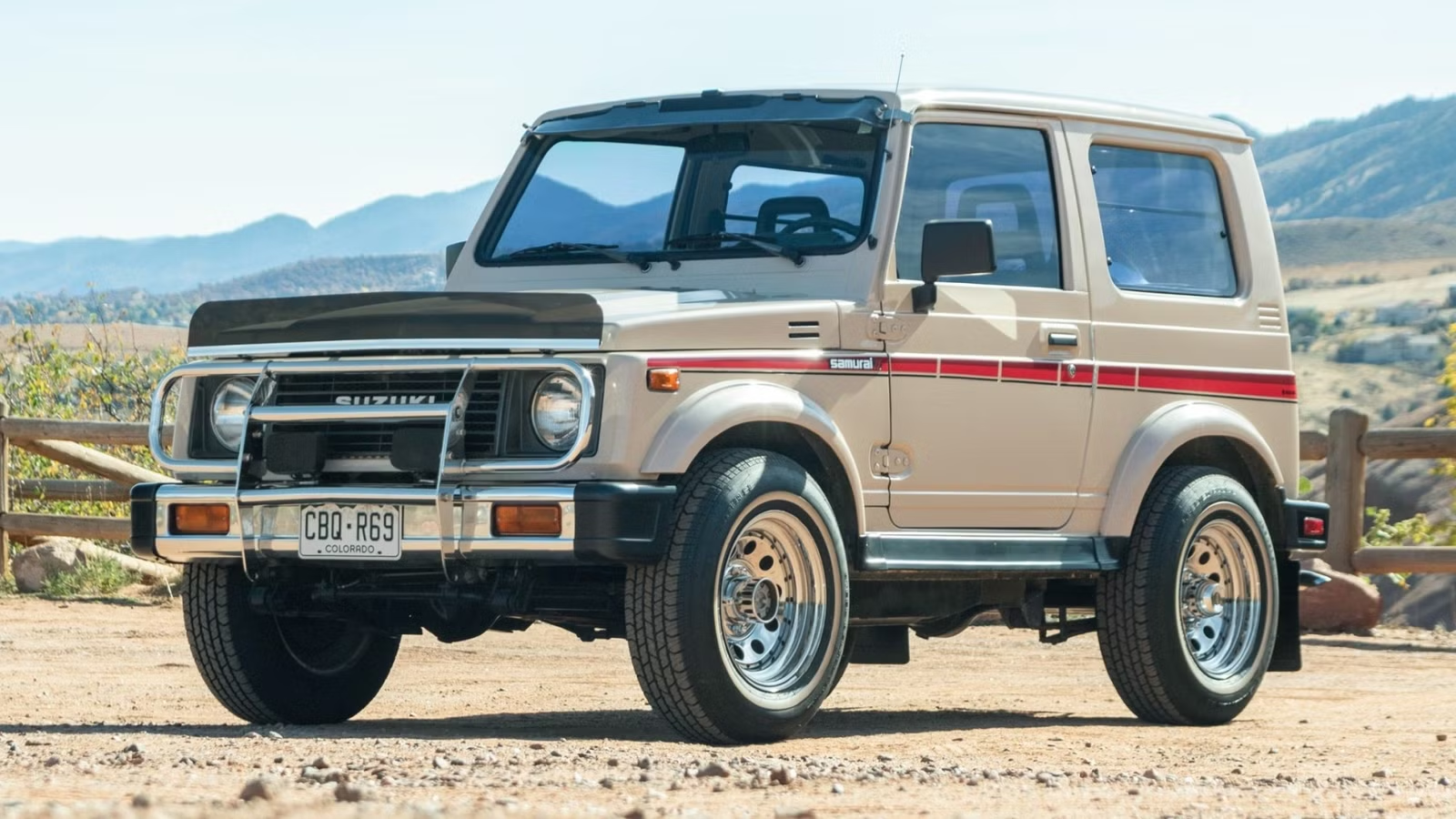
When it comes to off-roading SUVs, most fanatics would deem a 63-horsepower engine completely unusable. However, there’s a retro Japanese lightweight model that still proves its worth against some of the toughest overlanders currently on the market. The 1985 Suzuki Samurai is a Japanese subcompact SUV with small proportions that resemble a kei car. By modern standards, it’s lacking luxury features or advanced safety systems. Regardless, this icon remains one of the most enduring off-road machines ever built.

The Suzuki Samurai remains a legendary option for enthusiasts worldwide. It outlasted intense media scrutiny and economic shifts and created a massive community of dedicated owners. You can still see this compact 4×4 climbing steep trails where larger SUVs struggle. While it remains a niche model among classic car owners, the small community continues to swear by it, despite its historical safety controversies. It’s a low-powered and dependable recreational off-roader that has been embraced by the modding community, resulting in values that have steadily crept up in recent years.
The Genesis: Kei-Car Concept Meets Global Off-Road Ambition
Origins And Design Philosophy
Suzuki started building compact off-road vehicles long before the Samurai arrived in North America. The company specialized in the Japanese kei-car segment. This segment requires strict limits on exterior dimensions and engine displacement. Suzuki used this expertise to create the Jimny series.

Suzuki saw an opportunity to export a modified version of this platform to global markets. Designers developed a vehicle with simple mechanical components and lightweight materials. They prioritized extreme maneuverability and mechanical reliability.

Suzuki’s goal for the Samurai was to keep it mechanically simple and as reliable as possible, prioritizing low-cost durability over outright performance and innovation. The North American Suzuki Samurai specs feature a 1.3-liter four-cylinder engine, generating 63 horsepower and 76 pound-feet of torque. A five-speed manual transmission sends power to a part-time four-wheel-drive system.
The physical dimensions make the Samurai look like a soft and approachable lifestyle SUV, but this design actually gives you an incredible advantage on tight trails. The vehicle weighs just 2,059 pounds in its soft-top configuration. It has a 79.9-inch wheelbase. The total length measures 135 inches. You get a ground clearance of 8.1 inches from the factory. The approach angle measures 41 degrees, and the departure angle is 35 degrees. These numbers mean you can clear obstacles that modern pickup trucks with a higher center of gravity sometimes struggle with.

The Samurai achieved considerable success in Europe and Asia before its North American introduction. Buyers praised the low purchase price and the durable solid-axle suspension. Off-road clubs recognized the potential of the leaf-sprung chassis. Early enthusiast publications noted that the low weight prevented the vehicle from sinking into deep mud and didn’t detract from its adventurous aesthetic despite being significantly smaller.
The US Import Saga: Controversy And Survival

Suzuki introduced the Samurai to the United States market in 1985 as a 1986 model. Sales grew rapidly during the first few years. The $6,550 MSRP attracted young buyers who wanted a fun utility vehicle that was cheap to run. However, a major media event altered the trajectory of the vehicle in 1988.
Consumer Reports Rollover Testing and Safety Debate

The consumer advocacy organization Consumer Reports published a review that targeted the safety of the vehicle. Testers conducted an emergency avoidance maneuver on a closed course. They claimed the vehicle lifted its wheels and showed a high propensity to roll over during sharp turns. The organization gave the vehicle a Not Acceptable rating.
This report created immediate legal and financial pressure for the automaker, resulting in a significant drop in sales. The National Highway Traffic Safety Administration reviewed the data and investigated the claims, but ultimately refused to issue a safety recall. They stated that the testing environment did not replicate real-world driving conditions accurately.
Suzuki eventually sued the publisher of Consumer Reports for product defamation, resulting in a legal battle that lasted for years. The two parties settled out of court in 2004, but neither side admitted guilt or retracted their statements.
Why The Samurai Persisted Despite Negative Publicity

Despite the negative press, the vehicle survived in the marketplace. Buyers who understood traditional four-by-fours continued to support the platform. They recognized that short wheelbases and high centers of gravity require specific driving habits. You cannot drive a traditional utility vehicle like a low-slung sports car. Word-of-mouth praise from real owners countered the media narrative. The vehicle remained on sale in the United States until 1995.
The Cult Phenomenon: Mod Culture And Enthusiast Evolution

The end of the Suzuki Samurai’s official factory sales in the U.S. immediately sparked the beginning of its true cult status among dedicated owners. The off-roading SUV’s mechanical simplicity makes the platform a perfect canvas for all sorts of modifications, with almost every component only needing basic hand tools that you’d find in a home garage.
Most notably, a massive aftermarket ecosystem has grown around the platform over the last few decades. Specialty shops across the country manufacture custom components to enhance performance. You can buy heavy-duty axle shafts and crawler gears for the transfer case from suppliers such as Low Range Off-Road and Rocky Road Outfitters.
Aftermarket Ecosystem And Tuning Culture

Engine swaps are highly popular among owners who want more power. Many builders replace the original 1.3-liter engine with a Volkswagen 1.9-liter turbo-diesel unit for a torque-heavy driving experience. There have been some that are brave enough to install one of General Motors’ Vortec V-6 engines in the bay. One of the more common swaps is Toyota’s fuel-injected four-cylinder 16-valve engine, providing better power and efficiency. There is also a more road-biased build documented on YouTube, showcasing a full Honda K20 drivetrain conversion, with some components sourced from the S2000.
Suspension upgrades represent another massive sector of the market. You can convert the factory leaf-spring setup to a modern coil-spring suspension, resulting in better comfort and daily usability without sacrificing too much of its off-road ability, as it is a modification that dramatically increases wheel articulation and ride comfort. You can easily fit 33-inch or 35-inch mud tires after installing a suspension lift kit, giving it a more aggressive appearance and better off-roading ability.
Owner Clubs And Community

Digital communities keep the Suzuki Samurai knowledge base and owner support alive today. The dedicated subreddit has almost 4,000 active weekly users, and various independent owner registries contain thousands of active members. These platforms allow DIY mechanics to share wiring diagrams and troubleshooting tips. You can find answers to complex mechanical issues within minutes, making the ownership experience an easier and more stress-free one.
The vehicle also influenced modern automotive design. You can see its DNA in the current fourth-generation global Suzuki Jimny. The blocky proportions and utilitarian cabin layout mirror the original design philosophy. Collectors view the original model as a pure expression of mechanical utility.
Cultural References And Media

The aesthetic identity of the Suzuki Samurai made it an immediate favorite for television, film, and music video producers looking to capture a specific, carefree energy. Its roof-off design and bright factory color options became visual shorthand for beach culture, youth, and late-1980s adventure. You can spot the subcompact Suzuki Samurai 4×4 in numerous period-correct productions, where it typically serves as the ultimate transport for free-spirited characters.
The pop culture presence of the vehicle spans multiple genres. It features prominently in action films like Turbo: A Power Rangers Movie and appears in the background of countless beach-centric television shows. Because it represented an attainable, highly visual lifestyle choice, it frequently anchored regional advertising campaigns and music videos that targeted young buyers.
Beyond the screen, the Samurai deeply influenced the modern compact four-by-four design landscape. It established a blueprint that proved small dimensions and a low price could coexist with genuine off-road performance. You can track this design lineage directly to modern neo-retro compacts like the Mahindra Thar and the current global-market Suzuki Jimny.
Technical Deep-Dive: Why the Platform Works Off-Road

The genius of the Suzuki Samurai is all in its compact proportions, showing how an uncompromising off-roading SUV can do more with less. The vehicle sits on a traditional ladder-frame chassis with a steel frame that provides immense structural rigidity when crossing uneven terrain. Joining this are solid front and rear axles with leaf springs. It is a setup that produces a stiff ride on paved roads, but delivers reliable traction on rocky and loose surfaces. When one wheel climbs an obstacle, the solid axle pushes the opposite wheel down into the ground, resulting in a more stable articulation.
The transfer case uses a mechanical lever to select between two-wheel drive, four-wheel-drive high, and four-wheel-drive low. The low-range gear ratio multiplies the engine torque. This multiplication allows you to crawl up steep inclines despite the low factory horsepower rating.
Specs That Matter: Weight, Angles, And Simplicity
With a curb weight of just 2,059 pounds and a compact 79.9-inch wheelbase, this vehicle was designed to remain light, maneuverable, and uncomplicated. Its 1.3-liter engine produces 63 horsepower and 76 pound-feet of torque, modest figures that suit its focus on simplicity rather than outright speed.
Its off-road geometry is equally important. A 41-degree approach angle helps it tackle steep obstacles without scraping the front end, while a 35-degree departure angle provides useful clearance when descending or leaving uneven terrain. Together, these dimensions highlight how its lightweight construction and purposeful design contribute to its capability.
Off-Road Capability n Practice
A low curb weight of 2,059 pounds is its strongest advantage when taking the Suzuki Samurai off-road. A heavy off-roader, such as the 5,733-pound Ford Bronco, typically breaks through the upper crust of dirt and sinks into obstacles if not driven correctly. Suzuki’s compact 4×4 tackles soft sand and deep snow with ease, as there is less weight pushing down on the wheels. Its lighter weight also means that if you get stuck on a trail, all you need to do is just push the vehicle free with the help of a few friends. In most cases, off-roading in a Samurai means that you don’t have to bring heavy winches or complex recovery gear.
The Market Today: Scarcity And Value Retention
As is the case with many cult-classic cars in the U.S. today, the Samurai’s used-vehicle market reflects the growing appreciation for these quirky compact SUVs. Due to its limited sales performance in the U.S. and the fact that many examples have been left under-maintained, finding a clean example requires patience and financial commitment.
Used-Market Realities

Suzuki Samurai for sale values vary drastically based on condition and rust damage. Rust is the primary enemy of steel body tubs, especially those from the 80s and 90s, due to the poorer quality of metals at the time. Exterior wear of any sort is almost a guarantee, given how frequently Samurais are subjected to harsh off-roading conditions.
Another concern you need to be aware of is the water that accumulates under the factory floor mats and rots the floorboards. High-mileage examples with significant body damage still sell for around $6,000, as per Bring a Trailer’s sales metrics over the last five years. These vehicles usually serve as dedicated trail rigs not fit for road use.
Unmodified examples in pristine condition command premium prices as high as $30,000. You can see well-documented models selling for over $15,000 at typical classic car auctions. Collectors value original paint, intact factory graphics, and uncracked dashboards, all of which are increasingly rare in these vehicles.
Why Samurais Appreciate While Others Depreciate

Finite supply drives this price appreciation, especially in the American market. Suzuki stopped selling the Samurai in North America over thirty years ago. Many examples suffered severe damage on trails or fell victim to rust. The remaining pool of clean vehicles shrinks every year. Off-roading is a niche hobby by broader American standards, but it is one that is steadily growing. This draws more attention to Samurai ownership, as it is one of the cheapest SUVs you can buy with a solid front and rear axle.
The Samurai’s Cultural Legacy

The platform follows a similar valuation curve to the early Jeep CJ and the original Ford Bronco, both of which have reached less attainable value levels. The Land Rover Defender follows the same trend, but its longer production cycle means that there is a lot more stock available in used markets. The Samurai appears to be transitioning from a cheap used car into a recognized classic, resulting in a demand that sees even rough examples as valuable assets for parts-bin use.
The Everlasting Legacy Of The Compact 4×4
The enduring legacy of the Suzuki Samurai reveals a fundamental truth about automotive enthusiasm. A vehicle does not require high horsepower outputs or digital terrain management systems to dominate the off-road surfaces. Suzuki shows us that prioritizing featherweight design, mechanical simplicity, and ease of repair and modification accomplishes what many larger, more powerful SUVs cannot. The small-sized utility master carves out a permanent position in automotive history by delivering pure and uncompromised multipurpose functionality.
The Samurai’s honest capability allows the platform to largely bypass the heavy safety criticisms, notwithstanding the negative impact on showroom sales. The current classic lifestyle SUV market recognizes that the narrow-track, short-wheelbase geometry requires a deliberate driving style, resulting in the core community adapting better components rather than abandoning the platform.
The Icon Status Explained

Decades after the final model left North American showrooms, the expansive global aftermarket and highly active digital owner networks stand as proof of this resilience. Owners are systematically re-engineering Samurais to conquer everything from local mud pits to extreme rock-crawling trails, making them live up to their name.
Ultimately, the Samurai stands as concrete proof that mechanical transparency matters far more than raw power when building a lasting cult following. It forces you to engage directly with the machine, demanding your input as a driver to maximize its lightweight advantages. Because Suzuki built an uncomplicated, rugged tool rather than a complex lifestyle product, the vehicle avoids obsolescence.
New SUVs roll off assembly lines with higher price tags and more computing power, but they cannot replicate the pure utility of a 2,000-pound ladder-frame model.
Sources: Bring a Trailer, Reddit, Low Range Off-Road, MotorTrend, and Rocky Road Outfitters.

Related posts






Latest Post



No Comments