
Audi Outclassed Its Own Porsche-Built RS2 With A Tiptronic-Only V8 Wagon
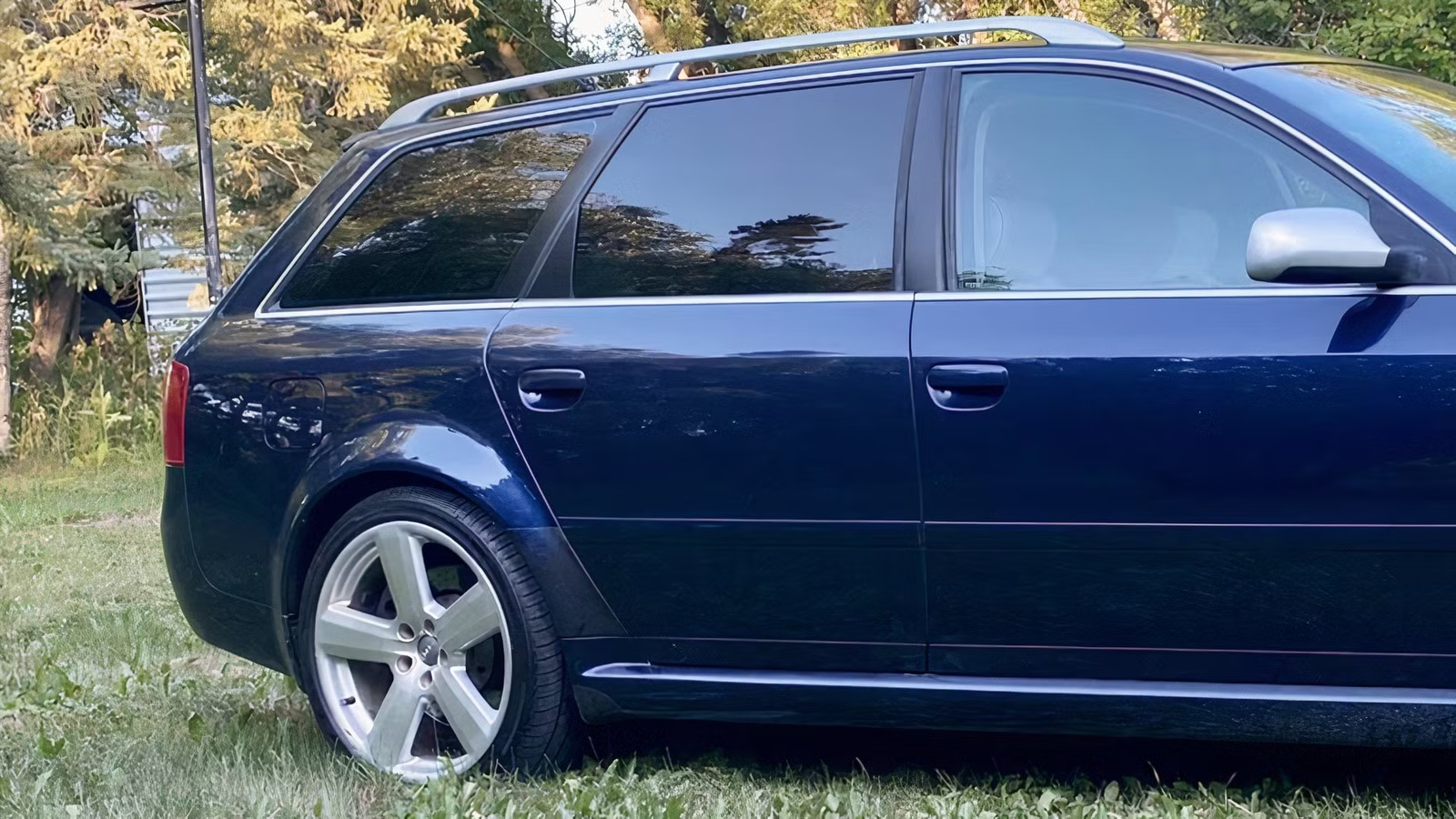
A Cosworth-developed twin-turbo V8 and near-supercar pace for ordinary used-car money sound like a bargain beside the collectible, Porsche-built Audi RS2. But those cheap U.S. listings are sedans; Europe also received the wagon, with its own market prices.

Then come the repair estimates: CarBuzz reports roughly $4,000 for a timing-belt service and $7,500 for engine-out turbo replacement. The later Audi outpaced its ancestor, but those bills help explain its discount. The hard part is knowing which ones are still ahead.
The Porsche-Built RS2 Set A High Bar For Fast Wagons
The 1994 RS2 turned Audi’s 80 Avant into something worth inspecting through the wheel spokes: Porsche-lettered brake calipers sat behind Porsche wheels, while Porsche mirrors carried the resemblance onto the doors. That partnership between Audi and Porsche extended to Zuffenhausen’s Rössle building, previously home to the Mercedes-Benz 500 E. Audi supplied painted bodies and shared components; Porsche handled development and final assembly.


The six-speed manual was the only factory gearbox offered, so keeping its 315-PS, 2.2-liter turbo five-cylinder on song was the driver’s job. There’s lag, then a shove into the seat as boost arrives. Porsche’s larger turbocharger and larger intercooler helped produce that shove without sacrificing wagon practicality. The reported 0–60 mph time is roughly 4.8 seconds; Hagerty recalls Autocar’s 1.5 seconds to 30 mph, quicker than the McLaren F1 only over that short interval.
Porsche’s newsroom gives RS2 production as 2,891 cars. That small run, the manual gearbox and the unusual manufacturing partnership help explain its appeal beyond acceleration times. Hagerty’s indexed October 2026 U.S. price guide, retrieved October 16, values a 1994 RS2 Avant in Good condition at approximately $71,400. More power alone wouldn’t reproduce that combination for collectors.
The C5 RS6 Avant Brought Cosworth Power And Tiptronic

The answer was the 2002–2004 C5 RS6 Avant, Audi’s first A6-class RS. Audi and Cosworth developed its 4.2-liter twin-turbo V8: 450 PS (444 hp) and 560 Nm (413 lb-ft), with 43 percent more power than the RS2; Audi extended the nose 1.6 inches to fit it. The five-speed Tiptronic was the only road-car gearbox; CarBuzz attributes that choice to available gearboxes’ torque limits. You could select a lower gear before a bend, but traffic no longer meant working a clutch.

Quattro all-wheel drive sent power to all four wheels, helping the tires find grip under acceleration, including when pulling out of a tight bend. Dynamic Ride Control (DRC) connected diagonally opposite shock absorbers hydraulically, resisting body lean in bends and nose-dive under braking without electronics. Steel springs and DRC balanced body control with everyday comfort. Wider arches and oval exhaust outlets only hinted at the hardware beneath its A6-based shape, preserving the wagon’s understated appearance.
Europe received both sedans and wagons; North America received sedans only. Audi’s production-end announcement, reproduced by Audizine, records 8,081 C5 RS6s worldwide. The estimates cover different territories: Supercar Nostalgia gives about 1,200 North American exports, while CarBuzz reports fewer than 1,500 U.S. sales.
What The Acceleration Figures Actually Show

Reported 0–60 mph figures span 4.2–4.6 seconds, against the RS2’s roughly 4.8 seconds. CarBuzz’s table gives 4.6; the optimistic 4.2 comes from CarThrottle sedan owner Nick Wilkinson’s retrospective. That’s an owner’s claim, not an independently verified Avant test, so it doesn’t establish an exact wagon-to-wagon advantage.
Audi’s factory 0–62 mph figure is 4.7 seconds, versus Porsche’s 5.4 for the RS2 and Ferrari’s claimed 4.5 for the contemporary 360 Modena. That put a wagon within two-tenths of the Ferrari on factory claims. Standard top speed was electronically limited to 155 mph; the later 480-PS Plus raised it to 174 mph.
Beyond The Bargain Price, The Hidden Bills Still Matter

CarBuzz’s September 2026 U.S. sedan feature lists a $16,625 average used value. CLASSIC.COM’s C5 sedan benchmark stood at $17,586 on October 16. That calculated indicator isn’t an asking price for a particular car, and neither figure prices a European wagon.
PistonAlpha’s European C5 median asking price was €36,666 on the same date. It covers advertised cars, not completed sales, and isn’t Avant-only. Different currencies and body styles prevent a direct comparison; Hagerty’s Good-condition RS2 valuation is a different measure again.
The sedan market does produce tempting buys: CLASSIC.COM records a modified U.S. example sold for $11,000 that September with 129,000 miles. A low winning bid doesn’t prove the major work is finished.
The Repair Bills Behind The Discount

CarBuzz reports timing-belt replacement every 35,000 miles and estimates around $4,000 for the service at a specialist. It puts turbocharger replacement at roughly $7,500 because accessing the turbos requires removing the engine. These are reported U.S. cost estimates, not universal workshop quotes. Together, those two jobs total $11,500, close to two-thirds of the sedan’s $17,586 benchmark before any other work enters the bill.
The same report puts transmission rebuilds or replacements as high as $10,000 and flags leaking DRC dampers. Have an Audi specialist inspect the belt history, turbo system, gearbox and hydraulic suspension before buying. Obtain invoices for completed work and local quotes for anything outstanding.
Price a European Avant in its own market, and keep a repair reserve whichever body style you buy. As these cars age, documented maintenance matters more than another acceleration claim. Paying less for the car won’t make its engine any easier to remove.
Sources: Audi, Porsche, Hagerty, CLASSIC.COM

Related posts



Latest Post


No Comments