
The Rarest 455 Muscle Car Detroit Hid Under Pace-Car Decals
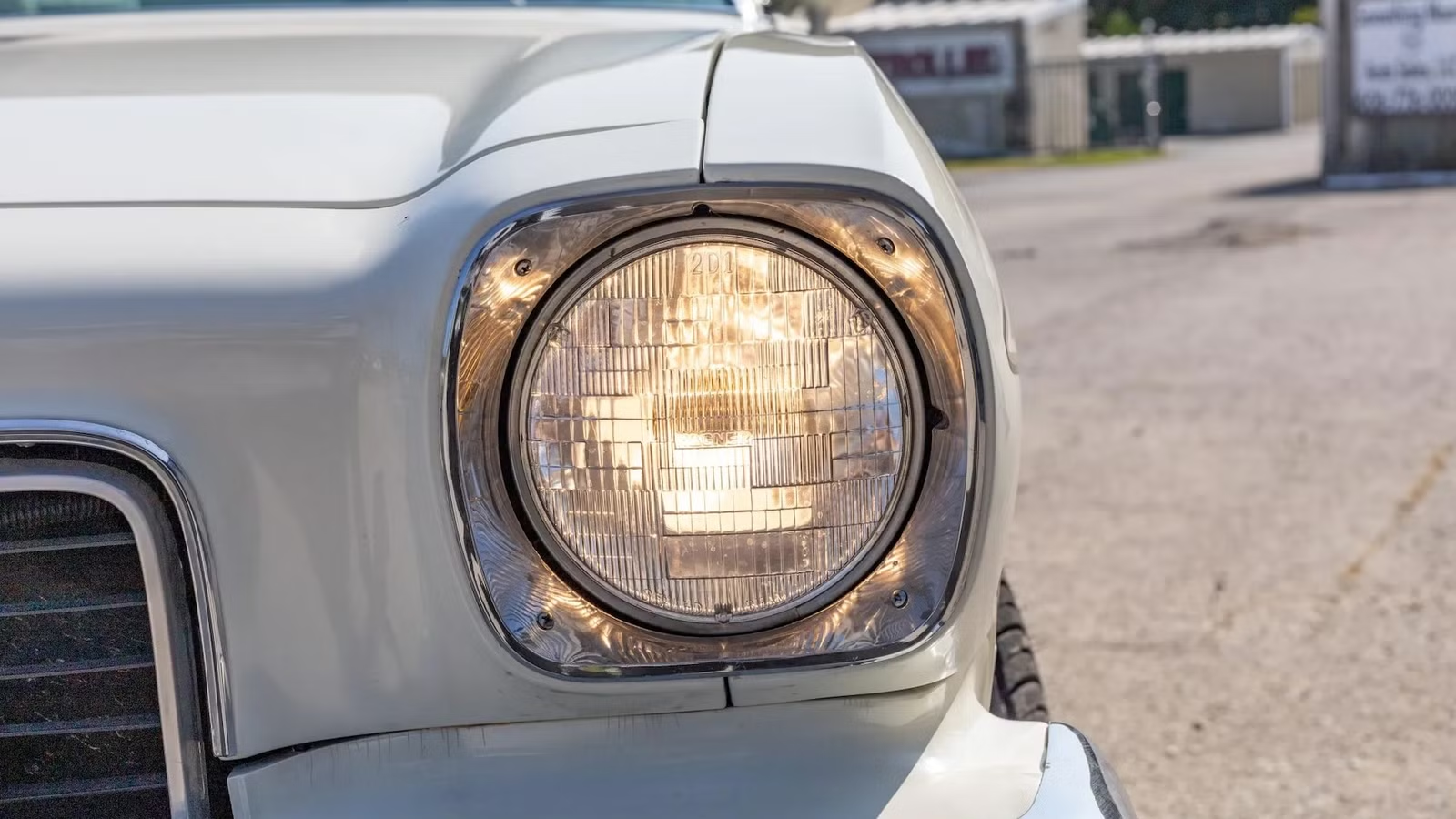
Sleeper alert: don’t miss out on one General Motors muscle car that packed 455 power pretty late in the game. Seriously, the last legitimate 455 muscle car sat in plain sight but was hidden under pace car decals. Despite having racing heritage and true historic relevance, it’s easy to miss. As a result, it remains tragically undervalued today.

It was produced in low numbers, and even fewer exist in convertible form. They certainly deserve more attention and respect. However, as affordable sleeper cars, collectors are probably happy that this particular model flies under the radar. If others caught on, then pricing would have the potential to skyrocket.
The Malaise Era Was Killing 455 Power
Things were getting pretty rough for General Motors cars powered by 455 muscle in the early 1970s. The malaise era struck without remorse, killing high-performance V8 engines left and right. Suddenly, higher insurance premiums were targeting heavy, incredibly powerful muscle cars, causing buyers to look for more practical and affordable options.

Plus, rising emission standards and the introduction of new equipment like catalytic converters were choking out power. On top of that, the oil crisis led to increasing fuel costs. This was another reason for drivers to seek lighter, more efficient options, and sales for legendary beasts started to decline.
Across every division, cars with the 455 engine were struggling. Icons like the Pontiac 455 High Output and Super Duty, as well as the Buick 455, were going out to pasture. So, when the opportunity to get around malaise-era restrictions occurred, two companies teamed up to take advantage of it.
The W-30 Hurst/Olds Was Built To Celebrate High-Performance Power

The highly coveted chance to build an Indy 500 pace car gave Oldsmobile and Hurst Performance a reason to celebrate. They teamed up to build the 1974 W-30 Hurst/Olds and its replica models for the Indianapolis 500. It was a big deal for the Oldsmobile to perform pacing in the Indianapolis 500.
But this also provided a reason to celebrate the 455 and its historic achievements in the racing world. It had quite a beefy reputation based on its ongoing legacy and didn’t deserve to go out quietly. So, the 1974 W-30 Hurst/Olds was a way to glorify the 455 engine with a final hurrah while wearing an attractive style.
This Cutlass was dressed to the nines with its Colonnade body style, a striking black or white paint scheme, gold and black striping, gold decals, a unique roof band that splits the vinyl top into two, and 15-inch gold-finished Superstock III wheels. Plus, the luxury sport interior features Strato bucket seats that swivel 90 degrees and a center console equipped with the Hurst Dual-Gate shifter.
The 1974 W-30 Hurst/Olds Hid Rocket V8 Power

Rocket V8 power was hidden under the lively paint scheme and luxury appointments. The 455 cubic-inch (7.5-liter) engine churns out 230 horsepower and 370 lb-ft of torque, making it one of the last true big-block engines available during the era. It can accelerate from 0 to 60 mph in about 7.3 seconds with a 15.5-second quarter-mile time. Plus, it has a top speed of about 125 mph.
In its heyday, the 455 Rocket V8 delivered 400 hp and 500 lb-ft of torque in the 1968-1970 Oldsmobile Toronado GT. But because of its massive size, it wasn’t much faster, with the ability to hit 60 mph in about 7.5 seconds and cover a quarter mile in 15.7 seconds. The 455 engine did help the 1970 Buick Gran Sport GXS Stage 1 accelerate from 0 to 60 mph in about 5.5 seconds with 360 hp and 510 lb-ft of torque.
Also, most of the 1974 Cutlass models were equipped with a 350 cubic-inch (5.7-liter) Rocket V8 engine instead. It produces 180 hp and 270 lb-ft of torque. This engine helps the Cutlass accelerate from 0 to 60 mph in about 12.1 seconds and cover a quarter mile in roughly 17.4 seconds with a top speed of 120 mph. So the rare W-30 Hurst/Olds models were much more exciting.
The Colonnade Brought Immense Power To The Showroom Floor

The 1974 W-30 Hurst/Olds stood out against its rivals at the dealership for having a significant amount of power because it managed to skirt around a few different loopholes. General Motors had a corporate rule that prevented divisions from using engines larger than 400 cubic inches in mid-size cars like the A-Body Cutlass.
So Oldsmobile cleverly bypassed the rule by having the 455 V8 engines installed by Hurst instead of on the standard assembly line. To avoid steep insurance premiums, the W-30 package was marketed as a Pace Car Replica instead of a drag strip brawler. Also, on that note, the Indy 500 required pace cars to be convertibles at the time. The official pace car was the Delta 88, and about 92 models were made.
Then, to make up for the loss of power due to new emissions equipment, the W-30 Hurst/Olds gained a FE2 Ralley suspension, a His-and-Hers Hurst Dual Gate shifter, a heavy-duty Turbo Hydramatic 400 transmission, a distinct 4-4-2 louvered hood, a Rochester Quadrajet four-barrel carburetor, and a low-restriction dual exhaust.
Now This Rare 455 Muscle Car Is Undervalued

While around 1,800 Hurst/Olds models were built in 1974, only about 380 were equipped with the W-30 package and 455 engines. Also, the 92 Delta 88 convertible models were used as track parade cars. You would think that this rare muscle car would have an insane price tag due to its racing heritage and rebel story.
However, the average going price is about $20,000. Highly original models that have been well maintained have an average of around $37,000. Models in pristine condition or Indy 500 festival models can fetch over $126,000. Even though the Delta 88 convertibles are even rarer, they still typically only sell for between $15,000 to $38,000.
These muscle cars still stand out as attractive and reliable cruisers, as they arrived during the muscle car shift from raw, straight-line power to luxury comfort. But that’s part of the problem. They had less power because they were built at the wrong time. If only they had come out a few years earlier, they could have gained a better cult following. Oh well, at least they’re bargains for the time being.
Source: Oldsmobile, Classic.com

Related posts



Latest Post


No Comments