
Why The Suzuki GSX-10R Makes More Sense Than A GSX-R1000
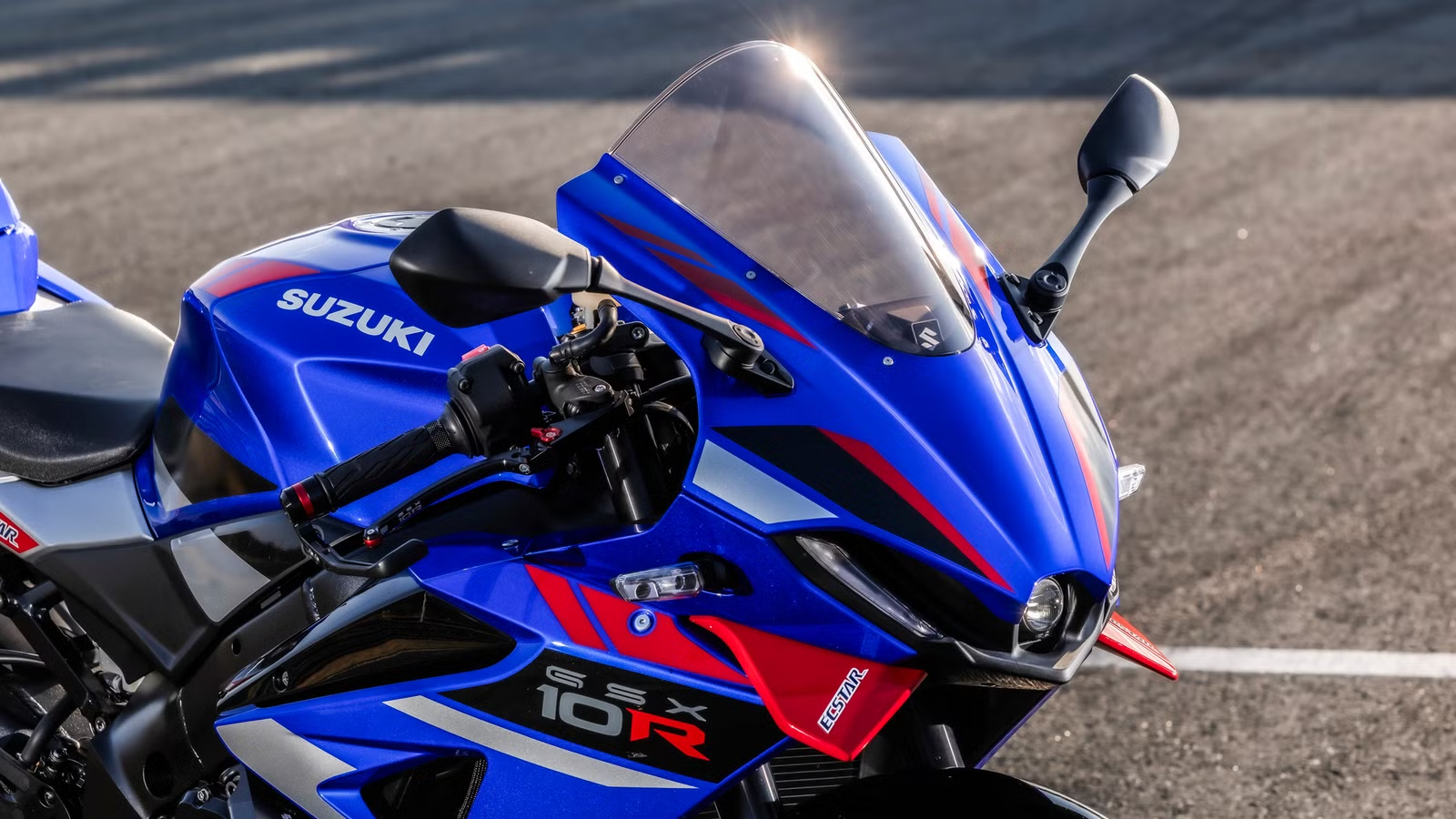
Split-personalities are an issue that motorcycles have had to deal with since multiple genres started to sprout from the same or similar engines. A prime example is Suzuki. It now has two liter-class GSX-badged bikes that look closely related. Both wear full fairings, clip-ons, winglets, sophisticated suspension, and liter inline-fours. Yet one exists to preserve everything uncompromising about the traditional superbike, while the other reshuffles those ingredients around real-world riding.
Why Suzuki No Longer Needs One Liter Bike To Do Two Jobs

For most of the GSX-R1000’s life, there was no choice for the person intending to buy one. If you wanted Suzuki’s fastest fully-faired liter bike, you bought the superbike and also the compromises that came with it. That worked when the road-going flagship and the race machine could occupy the same space. Modern superbikes, however, have moved far enough toward circuit specialization that the compromise is harder to ignore when you take it onto less than perfect public roads.
Peak power has climbed, electronic intervention has become more sophisticated, and chassis development has increasingly focused on exploiting grip at speeds that barely a few public roads can accommodate. That doesn’t make a superbike worse at its intended job, but it does mean that the qualities separating one from an ordinary sport bike now matter most in an environment where braking markers, warm tires, and runoff areas exist.

Road riding is vastly different. Strong low-end performance, greater stability, a little more comfort, good fuel range, and electronics that help outside a racetrack matter substantially more for doing the same job better. The motorcycle can still be fast enough for a track day without allowing that occasional use to dictate every decision made around its engineering.

That creates room for two interpretations of the same liter-class idea rather than one machine forced to satisfy incompatible priorities. One can remain the homologation-bred, high-revving benchmark for outright performance. The other can preserve the visual drama and hardware expected of a serious sportbike while shifting its useful performance toward the road. Suzuki’s new two-bike strategy starts making sense once those jobs are separated.
The GSX-10R Moves The Performance Where Road Riders Can Reach It

The new bike starts with familiar ingredients but rearranges its priorities. Suzuki uses a long-stroke 999cc inline-four derived from the famed K5 family and further developed through the GSX-S1000 platform. European figures put it at 150 horsepower at 11,000 rpm and 78 pound-feet at 9,250 rpm. The GSX-R1000R, in comparison, makes 193 horsepower, yet has only about three pound-feet more torque.
Peak Horsepower Is An Obvious Sacrifice

The GSX-10R is not simply a detuned version of the 1000R. Its 73.4 x 59mm bore and stroke differ significantly from the GSX-R1000R’s 76 x 55.1mm dimensions, while compression drops from 13.8:1 to 12.2:1. Suzuki is essentially trading high-rpm breathing and outright peak output for a broader power delivery spectrum that does not require the rider wringing out the right grip to extract max performance.
On a racetrack, the GSX-R’s extra power is what makes it compete with the rest of the liter crop. On the road, nearly 200 horsepower either means you’re using a fraction of the throttle or are at illegal speeds very quickly. Around 150 horsepower is hardly restrained, though, but more of the GSX-10R’s engine can be explored with usable performance. It’ll still demand ample respect from the rider, who wouldn’t have to exercise as much caution and restraint to enjoy a good stretch of road.
The Chassis Is Still Serious, Just Less Single-Minded

The same philosophy appears under the gorgeous bodywork. The GSX-10R gets a twin-spar aluminum frame, fully adjustable 43mm KYB fork, Brembo radial-mount front calipers, 190-section rear tire, and an electronic steering damper. Clearly, Suzuki has kept enough sportbike hardware to make track days part of the equation. At 471 pounds, it is 23 pounds heavier than the GSX-R1000R, while its 57.2-inch wheelbase is 1.3 inches longer, pointing to better straight-line stability for highway miles. Its seat is lower at 31.8 inches, the padding is softer, and the 4.7-gallon tank carries half a gallon more fuel than the GSX-R.
The Electronics Show Who The GSX-10R Is Really For

Among the plethora of electronic controls on the GSX-10R, the ones that reveal its intent aren’t launch control or cornering ABS. Cruise control, an active speed limiter, brake hold, smartphone connectivity, turn-by-turn navigation, a 4.2-inch TFT, and a USB-C outlet are all concessions to riders who intend to spend a considerable time away from a paddock. They widen the motorcycle’s usefulness.
The ergonomics also separate themselves from the GSX-S1000GT+. The GSX-10R still uses clip-ons, a forward-leaning riding position, winglets, and chassis hardware chosen with spirited riding in mind. It is not trying to make touring a priority. Instead, it treats commuting, weekend mileage, and longer rides as legitimate uses for a liter-class sportbike.
The GSX-R1000 Still Needs To Stay Uncompromised

There were definite questions about the existence of the GSX-10R when it was shown at the EICMA 2026, but one thing it does is that it gives the GSX-R1000 more reason to remain extreme. Suzuki can keep developing the 1000R around outright acceleration, drastic weight reduction, chassis adjustment, race preparation, and high-rpm performance because it no longer has to cater to the liter-bike audience that leans towards practicality.
There is also a branding reason not to blur the two. The GSX-R name has spent four decades tied to production racing, and the 1000R remains Suzuki’s clearest connection between a showroom and a circuit. Turning it into a softer road bike would make it easier to use but less meaningful in identity. The GSX-10R, on the other hand, works because Suzuki has created somewhere else for the road-focused bits to go.

Ultimately, it’s the pricing that will decide whether the split actually works. Suzuki has confirmed the GSX-10R for the United States as a 2027 model, but its MSRP remains unannounced. Since the 2027 GSX-R1000 starts at $16,399 and the GSX-R1000R at $17,939, the GSX-10R needs to land below or close to the standard GSX-R1000, so that the hierarchy is easy to understand. Buyers get the broader performance and modern convenience for the least amount, and then pay more for the lighter, faster superbike if that specialization is what they’re looking for.
Source: Suzuki

Related posts


Latest Post


No Comments