
The Ultra-Rare Mercury Muscle Car That Slipped Through The Cracks
Think rare muscle cars, and your mind will probably drift back to COPO ZL1 Camaros and Pontiac GTO Judge convertibles. The other thing that you may think of is suitcases full of money, and auction houses going into meltdown. That’s because rare muscle cars often have eye-watering price tags, and every collector wants to get their hands on one. But there is one unicorn that everyone forgot — and if it ever comes up for sale, you might need a lot less cash than you think.


Mercury Has Always Been A Muscle Car Outsider

Mercury, in Roman religion, is the god of commerce, shopkeepers, and merchants. He also represents travel and the transport of goods, a fitting choice by Henry Ford’s son, Edsel, for a new car brand to sit between everyday Ford and luxury Lincoln in the late 1930s. As far as we know, Mercury wasn’t the god of V8 Muscle Cars, but by the ’60s Ford decided that the relatively new brand could dabble in this new genre too.
Mixing an upscale division with the spit and sawdust world of muscle cars may have seemed like an unlikely mix, but models such as the S-55 and Marauder gave buyers another option if they wanted both muscle and luxury. More grown-up buyers, one might say. The Comet Cyclone had arrived in 1964 but was hardly a sales success, shifting barely more than four figures annually. By 1968, the Cyclone switched from being a Fairlane-derived coupe to a Torino-based fastback.
Mercury Had One Last Roll On The Muscle Car Dice

By the early ’70s, the muscle car genre was starting to collapse under the weight of soaring insurance premiums, a looming oil crisis, and new emissions regulations. For the 1970 model year, buyers could choose from a few Cyclone models. The range started with a 360-hp, 429-cid V8 linked to a four-speed transmission, with the possibility to option a 370-hp 429 V8 engine or a 375-hp Super CJ 429 engine.
There were a few Boss 429 Cyclones, and the Cyclone GT received a 250-hp 351-ci V8. The Cyclone Spoiler had a Ram-Air 370-hp 429 under the hood. With the demand for muscle cars waning, the Cyclone name was absorbed into the Mercury Montego line in 1971. The move didn’t bring many sales, with just 444 Montego Cyclones sold, along with 2,287 Cyclone GTs and 353 Cyclone Spoilers. But Mercury hadn’t given up on the Cyclone name.
1969 Ford Mustang Buying Guide: Mach 1, Boss 302, Boss 429, And GT500
The 1969 Ford Mustang represents the moment the Mustang reached its full potential—where design, performance, and identity aligned perfectly.
The Mercury Montego Cyclone Was An Unlikely Muscle Car

Cyclone-badged Montegos of the early ’70s had enough punch to keep the muscle car flame alive — well, kind of. Engine options went from a 210-hp 302 V8, up to a 370-hp, 429-cid Cobra-Jet V8, the latter also available with Ram-Air. These cars certainly offered something unique. Just like the Buick GSX Stage Is, they tried to fill the gap above the more youthful and rebellious muscle machines, giving buyers a touch of luxury infused with a dash of class. For 1972, the Cyclone story gets a little more murky, with Mercury offering it as the “Cyclone Performance Package” for two-door Montego and Montego MX hardtops, and the Montego GT.
The 1972 Montego Cyclone Package Offered Muscle Car Thrills When They Were In Short Supply

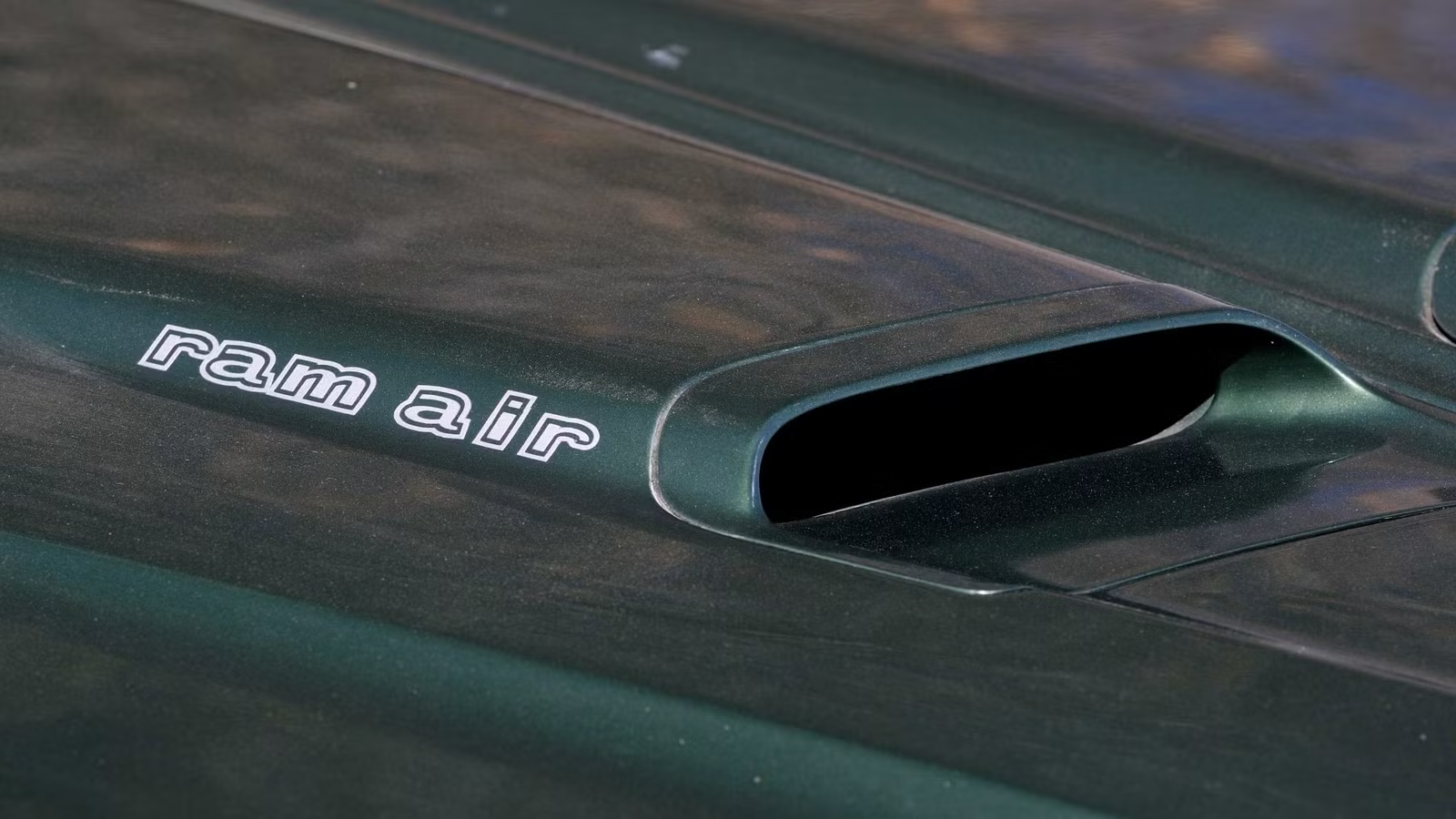
The Cyclone Performance Package was only available on two engine options. The 351 Cobra Jet, which had 248 hp and 299 lb-ft of torque, and the N-Code 429, which was pushing out 205 hp and 322 lb-ft. The cost in 1972, according to Hemmings, was $518.10 and $616.60, respectively. Ticking the Cyclone box got some extra goodies to muscle things up. There was a functioning Ram Air/hood scoop system, F70-14s with the 351CJ or G70-14s with the 429 (also available as an option for the 351CJ), plus a Traction-Lok differential. The Cobra Jet could also be specified with a four-speed manual. Then there were visual enhancements such as hubcaps and trim rings, body stripes, dual racing mirrors, and a three-spoke steering wheel. There are no official figures for any output gains, but they would have been marginal to say the least.
It Is One Of The Rarest Muscle Cars Ever Built

It turns out that not many people were interested in the Cyclone Performance Package, even if it was one of the few dwindling sporting offerings in the early 70s. Hemmings analyzed the 1972/73 Mercury Montego GT Registry and said that a second edition of dealer literature does not even mention this package, suggesting it was “canceled, too expensive, or both.” Just 29 Montego GTs were produced with the Cyclone package. That figure is made up of nine 351CJs and 20 429s. Add to that just one 351CJ Montego MX Cyclone that rolled out of the factory. Hemmings says that as of 2011, just three Cyclone GTs have been accounted for, all with the 429 engine. That makes the Montegos with this package one of the rarest muscle cars ever made.
Here’s Why The Montego Cyclone Slipped Through The Cracks

Even before the muscle car wars ended in the early ’70s, things weren’t looking great for the Cyclone name. Mercury only built 10,170 GTs—plus another 1695 Cyclones and 1631 Spoilers—for 1970, says Hagerty. For the following year, that was down to 444 Cyclones, 2,287 GTs, and 353 Spoilers. The reality was that while mid-level, luxury-oriented cars were certainly a break from the norm, they would remain a niche product. Buick only shifted 400 GSXs with the 360 hp Stage 1 option, says Mecum. The Cyclone had another problem — its siblings. It was always overshadowed by the Ford Mustang and Torino, lacking the household name status of both.
Getting Your Hands On One Of These Unicorns Is Cheaper Than You May Expect

With these cars being so rare, and so few left documented, they almost never appear at auction. However, the 1972 Montego in the pictures above has a 429 and is correctly badged as a Cyclone, complete with a Ram Air hood. This car went up for sale at Mecum in 2013, with a possible engine problem, and sold for just $17,600. There was no verification if it was a real Cyclone Performance Package, but nothing to suggest it isn’t either. Interestingly, a very similar-looking car appeared on the YouTube channel Two Guys and a Ride in 2026, fully restored. You can check out that video above.
As for prices today, it would be down to an auction frenzy if one of these unicorns ever went up for sale, but we do know this: Montegos are cheap, very cheap. A 1972 Mercury Montego GT has a good condition price of $10,800, says Hagerty’s Valuation Tools, and a 429 is $9,700. This tallies up with the idea that the car sold in 2013 was a real Cyclone. It may be a long wait before one of these intriguing beasts goes on sale again, but if you can get the keys, you’ll have something very rare indeed.
Sources: Hagerty.com; Hemmings.com

Related posts




Latest Post


No Comments