
Dodge SRT Copperhead Won’t Share A Platform With The Charger
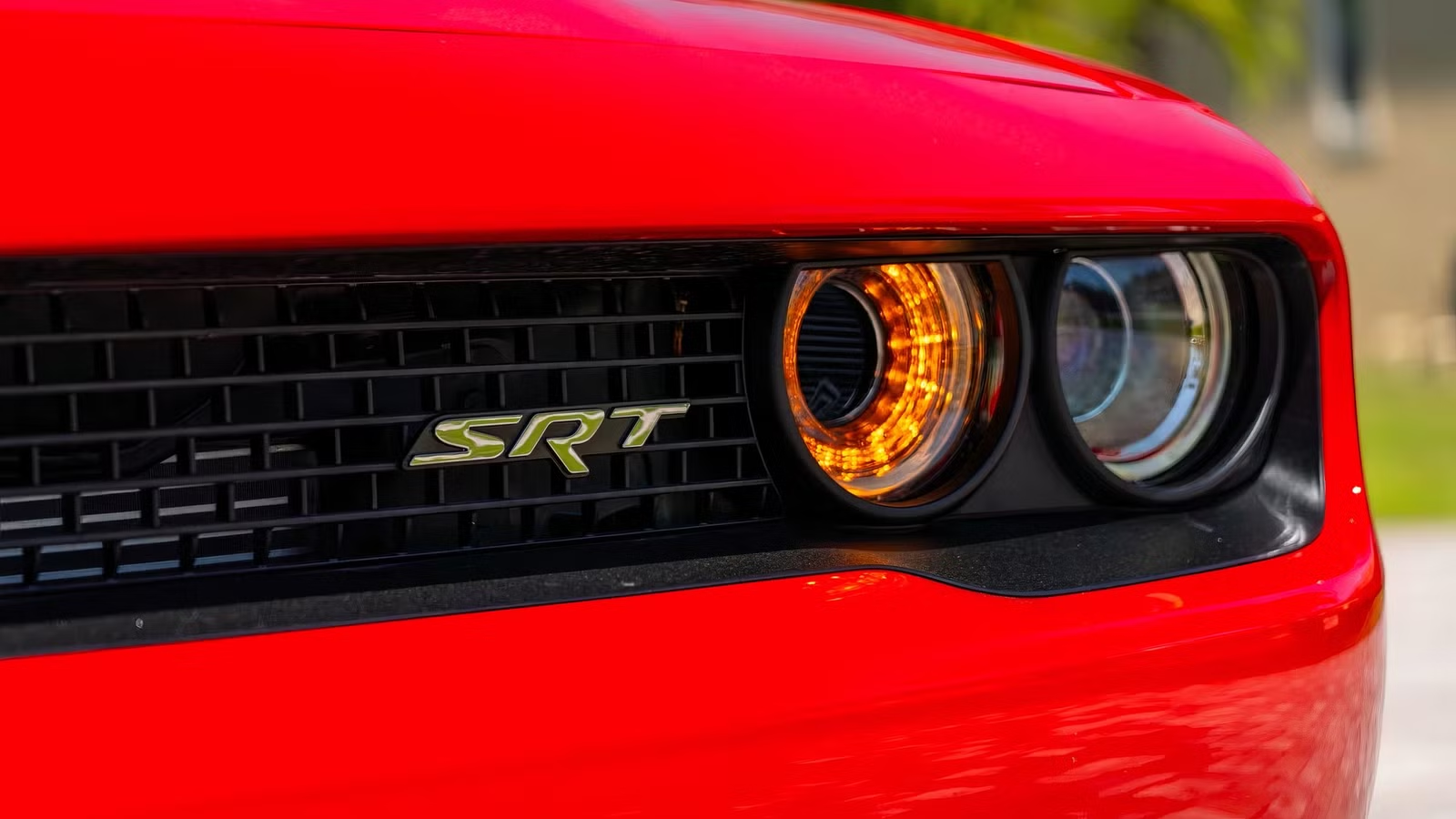
Pay attention, Dodge fans: things are changing under Ram CEO and Head of American Brands for Stellantis, Tim Kuniskis. The SRT lineup is being completely revived with the introduction of a new hyper- muscle car, a two-door coupe. But that isn’t the only significant change that’s on the way.

There is a Stellantis road map that involves four years of innovative upgrades. While SRT will still remain true to its Street and Racing Technology high-performance core, the Dodge Charger and Challenger will no longer be the breakout stars. In fact, the current HEMI V8 engine family might be a little too dated for these upcoming modern changes. The plot thickens as Kuniskis plans to modernize the SRT lineup in a post-Charger and Challenger era while borrowing from Chevrolet. Taking cues from the Corvette and Camaro playbook may seem unlikely, but the changes are already in motion and include the historic Copperhead moniker.
Dodge Is Borrowing The Corvette’s Playbook
It’s no secret that Chevrolet muscle cars stand out with distinct identities and that the lineup has a clear hierarchy. For example, the Chevy Corvette ZR1 sports car sits above the Camaro. Basically, the more luxurious and upscale Corvette outranks the brand’s mainstream muscle cars. But Kuniskis isn’t borrowing from this hierarchy to build a direct Corvette rival; he’s simply building a parallel hierarchy.

The Corvette is a sports car, and the upcoming Dodge SRT Copperhead is a dedicated hyper-muscle car. This new coupe will give the SRT lineup a new, unique identity to stay relevant in a rapidly changing market. The Copperhead will sit at the top of the podium, above the Dodge Charger or Challenger, which will be known as SRT successors.
It’s important to note that this is a bit of a surprise. This move is part of a broader strategic plan to rebuild SRT as a premium high-performance brand. Kuniskis is even picking the Copperhead name over the Dodge Viper, as the Viper has already reached the end of its life cycle and the Copperhead is crucial for forging an entirely new identity. On that note, the name stems from a concept car from 1997. The name is also drawn from a venomous snake, maintaining the brand’s predatory naming tradition.
The Next SRT Model Won’t Use The STLA Large Platform

There is still more to cover here. The Dodge Challenger rides on the STLA large platform, which is five years old. Its age is a little rough for the future of the brand, which is why the Copperhead won’t be built on it. The new hypercar is getting a global platform optimized for internal combustion, rather than the battery-electric architectures used by more recent Dodge models.
That should please EV skeptics. But the old school Challenger fans might be upset. However, the STLA platform is a bit limited. It has a raised floor plan that requires an elevated ride height. As a result, the Copperhead’s long, low aerodynamic proportions and multi-energy design won’t fit within the platform’s constraints. Building on the specialized global platform allows for a combustion-focused chassis free from the compromises of architectures designed to accommodate electric vehicle setups.

The Charger and Challenger are better fits for the STLA platform because they don’t have the same hard points as the Copperhead. Plus, the Copperhead isn’t based on the Challenger. The platform has space for electric batteries, which is great for the electric Challenger. But it leaves quite a bit of space under the gas-powered models.
Its multi-energy layout pairs with low-profile proportions and a track-ready stance rooted in classic Viper DNA. You can spot the shark-nose front, gigantic air intakes, functional hood duct, and beefy rear wing.
The Dodge SRT Copperhead Will Strike Hard

The upcoming Dodge SRT Copperhead isn’t planning on using the HEMI V8 engine. Tim Kuniskis feels the HEMI identity would instantly date the futuristic car. Plus, the hyper-muscle car is expected to arrive between now and 2030. There could be completely new engines in use by then.
Stellantis targets an output of between 700 and 800 hp for the new halo car. Some more intense clues and rumors point to an output of 1,000 hp, which would be better for fighting rivals like the Corvette ZR1 and Ford Mustang GTD. It will represent a significant departure from the Hellcat-era displacement wars. Don’t expect to see a hybrid V8 engine paired with the new car, either.
Currently, the 2026 Chevy Corvette ZR1 has a 5.5-liter twin-turbocharged flat-plane crank DOHC V8 engine with 1,064 hp and 828 lb-ft of torque. Then the Ford Mustang GTD rings in with a 5.2-liter supercharged V8 engine that delivers 815 hp and 644 lb-ft of torque. The Dodge Challenger SRT Demon 170 is currently the most powerful production SRT model. It uses the supercharged 6.2-liter High-Output HEMI V8 to produce 1,025 hp and 945 lb-ft of torque.
|
Car |
Engine |
HP |
Torque |
|
Corvette ZR1 |
5.5-liter twin-turbocharged V8 |
1,064 |
828 LB-FT |
|
Mustang GTD |
5.2-liter supercharged V8 |
815 |
644 LB-FT |
|
Dodge Challenger SRT Demon 170 |
6.2-liter supercharged V8 |
1,025 |
945 LB-FT |
Kuniskis has shared that Stellantis has been developing new technology that will be revealed later this summer, ahead of Roadkill Nights in August. Which vehicle will feature the new engine remains to be seen, though the Copperhead itself is a strong candidate. While comparisons to the 777-hp Ram Rumble Bee SRT truck and its supercharged V8 are tempting, the Copperhead appears to be getting something entirely different.
The SRT Brand Is Going Premium
The SRT brand is clearly moving upmarket. The Dodge SRT Copperhead is only one example of an upcoming model to elevate the SRT brand. It will deliver racing sophistication, while the Dodge Challenger and Charger HEMI era is rooted in brute muscle.
The Stellantis road map claims that there will be eight new SRT vehicles. There are a lot of things currently in motion, including eight vehicles that we haven’t seen. But this isn’t in an effort to replace or discontinue the famous HEMI muscle era. Instead, the new lineup will build upon it with unique, modern advancements.

Upcoming SRT vehicles to expect include the two-door and four-door Charger, Durango, Ramcharger, Dakota, Grand Wagoneer, Grand Cherokee, Grand Cherokee L, Recon, Cherokee, Wrangler Scrambler, Arrow, GLH, Arrow Cross, and Airflow. The GLH stands for Goes Like Hell. So, get your motor running for more racing-oriented vehicles.
While excitement surrounding these new cars and the mystery of the Copperhead is considerable, one persistent concern relates to pricing. Stellantis has already made significant bets on the luxury market with high-priced entries like the Jeep Grand Wagoneer, which has faced substantial sales declines. Whether loyal Dodge fans will get priced out of the market remains a legitimate concern.
SOURCE: Top Speed, Car Buzz

Related posts




Latest Post


No Comments