
The Japanese Motorcycle Built For Riders Who Prefer Torque Over Technology
When riders talk about low-end torque, Japan is rarely the first country mentioned. After all, the Japanese motorcycle industry built its name on light, fuel-efficient commuter bikes and high-revving four-cylinder sportbikes. If an owner wanted heavy, tractor-like pull, they usually walked into an American showroom, or maybe looked at a few European twins. But assuming Japan cannot do torque ignores history; Japanese factories never lacked the ability to design high-torque engines; they just put their priorities elsewhere across their lineups.
Kawasaki Proved Japan Could Build Monster Torque Before Modern Digital Bloat

Kawasaki proved that point early. The company built the largest-displacement production V-twin in motorcycle history: the 2,053cc Vulcan 2000, which made 141 pound-feet of torque on engine size alone. When Kawasaki applied that displacement mindset to four-cylinder bikes, it produced the Ninja ZX-14R and the Concours 14, engines with roll-on pulling force that beat most cruisers. Today, though, buying a highway touring bike means dealing with bloated design. Modern touring bikes come packed with touchscreens, phone-pairing systems, and complex electronic rider aids. Those parts drive up purchase prices and create electrical failure points on long highway trips.
It Has A Torque-Rich And Gimmick-Free Touring Bike On Sale Today

Kawasaki knows how to build complex electronics. The company makes supercharged liter bikes and high-revving four-cylinders with tech that is second to none. But long-distance touring does not need digital systems. Real touring comfort comes from basic, functional hardware. Bolting the front fairing straight to the frame instead of the handlebars keeps crosswinds and truck wake from pulling on the front wheel. Adding linked hydraulic brakes, basic cruise control, and a tall overdrive sixth gear keeps highway speeds relaxed without software getting in the way. The Kawasaki in context brings all of that to the table and none of the gimmicks.
The Kawasaki Vulcan 1700 Vaquero Offers Pure V-Twin Grunt Over Electronic Nannies


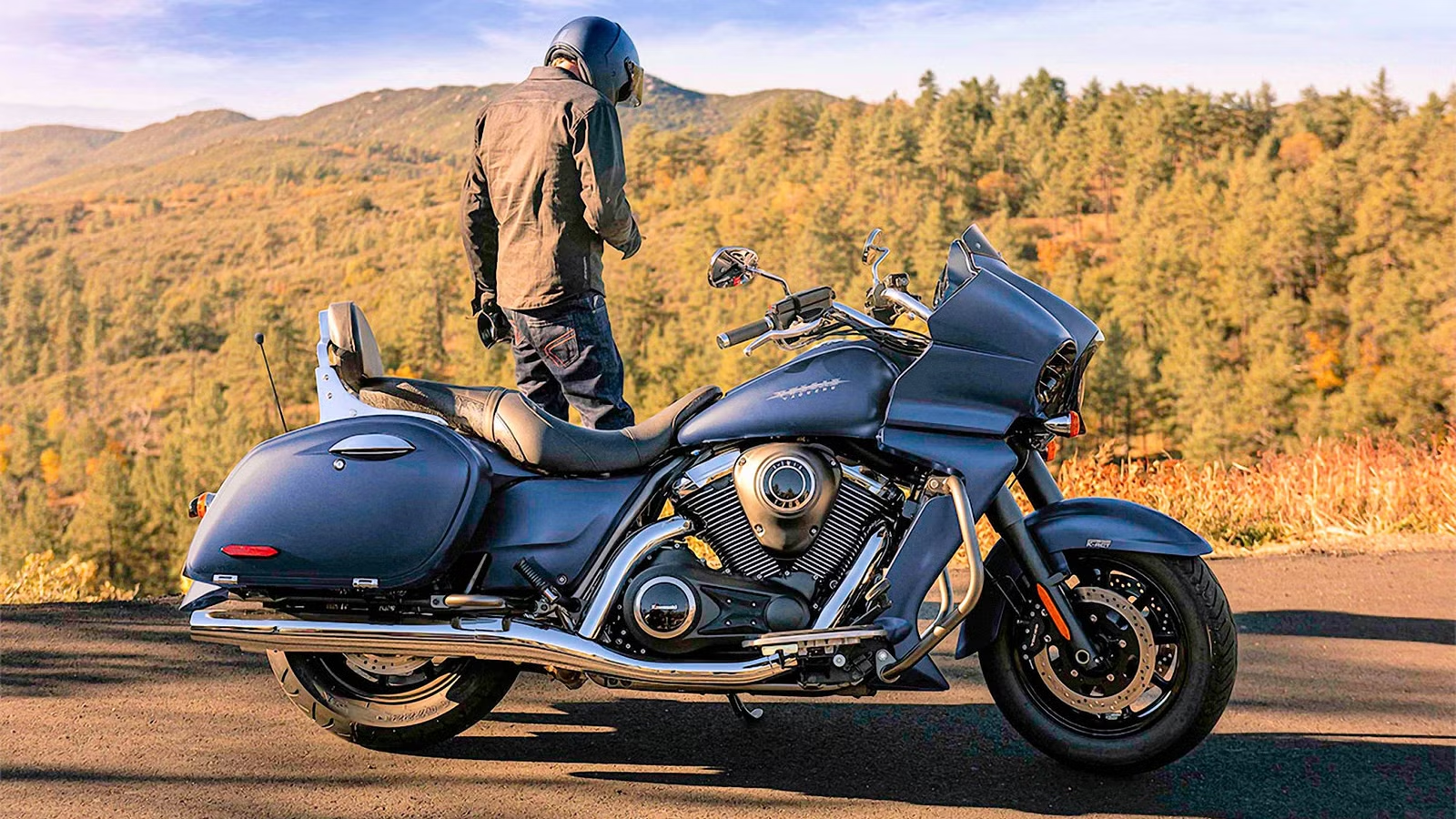
The $19,999 Kawasaki Vulcan 1700 Vaquero is one of the cheapest new bikes with impressive torque, and is the direct result of that straightforward build style. Its 1,700cc V-twin puts out 107.6 pound-feet of torque at just 2,750 RPM, pulling hard the second you crack the throttle. The 82 horsepower figure arrives much higher in the rev range at 5,000 RPM. Instead of digital displays and selectable engine modes, it sticks to analog gauges, hard saddlebags, and a frame-mounted fairing. It is a long-distance road bike focused on low-end grunt, clean wind protection, and simple mechanical parts at an approachable price.
Kawasaki’s Largest Engine Today Shows There Is No Replacement For Displacement

The Vulcan 1700 Vaquero has an engine that is approaching two decades of age, but even at launch it had liquid cooling and fuel injection. This is a 52-degree V-twin with a nearly square bore and stroke: the stroke is longer than the bore by just 2 mm. It is still Kawasaki’s largest engine today at 1,700 cc, has an SOHC head with four valves per cylinder, and a relaxed compression ratio of 9.5:1. This is only enhanced by the six-speed manual transmission with overdrive. Like all good tourers, it chooses a carbon-reinforced belt drive to send power to the rear wheel.
Frame-Mounted Fairing And Heavy-Duty Chassis Anchor High-Speed Stability

The Vaquero uses a double-cradle steel frame with a box-section single-tube backbone. The suspension is simple as well, with a 45 mm Showa telescopic fork offering 5.5 inches of travel, and a four-way rebound-adjustable, twin air-assisted shocks at the rear that offer 3.1 inches of travel. The brakes are a little more serious, with twin 300 mm discs at the front with two-piston floating calipers, and another disc of the same diameter at the back with the exact same caliper. It uses a 16-inch-diameter alloy wheel both front and rear, and tubeless radial tires are fitted.
Coming to dimensions, this is a large, comfortable bagger that is 98.8 inches long and 38.2 inches wide, with a massive 65.6-inch wheelbase. The seat is also a little higher than usual at 28.7 inches, but you also get quite good ground clearance of 5.7 inches. It can hold 5.3 gallons of fuel, and it weighs 844.5 pounds ready to ride with a full tank of gas. Despite the apparently simple setup, it handles long highway days beautifully.
Analog Dials And Minimalist Tech Preserve Pure Riding Focus

The Vulcan 1700 Vaquero hasn’t changed in 15 years, and that’s why it works. It uses minimal electronics, supporting torque over technology as much as it can. It has a by-wire throttle, but it is used to smooth out abrupt throttle inputs and assist with cold starts only. There is electronic cruise control and dual-channel ABS with linked brakes; this is possibly the most technologically advanced feature on it. No matter which lever you actuate, the Vaquero decides where the braking force can be used best and sends it there. This linked function is active at over 12 MPH only.
In the cockpit, it has a mostly analog instrument cluster that is modeled after 1960s American muscle car dashboards. It has analog dials for the speedometer, tachometer, fuel gauge, and coolant temperature. There is a multifunction LCD that displays the odometer, dual trip meters, the clock, gear position, the radio station, and it even has a trip computer with the estimated fuel range and average consumption. There are lockable storage compartments on it, and the saddlebags have nearly 10 gallons of storage each.
The Vaquero Seems Dated Compared To Japan’s Modern High-Torque Heavyweights

There is no shortage of Japanese motorcycles that have gobs of torque. At the top of the pile is the $25,700 Honda Gold Wing with its 125 pound-feet of torque; however, it does take 1,833 cc and six cylinders to generate that. The Suzuki Boulevard M109R uses a third of the number of pistons with its V-twin, and it costs a lot less at $15,799, but it also generates massive twisting force at 118 pound-feet. In third place is a surprise: the Kawasaki Ninja ZX-14R, with its high-revving inline four-cylinder engine, generates 116.5 pound-feet. It must be the fact that it is the largest-displacement inline four-cylinder in history in a production motorcycle; you will have to shell out $17,559 for it.
Source: Kawasaki USA

Related posts


Latest Post


No Comments