
Pontiac Solstice GXP: The Forgotten Sports Car Worth Buying
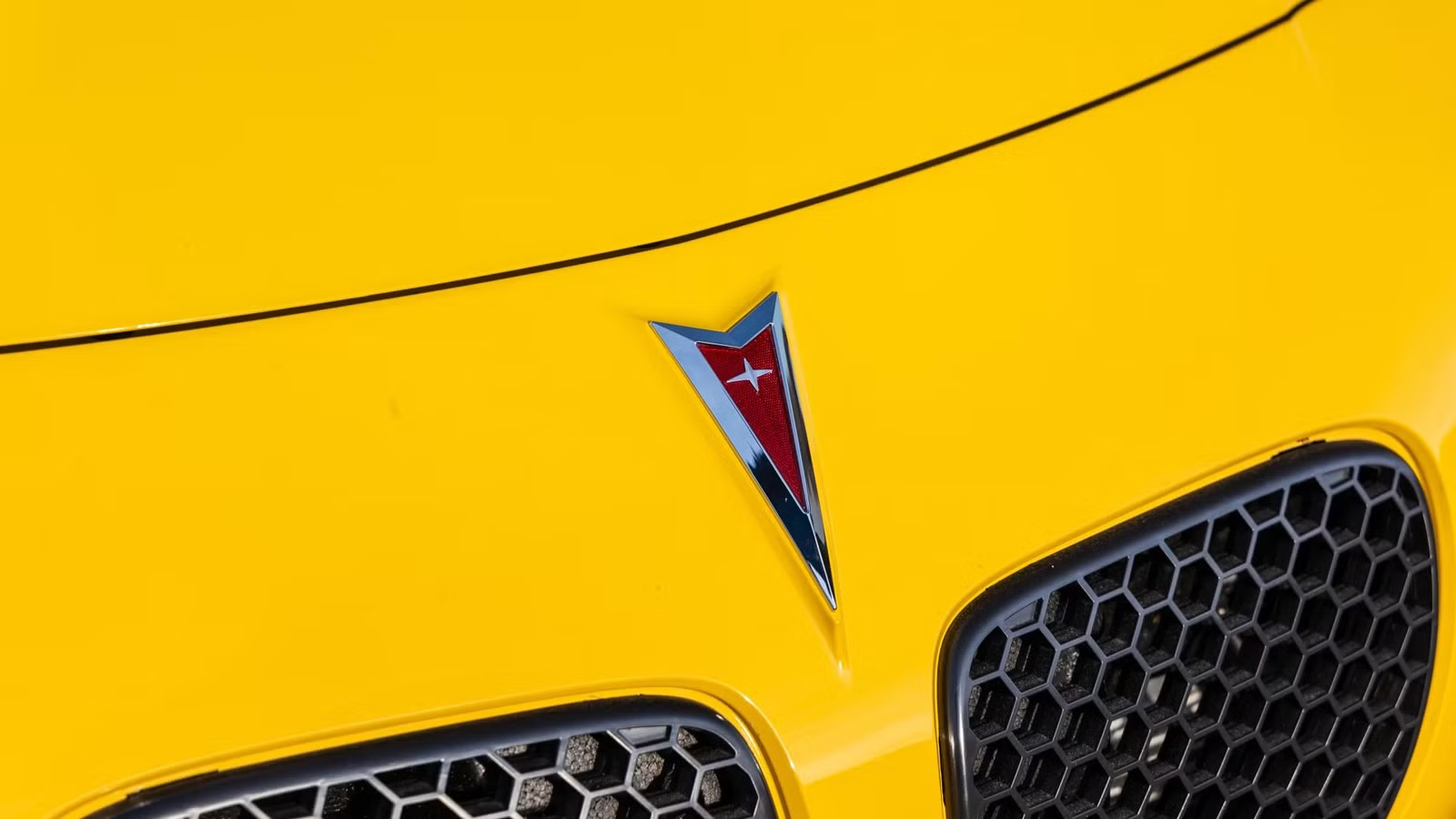
Many of us love a proper, driver-focused sports car. These cars are brilliant to drive, don’t have anything unnecessary and prioritize driving fun over outright speed. The car we’re about to talk about has all of these qualities, but it’s from a brand you wouldn’t expect. It’s not British, French, German, or Japanese. It’s actually from North America, and it carries the badge of a brand that hasn’t existed for a long time.
The Pontiac Brand Is Becoming Forgotten As Time Goes On

Pontiac is now a car brand that’s slipped into being nothing more than a memory in some aspects. Its demise was only relatively recently (the last Pontiac was sold in 2010), yet it’s already become one of America’s forgotten car brands. That’s a real shame, as for a long time it was one of the cornerstone brands of the American car industry. It built a variety of great cars, from big, luxurious models to high-performance monsters. It’s the latter of those that Pontiac has gained a great reputation for in enthusiast circles.
 45 autotech
The Pontiac Nobody Expected Was Faster Than A Mustang
Pontiac’s final performance car carried a Corvette engine and left the Mustang GT standing. Barely anyone noticed before the brand was gone.
Pontiac Quietly Built Some Of General Motors’s Best Cars Ever

During its time as one of GM’s prime brands, Pontiac quietly produced some of the best sports cars that were ever produced by the American mega-manufacturer. Many people already know about the legendary Firebird and Trans Am models, which shared a platform with the Chevrolet Corvette. There was also the Pontiac GTO, which was arguably one of the first muscle cars ever and got a brilliant modern re-interpretation in the mid-2000s. The G8 muscle sedan also deserves a mention, as it’s absolutely beloved by enthusiasts.
But, there’s one secretly brilliant Pontiac sports car out there that’s perhaps one of the best value-for-money buys you can get on the used market. It’s a forgotten sports car that punches well above its weight, to the point where it can actually challenge modern sports cars in its class.
Pontiac’s Rare Muscle Car That Beat Ferraris On The Track And Then Vanished
It was the fastest muscle car of its era, but it disappeared just as quickly as it appeared.
The Pontiac Solstice GXP Is A Forgotten Sports Car That Punches Way Above Its Weight

|
Model |
Engine |
Transmission |
Drivetrain |
Power |
Torque |
|
GXP |
2-liter turbocharged inline-4 |
5-speed manual, 5-speed automatic |
Rear-wheel drive |
260 hp |
260 lb-ft |
|
GXP w/GMPP Package |
2-liter turbocharged inline-4 |
5-speed manual, 5-speed automatic |
Rear-wheel drive |
290 hp |
340 lb-ft (Manual), 325 lb-ft (Automatic) |
Unless you really know your sports cars, you may never have heard of the Pontiac Solstice GXP. This was the most powerful variant of the Pontiac Solstice, producing 260 horsepower and 260 lb-ft of torque from its 2-liter turbocharged Ecotec inline-4 engine. Pontiac also offered a dealer upgrade known as the GMPP package, which bumped the power up to 290 horsepower and either 340 lb-ft of torque with the manual transmission or 325 lb-ft with the automatic transmission.
While that doesn’t sound like a lot of power, the Solstice GXP only weighs 2,976 lbs. That gives it some seriously great performance for a small, late 2000s sports car. It could accelerate from 0-60 mph in 5.6 seconds, and run a standing 1/4 mile in 14.2 seconds at 98 mph.
It’s Based On A Bespoke Platform

One of the biggest aspects of the development of the Pontiac Solstice is that General Motors created an entirely new platform for it. This is known as the Kappa platform, and it’s specifically designed for a front-engined, rear-wheel drive compact sports car layout. It uses a lot of parts from other GM platforms; several components came from the Delta platform, and the rear axle and differential were taken from the Sigma platform (specifically the Cadillac CTS).
That brand new platform built specifically for the Pontiac Solstice is a big factor into why the Solstice GXP is such a great car. That’s even though quite a lot of its components came out of the General Motors parts bin! It’s not making do with a version of a platform that was designed for a sedan or a hatchback. It’s got its own, dedicated setup, and a lot of thought was put into making sure that this platform worked exactly how a compact sports car platform should.
It’s Got Better Performance In Some Areas Than The Current Mazda MX-5 Miata

The Pontiac Solstice GXP typically doesn’t get mentioned in the performance stakes as a genuine competitor. But, its performance is so good that it can actually put up a challenge to today’s compact sports cars! Its 0-60 mph time is around the same as the current Mazda MX-5 Miata’s (5.5 seconds for the manual transmission version) and its standing 1/4 mile time is fairly similar to the ND Miata’s too (14.3 seconds at 96 mph). In the areas where the Solstice GXP’s stronger torque is an advantage (the ND Miata has 151 lb-ft of torque, over 100 lb-ft less than the Solstice GXP in its standard factory tune), it actually wins out over Mazda’s current offering. The Pontiac Solstice GXP can accelerate from 50-70 mph in top gear in 7.9 seconds, significantly faster than the 9.3 seconds the ND Miata takes.
It Was Also Sold As An Opel And A Saturn

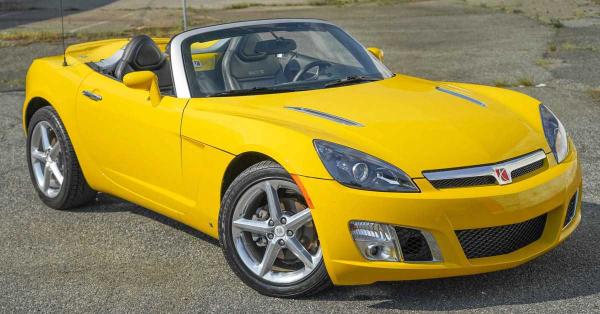
One of the most interesting parts about the Pontiac Solstice GXP is that it wasn’t just sold as a Pontiac. Just as the more regular Solstice models were rebadged as the Saturn Sky, the Pontiac Solstice GXP was also repackaged as the Saturn Sky Red Line. This car was also sold in North America, and had exactly the same performance as the Pontiac Solstice GXP. It even had the same GMPP dealer performance package option as the Solstice GXP!
Meanwhile, on the other side of the Atlantic, the Saturn Sky Red Line version of the Pontiac Solstice GXP was adapted into the Opel GT. It was only sold in mainland Europe, and it’s got even more of a forgotten and underrated reputation than the original American car it’s based on.
How Saturn Beat The Miata At Its Own Game In 2007
The Saturn Sky Red Line packed 260 hp, a twin-scroll turbo, and Miata-beating speed into a roadster killed too soon by Saturn’s collapse.
Why Did The Pontiac Solstice GXP Get Suddenly Cancelled?

With how great the Pontiac Solstice GXP is, you’d expect that it would have been a success. Instead, the opposite happened. It only ended up being in production for three years (2007-2009), and its end was because of production being cancelled. Why did that happen? There are a couple of big reasons why.
It Sold Poorly – But That Wasn’t The Car’s Fault

If people do know about the Pontiac Solstice, it’s typically because it’s considered to be a sales flop. Around 18,000 Solstice GXPs were sold in the whole of its 2007-2009 production run. That might sound like a great number. But, at the same time, Mazda was selling between 15,000 and 19,000 Miatas per year in just the USA. Expand that globally, and the NC-generation Mazda Miata sold 79,249 cars during that 2007-2009 period. That really does make the Solstice GXP look like an absolute sales failure.
The car itself shouldn’t be blamed for those poor sales, though. Those sales issues were caused entirely by external factors that General Motors couldn’t really control. The Pontiac brand didn’t have an existing reputation in the Solstice GXP’s market segment. That means that most buyers would rather trust what they already knew was good, and would go for something like a Mazda Miata instead. The Solstice GXP was also released before the 2008 financial crisis, during a time when automakers were still optimistic and still up for doing a bit more experimenting.
That financial crisis was perhaps the single-biggest reason why the Pontiac Solstice GXP was a sales flop. Why? It’s because GM decided to do something that’s still viewed as a controversial decision among enthusiasts…
The Pontiac Brand Was Killed Off In 2009 Due To GM Budget Cuts
Perhaps the single biggest factor as to why the Pontiac Solstice GXP didn’t get the production run it really deserved is the demise of the Pontiac brand in 2009. The 2008 financial crisis severely affected all aspects of America’s economy, and several big and long-running businesses ended up closing their doors. GM was nearly one of those. It was saved by the US government giving it a bailout, but nothing would ever be the same again in Detroit.
Even after receiving a government bailout, GM still needed to slim down its finances to stay afloat. Unfortunately, GM decided that one of the casualties had to be one of its longest-running brands. This not only caused the death of the Solstice, but it also brought about the end of the beloved G8. It also killed any chance of a new Pontiac Trans Am happening; the Chevrolet Camaro was revived for 2010, barely any time after GM’s decision to get rid of the Pontiac brand for good.
That’s something that, as you’d expect, enthusiasts really weren’t happy with. Some have argued that GM should have killed off Buick instead of Pontiac, as Buick has now become a brand that mainly makes fairly generic crossovers. Pontiac shutting down also caused massive job losses in the brand’s home area of Pontiac, Michigan. The true driving enthusiasts also really miss those times where, even in its later years, Pontiac could still pull out a great performance car like the Solstice or the G8.
How Much Is A Pontiac Solstice GXP Worth Today?

Typically, a rare driver-focused sports car would end up being worth a lot of money on the used market. That’s not the case with the Pontiac Solstice GXP! These cars can be picked up for surprisingly cheap prices. While the nicest examples can cost upwards of $22,000, there are examples that have sold recently for as little as $8,400. A more realistic amount you can expect to pay for a good Solstice GXP is around the $17,500 mark. With used prices routinely being lower than $20,000-$25,000, it’s safe to say that the Pontiac Solstice GXP is one of the best value-for-money options out there if you want a small sports car that you’ll thoroughly enjoy every time you get behind the wheel.
Sources: Bring A Trailer, Car & Driver, Mazda, Pontiac

Related posts

Latest Post


No Comments