
This Single-Cylinder Motorcycle Makes More Power Than Some Larger V-Twins
Single-cylinder engines are generally preferred where simplicity, compactness, efficiency, and lightness are crucial, with little need for scenery-blurring performance. As you move up the segment, performance, refinement, and flexibility take center stage, and that’s when you stack up more cylinders. Hence, single-cylinder configuration is largely reserved for entry-level, dual-sport, or commute-centric offerings while high-speed track tools and tourers meant for circumnavigating the globe utilise multiple cylinders.

That said, you’ll always find outliers in the history of motorcycling who have flipped the script and gone the unconventional way, often to achieve a very specific goal. A recent example of that is a European brand which went on to produce the most powerful single-cylinder production motorcycle at the time of its debut.
One Stubborn Outlier Refuses To Follow the Script
Larger engines typically use more cylinders to overcome a single’s physical and thermal limits. Ducati took a different approach, building a big, high-revving single that set a new benchmark for production performance at launch.

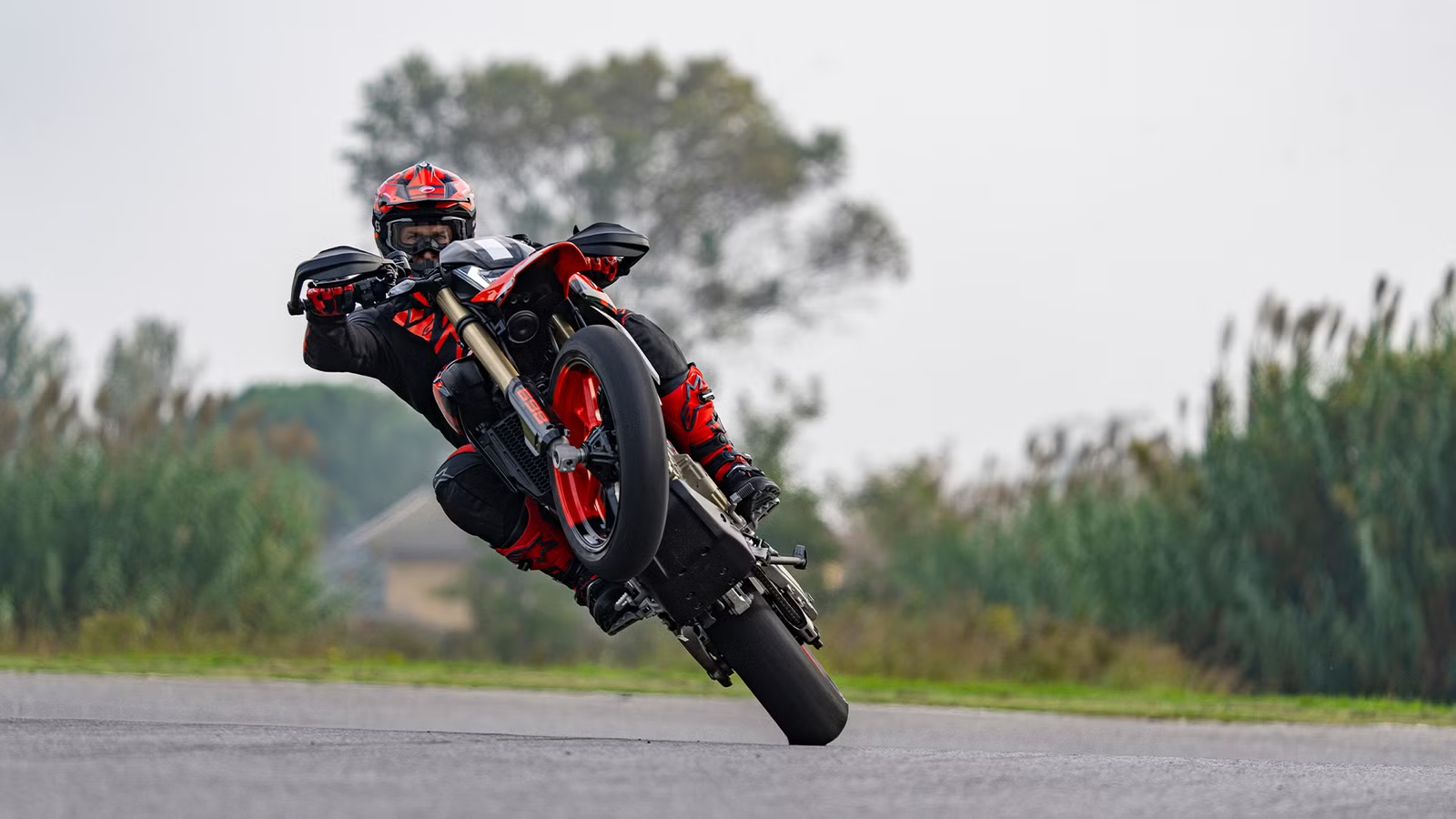
Known for powerful twins and V4s, Ducati chose one cylinder for the Hypermotard 698 Mono to suit its lightweight supermoto format—and demonstrate what its engineers could achieve.
Meet the Ducati Hypermotard 698 Mono – The Record-Breaking Single

The crown for being the most powerful single-cylinder production motorcycle was worn by the Ducati Hypermotard 698 Mono, until early 2026 when KTM updated its LC4 motor and stole Ducati’s thunder. The Hyper’s 659cc mill is called the Superquadro Mono because it is literally half of the 1299 Panigale’s twin-cylinder Superquadro motor. Producing an astonishing 77.5 hp, this block revs up to 10,250rpm, which is exceptional for a single. Slap on a Termignoni racing exhaust and the power output shoots up to 84.5 hp.
The trick to the benchmark-setting performance numbers lies in the engine architecture and metallurgy. With a 116 mm bore diameter married to a super short 62.4 mm stroke, the Superquadro Mono is an extremely oversquare engine with a bore-to-stroke ratio of 1.86. This allows the engine to achieve high rotation speeds. And the dry weight of just 333 pounds makes all that engine performance sound even more exhilarating, with a power-to-weight ratio of 512 hp per tonne.

With such high engine speed comes a lot of stress and the question of reliability. Ducati has addressed that concern with the use of its proprietary Desmodromic valve system. It comprises two distinct cam lobes and two rocker arms – one for opening the valve and the second for physically closing it. This is supposed to be a more robust and reliable setup than the more traditional spring-based valve closing mechanism. A 12-month service interval and 18,000 miles valve clearance check period further ensure a low-stress maintenance regime.
Why Ducati Chose A Single For The Mini Hyper?

Ducati adopted a high-performance single for the Hypermotard 698 Mono because it belongs to the supermoto format of motorcycles. This is a breed of bikes which don’t just demand a peppy engine but light weight and slim design also take precedence. Courtesy of the usage of lightweight materials such as magnesium and titanium, the engine of the Mono weighs just 98.3 pounds, contributing hugely to the motorcycle’s heft being surprisingly low. The compact dimensions of the motor have also allowed Ducati to package it into a featherweight 15.8-pound trellis frame.
All the engineering wizardry by Ducati has spawned a motorcycle that should feel like a toy around a supermoto track in skilled hands. And for those who are far from being skilled enough to pull off crossed-up wheelies and back it in around corners, Ducati has thrown in a plethora of electronic aids to have their back. Derived from the Panigale V4, the 6-axis IMU-backed electronic suite comprises cornering ABS, traction control, wheelie control, engine brake control, power launch system, and four ride modes. While the quick shifter comes as standard fitment on the RVE and Nera editions, standard model buyers need to pay extra for it.
The Edge Over Other Big Production Singles

If you purely look at the numbers, KTM’s updated 693cc LC4 motor produces more power than Ducati’s Superqaudro. The former is used not only in KTM’s SMC R, Enduro, and Rally models, but the Husqvarna and GasGas equivalents of some of them also run on the same mill. As mentioned before, the 2026 update to this motor bumped up the power by close to 4 hp and attempted to snatch Hyper’s crown by producing 78 hp. At 54 lb-ft, even the torque output of the Austrian engine is around 7.5 lb-ft higher than the Italian.
Where the Ducati has an edge over the KTM is in its sportbike-like engine behaviour. While the KTM (and its cousins) hit the limiter at close to 9,000rpm, the Ducati can go singing up to a towering 10,500rpm. Not to forget, slapping on the Termignoni exhaust, which costs around $3,000, raises the output of the Hyper by as much as 7 hp. What else makes the Ducati respectable is the sheer engineering efficiency it presents by making more power per cc despite its 34cc deficit. The fact that it produces 0.117 hp per cc over KTM’s 0.114 hp per cc makes it commendable.
Pure Thrill Without Stacking Cylinders

Reviews praise the Hypermotard 698 Mono for pairing high-revving thrills with everyday usability. Its punchy Superquadro single and nimble chassis deliver plenty of excitement without multiple cylinders. At 333 pounds and a starting price of $13,995, it’s also among Ducati’s lightest and most affordable offerings.
KTM’s latest LC4 narrowly beats it on power, but the Mono remains proof that one cylinder can deliver sportbike-like thrills in a light, compact package.

Related posts


Latest Post


No Comments