
The Motorcycle That Quietly Defines Yamaha’s Philosophy
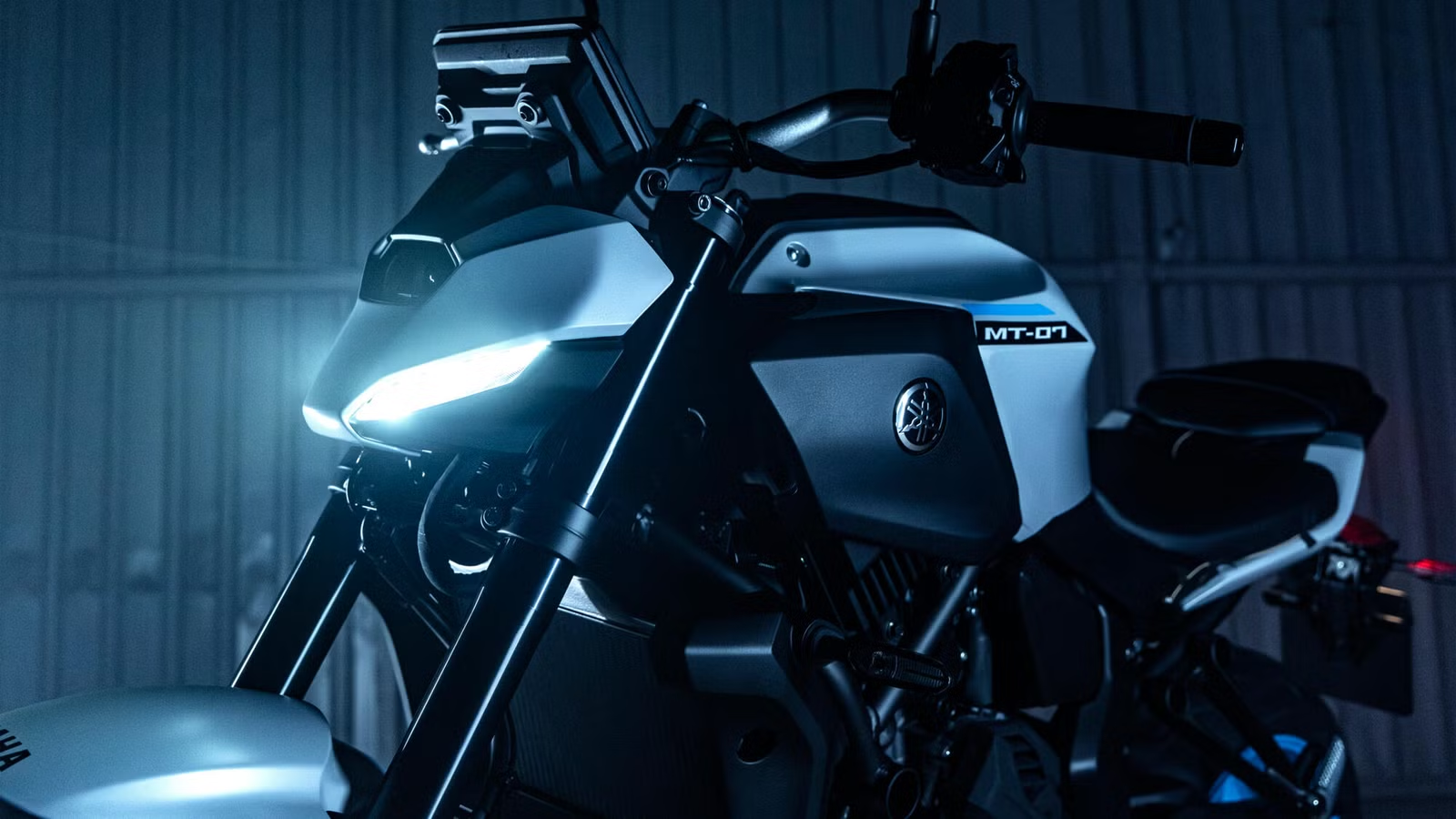
Research a bit, and you’ll find that Yamaha’s corporate philosophy centers around Kando. This Japanese word roughly translates to a feeling that moves you. In the context of what Yamaha wants customers to experience, it is “a feeling of deep satisfaction and intense excitement,” which also ties in with the brand’s “Revs Your Heart” slogan. Rider engagement and value are naturally the two key characteristics that are baked into every model. Thus, all of its bikes try to follow that to the core, but a certain MT manages to do that at a global level.
Yamaha Has Shifted Its Attention Back To Street Bikes

Between the mid-80s and late 00s, sport bikes well and truly captured the imagination. Along with these track-ready bikes, Yamaha also invested heavily in the cruiser segment and boasted a wide selection of premium bikes designed to compete with Harley-Davidson. Value-based street bikes were relegated to an afterthought, with most of them making use of repurposed platforms.

Around a decade ago, sales for both of these more dedicated segments slowed, and Yamaha needed to step away from one of them. The Japanese brand made the difficult decision to completely step away from the cruiser space and rather refocus on building value-based street bikes. For this, we are eternally grateful. The naked bike platforms which were developed over this period have since gone from strength to strength, and in a time when everything seems to be getting expensive, a value-based offering like the bike in question just makes sense.
The Yamaha MT-07 Is Kando Personified
MSRP: $8,599


The MT-07 has been around for quite some time now, but in its current form, it offers more value than ever before. It remains an engaging motorcycle that truly embodies Yamaha’s Kando philosophy. Over the years, this has actually become one of the most popular larger-displacement motorcycles in the world, and it is pretty easy to see why, because it offers a balance of performance and approachability that is hard to beat. It also features one of the most reliable engines currently on the market, and unlike most reliable motorcycles, it will never be accused of being the least bit boring.
An Efficient Parallel-Twin Promises Unrivaled Reliability
Power: 72 Horsepower

One of the key competitive advantages the CP2 has over direct competition is simple reliability. It has been around for well over a decade now and is yet to miss a beat. Since it made its debut, it has also been put in a wide selection of motorcycles, all of which offer this most desirable of characteristics. It has also been tuned specifically for street use, and offers meaty midrange performance, with most of its torque already available from 2,000 RPM.
Balancing Fun And Pragmatism

With a claimed fuel economy of 57 MPG, it makes for a rather practical commuter, but what sets it apart from most of the bikes competing in this space has nothing to do with pragmatism. It is just an unusually characterful twin, which works particularly well here in the naked bike. While it certainly is not the most powerful bike in the MT range, it certainly lives up to its “Master of Torque” moniker.
The MT-07 Offers A Lot Of Bang For The Buck

This middleweight space has become more competitive than ever, and while the Yamaha certainly is not the cheapest, it offers a lot of value. A recent update saw it get a few nice-to-have features, including switchable traction control and ride modes. You also get ABS, a TFT dash with smartphone connectivity, and turn-by-turn navigation.
In that same update (which happened a couple of years ago now), it also got a USD front fork for the first time, which has certainly helped improve the handling. One thing that keeps getting updated, and we are not entirely sure if it is a good thing, is the design. While the previous model was objectively ugly, the latest effort is not much better.

It is arguably the one area where the MT bikes (not just this one) lose ground to the competition. Most of the Japanese naked bikes feature some sort of riff on this angular, semi-futuristic design motif, but it is fair to say Yamaha’s take on it remains polarizing. Which is a genuine shame, because it only serves to detract from a motorcycle that offers such great value at this budget-oriented end of the market.
The Perfect Street Bike

In most respects, the MT-07 really is the perfect street bike. It has a short, nimble chassis which makes it a bundle of fun to ride through a congested city, or a tight and twisty mountain road. It is also incredibly light, with a wet weight of just 403 pounds; it is actually one of the lightest bikes in the middleweight class. But any motorcycle is a compromise, especially a motorcycle that has been built on a budget.
The biggest compromise Yamaha makes with the MT middle child is its chassis. When compared to most of the bikes competing in this space, its steel diamond arrangement looks a little rudimentary. For regular use, it is inarguably sufficient, especially for a motorcycle of this size and power output, but more experienced riders will run into its limits when pushing the bike on a track.
Obviously, it is not a track bike, but even so, the same characteristics hooligans will find appealing; others will find infuriating. Its front wheel is not all that fond of staying planted, and it will lift even when you have absolutely no intention of doing a wheelie. That is just the reality of a bike that is this light, has this much midrange power, and has a chassis this short.
For most riders, as underscored by the sheer amount of MT-07s Yamaha sells around the world, the positives most certainly outweigh these rather inconsequential drawbacks. While it is not the most powerful in the class, nor the prettiest, it splits the difference between rider engagement and practicality in such a way that it makes it quite impossible to ignore. It is an excellent example of what Yamaha brings to the table, and the physical embodiment of the Kando philosophy.
Source: Yamaha Motorsports

Related posts



Latest Post



No Comments