
The Harley-Davidson That Finally Wins Over Skeptics
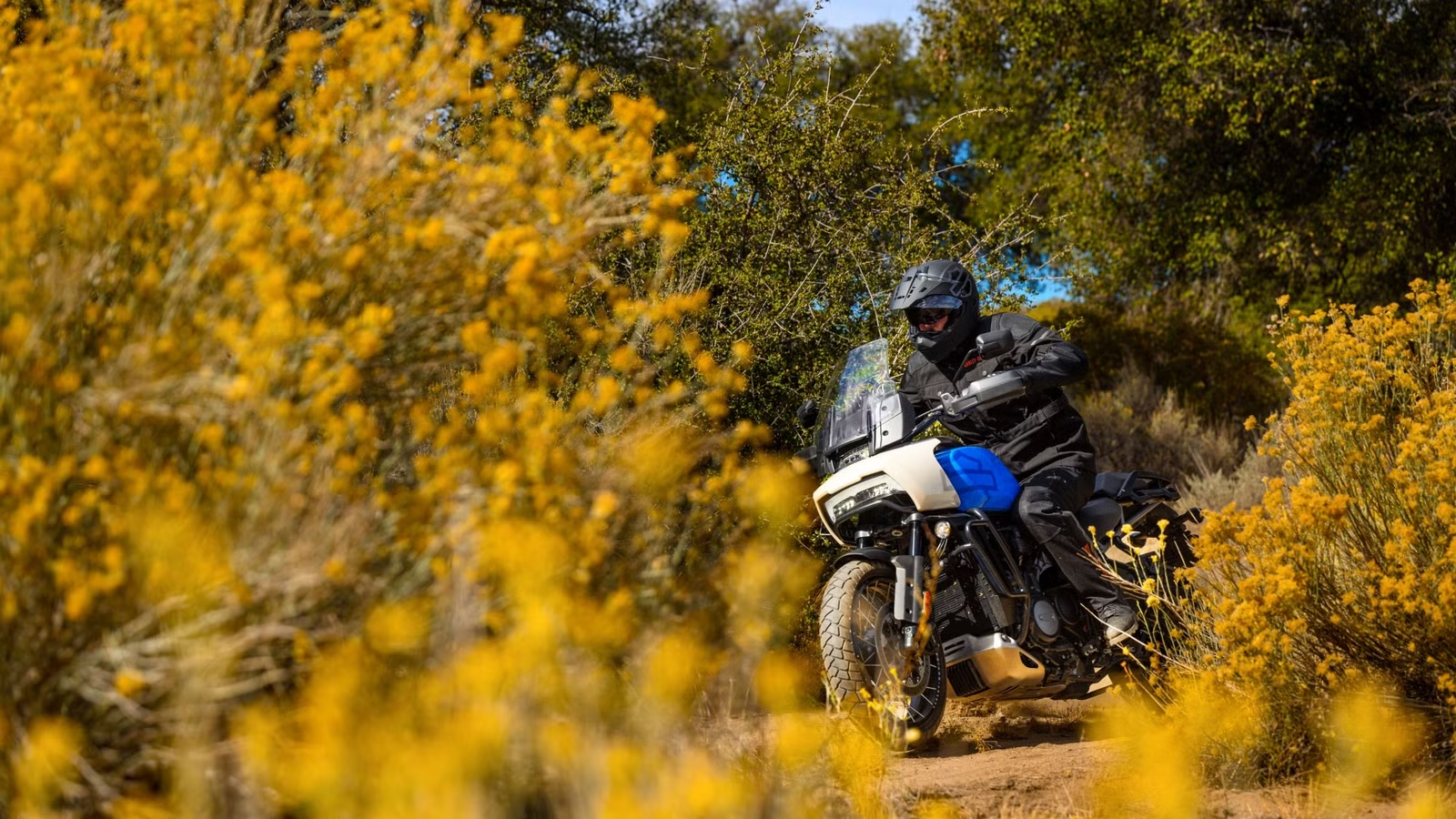
For the longest time, Harley-Davidson has conjured chrome, long wheelbases, V-twin rumble, and open highway. That’s the image the brand has spent a century building, and for most of that century, it worked spectacularly well. You knew exactly what you were getting when you walked into a Milwaukee showroom. You weren’t there to buy a motorcycle that could handle a gravel switchback or come equipped with nine riding modes and a lean-sensitive ABS system. You were there to buy a low-slung head-turner. Thus, with a century-long dominance in this space, trying to depart from the formula is a massive gamble. Yet, the brand did exactly that and proved skeptics wrong in a surprising manner.
Harley-Davidson Made A Bold Leap Beyond Asphalt In 2021

There’s something almost absurd about the idea of Harley-Davidson building an adventure motorcycle. For decades, the brand’s identity was synonymous with low-slung cruisers, highway-eating tourers, and bikes that never, under any circumstances, go near a dirt road. The core audience liked it that way.
So when the company announced it was going to take on the adventure bike segment — a world dominated by German engineering — the reaction was about what you’d expect. Polite skepticism from the press. Open mockery on forums. And a lot of very loyal Harley riders were wondering out loud what Milwaukee was thinking. Yet, against all odds, this wild gamble didn’t just survive—it absolutely crushed expectations.

The ADV crowd has always been a particular kind of opinionated. These are riders who debate suspension geometry over breakfast and have strong opinions about tire compounds. The benchmark machines — BMW’s GS, the KTM Super Adventure, the Ducati Multistrada V4 — had been refined over decades by engineers who’d grown up building serious off-road and performance hardware. The idea of Harley-Davidson entering that conversation with a credible machine felt, to many, like a category error.

The criticisms started the moment concept images surfaced. It’ll be too heavy. It won’t handle the dirt. Harley riders don’t wear full-face helmets and Klim gear. Some of those shots were fair. Most weren’t. What the skeptics missed was that Harley wasn’t trying to build something that looked like an adventure bike — they were genuinely engineering one from scratch.
The Harley-Davidson Pan America 1250 Special Won Over Skeptics
Base Price: $19,999

When the Harley-Davidson Pan America 1250 Special arrived in early 2021, it arrived as a clean-sheet machine. Not a cruiser with longer suspension travel bolted on, not a marketing exercise dressed up in rally-raid colors. The bike has remained relatively unchanged since its launch — a testament to how well Harley got it right the first time. The Revolution Max 1250 engine was developed specifically for this platform, sharing its 60-degree V-angle with the brand’s legendary VR1000 superbike project. The frame, the geometry, the electronics suite — none of it borrowed from anything Milwaukee had made before.
Critics who rode it early came back with the same general expression: mild disbelief. One publication called it a brilliant adventure bike in its own right, one that could hold its head up high against the best that European and Japanese manufacturers offer — and went as far as suggesting it lays a strong claim to being the best bike the company has ever built, if you look at handling and performance both on-road and off.
How A First-Gen Contender Outsold The Established Giants

The results were shocking. Within months of its debut, Harley-Davidson was bragging that the Pan America 1250 Special had become the best-selling adventure touring motorcycle in North America. The company even announced that it had sold out its entire 2021 allocation of Pan Americas. Industry data backed this up: Harley’s earnings call reported over 4,000 Pan Americas shipped by mid-2021 – roughly a thousand more than any competitor.
In other words, Harley had quietly leapfrogged BMW’s flagship GS series and KTM’s stalwart 1290 Adventure, at least in initial sales, even though the Harley was only on sale for three quarters of the year. Die-hard sport-tourers and dirt riders who swore they’d “never buy a Harley” found themselves putting down deposits after demo rides. The shockwaves were real: BMW, KTM, and others had long held this segment, and suddenly a Milwaukee newcomer was outselling them.
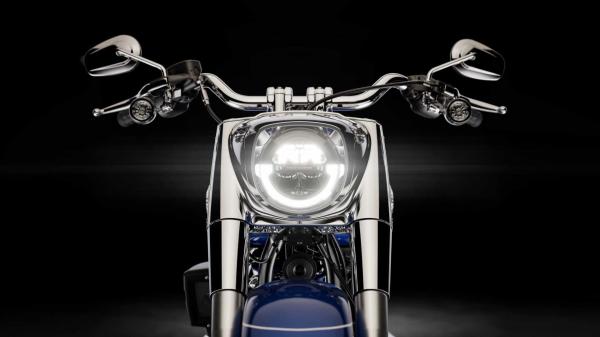
10 Most Affordable Harleys You Can Buy Right Now
Harley-Davidson’s most affordable models are a pleasantly surprising mix
The Revolution Max 1250 Engine Is Harley’s Most Advanced Powerhouse

The Revolution Max 1250 engine produces 150 hp at 8,750 rpm and 94 lb-ft of torque at 6,750 rpm. Those numbers, on a Harley-Davidson, still feel slightly surreal in 2026. The liquid-cooled 1,252cc V-twin uses variable valve timing (VVT) to widen its powerband significantly, delivering tractable torque at low revs while continuing to pull cleanly all the way to the top of the tachometer. The best thing, however, is that it never feels as if there is too much power for the chassis.
That balance is harder to achieve than it sounds, and it’s one of the reasons Pan America works as a complete motorcycle rather than just an impressive spec sheet. It isn’t a traditional Harley engine. It revs freely, it pulls hard all the way through the range, and it does so with a refinement the air-cooled Milwaukee-Eight was never asked to deliver.
Exhaust Note That Reminds Us It’s a V-Twin

Harley managed to keep enough character in the engine note to remind you what you’re riding. It’s not the thunderous, low-frequency thump of the touring lineup, but there’s enough V-twin pulse at idle and low revs to feel distinctly American. One honest caveat worth mentioning is the radiant heat present at low speeds in warm weather, particularly in stop-and-go traffic. It’s a consequence of the engine’s exhaust routing.
Built To Handle Roads Harleys Don’t Belong On

The rear suspension on the Pan America 1250 Special uses a Showa monoshock with automatic preload control and semi-active compression and rebound damping, offering 7.5 inches of travel. The semi-active system reads road conditions continuously and adjusts in real time, which is particularly noticeable on broken tarmac and gravel. The geometry backs that up. Rake and trail figures sit in the same ballpark as the GS, and real-world cornering behavior reflects that. Thus, the Pan America is as true an adventure bike as any BMW GS or KTM Super Adventure.

Adaptive Ride Height taps into the semi-active suspension to lower the seat when the bike comes to a stop, helping especially newer and smaller riders put a foot or two firmly on the ground, and automatically returns to normal ride height when moving. This feature surprised people the most when they first encountered it. While it was only present on the premium variant earlier, it is now standard on the Pan America. This allows riders to switch between 31.1-inch and 32-inch seat heights. On a motorcycle that weighs just under 580 lbs, the ability to confidently get a foot down at every intersection is a desired feature for most riders. No direct rival at this price point offers anything comparable as a factory fitment.
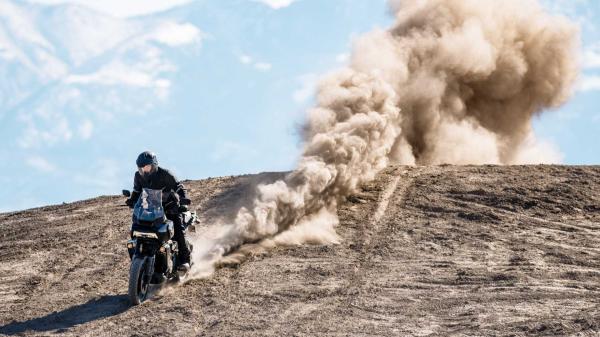
The Three-Year-Old Adventure Bike Worth Buying In 2025
Resale values for high-end luxury motorcycles continue to tumble, and this adventure bike might be the worst affected
Premium Electronic Features Right From The Factory

The Pan America 1250 Special’s Rider Safety Enhancements system includes Cornering ABS and Traction Control, with the cornering-enhanced version adjusting for lean angle to keep things smooth and steady. Wheelie control, hill hold control, and TPMS round out a safety net that covers most of what a rider could realistically encounter across mixed terrain.
Topping things, nine pre-programmed ride modes are accessible through the system, spanning Rain, Street, Sport, and multiple off-road profiles. The Custom mode lets experienced riders dial in their preferred combination of throttle response, ABS sensitivity, traction control threshold, and suspension behavior independently — so the bike can be set up exactly as the rider wants rather than as a compromise across presets.
Infotainment And Connectivity Via A Massive TFT

The 6.8-inch TFT color touchscreen features tap-and-swipe control that works even while wearing gloves, with Bluetooth connectivity via the H-D Connect system letting riders sync routes, playlists, and incoming calls and texts directly to the display. The Adaptive Forward Lighting system adjusts the LED headlight based on lean angle — a genuinely useful feature on winding mountain roads after dark.
Where the Pan America still trails the very best European rivals is in turn-by-turn navigation refinement. BMW’s connectivity interface, offered in the R 1300 GS, offers a more polished mapping experience with tighter smartphone integration. Riders have pointed out that while Harley’s system is capable and intuitive, it hasn’t quite reached that level of seamlessness.
Source: Harley-Davidson

Related posts



Latest Post


No Comments