The Hybrid Sedan That Makes Fuel Costs Feel Irrelevant
8 minutes reading
Monday, 22 Jun 2026 13:01 0 137 autotech
Hybrid car technology in the U.S. has undergone a remarkable transformation, evolving from a niche, experimental segment at the turn of the millennium into a cornerstone of the modern automotive market by 2026. Initially defined by specialized, efficiency-focused vehicles like the early Honda Insight and Toyota Prius, the technology was once viewed with skepticism and largely relegated to early adopters seeking maximum fuel economy.
Over the decades, however, manufacturers have successfully moved beyond these limited applications, integrating advanced hybrid systems across a diverse array of platforms, including popular SUVs, sedans, and luxury vehicles. This shift was accelerated by sensible consumer demand for fuel efficiency without the range anxiety or infrastructure reliance associated with pure electric vehicles. Over time, there have been a few compelling and revolutionary HEV creations, but one Japanese model stands out as a remarkable and high-quality option.
As of 2026, the demand for hybrid cars in the U.S. has reached a historic peak. The market is estimated at approximately $312.8 billion and captures a 42 percent share of the global hybrid sector. This surge is primarily driven by a pivot among American consumers who seek significant fuel efficiency and lower emissions without having to deal with the hurdles currently associated with fully electric vehicle ownership.
Over the last decade, hybrids have evolved from niche, economy-focused commuter cars into sophisticated and high-performance vehicles. Modern systems now benefit from advanced power electronics and lightweight materials to provide better acceleration and towing capabilities than their gasoline-only predecessors, effectively positioning hybrids as the new mainstream standard for the American road.
No One Beats Toyota In Hybrid Tech
2026 Toyota Corolla Hybrid HEV BadgeToyota
Toyota’s strategy in the U.S. for 2026 continues to center on a diverse but concentrated approach. The Japanese brand prioritizes a diverse lineup of crossovers and SUVs that cater to varying consumer needs rather than pivoting exclusively to battery-electric vehicles. This strategy has proven exceptionally successful. As of the first quarter of 2026, the brand’s hybrid vehicles accounted for over 50 percent of total sales volume. This is a milestone that reinforces its market dominance. Sales of its most popular compact and midsize utility models remain at historic highs.
Specific off-road-focused entries saw year-on-year surges as high as 84 percent for internal combustion variants and even more dramatic triple-digit growth for its hybridized counterparts as new generations reached dealerships. Toyota introduces hybridization as a core powertrain pillar, often making it the standard or exclusive offering for high-volume models to normalize the technology. By integrating planetary gear-based power split devices and high-capacity lithium-ion batteries across its catalog, the brand offers a seamless driving experience that requires no change in consumer behavior. Toyota’s choice to standardize hybridization effectively captures 37 percent of buyers who prioritize long-term resale value and low maintenance costs over the early adoption of fully electric platforms.
These Affordable Hybrids Are An Incredible Used Buy
These budget-friendly hybrid vehicles deliver exceptional fuel savings and reliability that make them smart buys today.
The Toyota Corolla Hybrid Aces Fuel Efficiency
Red 2026 Toyota Corolla Hybrid Side View While Going Around A CurveToyota
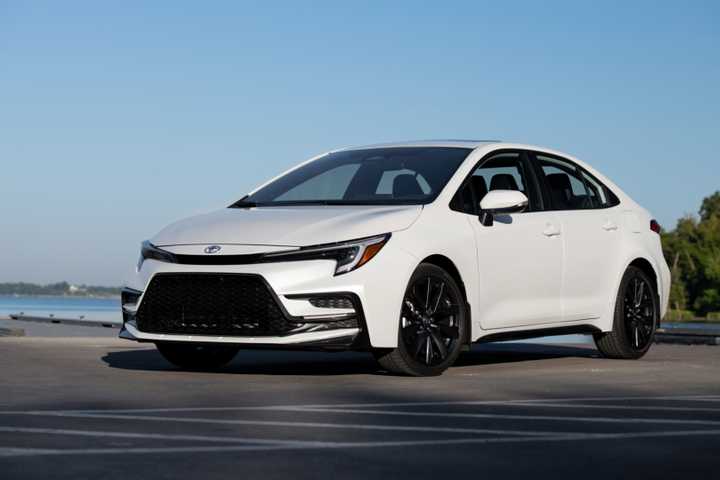
The 2026 Toyota Corolla Hybrid sedan is one of the brand’s most successful hybrid products, for multiple reasons. It may not be a high-performance hybrid, but it returns some attractive EPA-estimated fuel consumption results. The front-wheel-drive LE is the most efficient of the lot, returning a 53/46/50 MPG result on its city/highway/combined cycle. The EPA indicates this model will save you $5,250 in fuel costs over five years compared to the average new vehicle sold in the U.S. You’ll spend $1,350 on fuel every year and $2.25 to drive 25 miles.
The Corolla Hybrid range also has the added benefit of an optional all-wheel-drive system. The all-wheel-drive SE is the least efficient of the lot, bringing in a 41/47/44 MPG result. The all-wheel-drive model reduces the car’s tank size from 13.2 to 11.3 gallons, resulting in a decreased range from 565 to 497 miles on a single tank of gas. All hybrids feature the same 0.9 kWh nickel-metal-hydride battery.
Long-Term Ownership Costs Are Equally Appealing
2025 Toyota Corolla Hybrid Rear Three-Quarter DrivingToyota
According to Edmunds, the entry-level LE is the cheapest model that you can own, with an expected ownership cost of $30,470 over the course of five years and 60,000 miles. Included in this is $3,613 on maintenance, $601 on repairs, $10,259 on depreciation, and $5,029 on fuel. According to CarEdge, the Corolla, on average, will cost $34,616 to own, including $9,013 on depreciation, $6,600 on fuel, and $1,430 on maintenance.
RepairPal estimates that the 2026 Toyota Corolla Hybrid has an average annual maintenance and repair cost of $362, significantly lower than the $526 average for compact cars. Both the non-hybrid and hybrid models benefit from Toyota’s high reliability rating of 4.5 out of 5.0. Kelley Blue Book highlights that despite the hybrid’s specialized components, its long-term maintenance remains competitive with the gasoline model, often averaging under $400 annually once the free coverage expires.
The Hybrid SUV That Quietly Became The Smartest Buy In America
This compact Japanese crossover is a hugely underrated deal in 2026.
Toyota’s Trusty HEV Technology
A shot of the 2023 Toyota Corolla’s Hybrid powerplantToyota
The Toyota Corolla Hybrid features the brand’s previous-generation 1.8-liter four-cylinder Atkinson cycle 2ZR-FXE engine. The engine has the same bore and stroke as the non-hybrid model. Toyota gives it an increased 13.0:1 compression ratio and a late-stage closing inlet valve. In isolation, the powertrain generates 98 horsepower and 105 pound-feet.
Toyota merges this engine with a triple-permanent-magnet Hybrid Synergy Drive configuration, bringing the combined output up to 138 horsepower and 152 pound-feet of torque. The larger motor generates 93 horsepower, and the smaller just 40 horsepower. Toyota doesn’t disclose the third motor’s output or any of the torque figures. This output doesn’t change whether you select the front or all-wheel drive system. Toyota’s signature Electronically Controlled Continuously Variable Transmission is the only transmission option available.
Toyota doesn’t declare any official performance times, but independent testers reveal the all-wheel-drive model accelerates from 0 to 60 MPH in 9.0 seconds. The front-wheel-drive model is marginally slower, with a 9.6-second 0-60 MPH time. Toyota limits the entire range’s top speed to 114 MPH.
The Added Benefit Of Bulletproof Reliability
Front 3/4 shot of 2025 Toyota Corolla Hybrid in red parkedToyota
The 2026 Toyota Corolla sedan in both ICE and HEV formats benefits from highly impressive reliability standards, making it an exceptional option if you are a first-time buyer who doesn’t want to be left stranded on the side of the road. iSeeCars groups the drivetrains together and estimates that all Corollas will have an average lifespan of 11.4 years or 149,308 miles with a 17.5 percent probability of reaching 200,000 miles.
J.D. Power, grouping both drivetrain options as well, backs this with an 81/100 quality and reliability score, together with 79/100 for the driving experience, 88/100 for resale, and 76/100 for the dealership experience, bringing its consumer-verified overall score up to 76/100.
The Hybrid Car With The Best Fuel Economy In 2026
This full hybrid is the fuel-economy champion among cars that require no special charging routine from the driver to attain maximum efficiency.
Toyota’s Comprehensive Standard Specification
Interior of a 2025 Toyota Corolla Hybrid XLEToyota
The Toyota Corolla Hybrid range starts at a very competitive $24,975 for the base LE, followed by the $27,415 SE, and flagship $29,340 XLE. You can fit all derivatives with the $1,400 all-wheel drive system, and you also have to consider the brand’s mandatory $1,195 destination fee. The brand also offers a host of optional extras and packages, but these differ depending on which trim you are considering.
Base Trim Engine
2.0-liter 4-cylinder
Base Trim Transmission
CVT
Base Trim Drivetrain
Front-Wheel Drive
Base Trim Horsepower
169 HP @6600 RPM
Base Trim Torque
151 lb.-ft. @ 4400 RPM
Make
Toyota
Model
Corolla Sedan
Segment
Compact Sedan
Standard comfort and convenience features have seen a significant boost for 2026, with every trim now including a fully digital instrument cluster measuring 7.0 inches on the LE and SE and 12.3 inches on XSE and XLE. All models also include the Toyota Safety Sense 3.0 suite. Entertainment is anchored by a standard 8.0-inch Toyota Audio Multimedia touchscreen featuring wireless Apple CarPlay and Android Auto, with higher trims offering a larger 10.5-inch display and an available nine-speaker JBL Premium Audio system. Higher grades like the XSE also benefit from more premium touches, including SofTex-trimmed heated front seats, a power sunroof, and Qi wireless smartphone charging.
A Warranty That Has Your Back
2025 Toyota Corolla Hybrid Profile DrivingToyota
The 2026 Toyota Corolla comes with a standard three-year or 36,000-mile basic warranty and a five-year or 60,000-mile powertrain warranty. Hybrid models include an additional eight-year or 100,000-mile warranty on hybrid-related components and a 10-year or 150,000-mile battery warranty.
All Corolla purchases include ToyotaCare, which covers factory-scheduled maintenance for two years or 25,000 miles. Servicing follows a strict 5,000-mile interval, requiring a tire rotation and multipoint inspection, while synthetic oil changes and filter replacements typically occur every 10,000 miles. Major inspections of the fuel system, brakes, and suspension are required every 30,000 miles.
Sources: Toyota, The EPA, Edmunds, J.D. Power, iSeeCars, RepairPal, and CarEdge.














No Comments