
The First Production Car To Break 500 Pound-Feet Of Torque
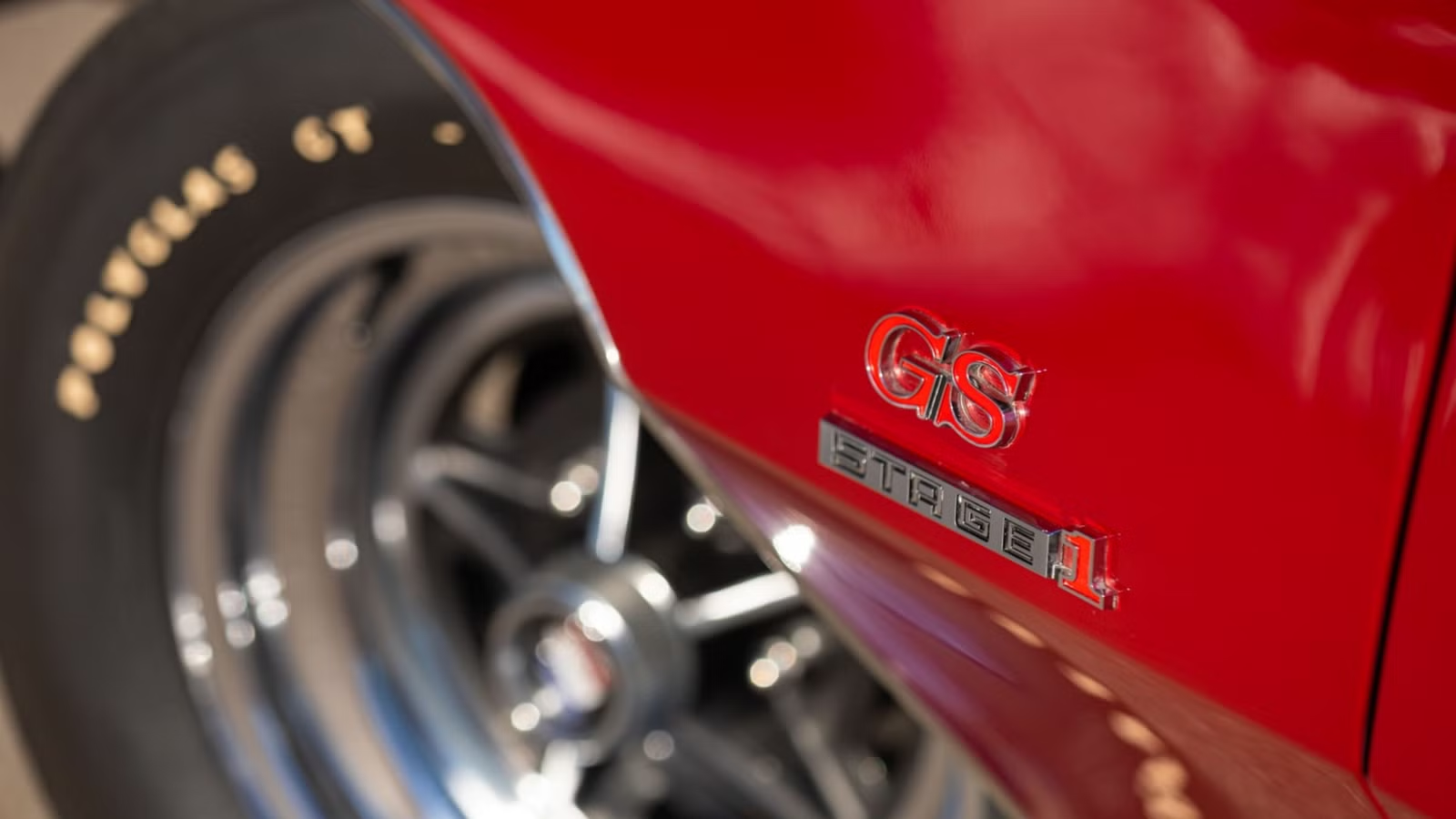
Long before superchargers and hybrid torque-fill became the industry’s go-to performance shortcuts, American engineers were wringing staggering twist out of iron-block V8s through sheer displacement and mechanical ingenuity. The story starts, as so many do, with Ford. Introduced in 1932, the Flathead V8 was the first affordable, mass-produced eight-cylinder to give everyday drivers a taste of real performance. A few years later, the 239 cubic-inch V8 — dubbed the “100 Horse” engine — became the first powerplant to crack 100 horsepower in an accessible car. From that moment, American automakers were locked in an escalating horsepower arms race. The first car to hit 200 hp skipped that milestone entirely and went straight to 300 ponies: the 1955 Chrysler C-300. Then the obscure 1958 Mercury Super Marauder pushed the needle to 400. Ford Of course, horsepower means nothing without tire-shredding torque, especially for launching off the line. That meant pound-feet were also on an upward trajectory. Drag racing went mainstream in the early 1960s and Detroit responded with some torquey V8s like the Chrysler 413 Max Wedge and Chevy 427 Z11 that were flirting with 500. While we would have to wait until the 2003 Dodge Viper SRT-10 Roadster for a factory 500-hp car, a 500 pound-feet of torque ride came much earlier — in 1970, and from a fairly unexpected source. In reality, this Buick exceeded 500 and held the record for more than three decades.
Why Muscle Cars Love Torque So Much

One of the most misunderstood things about cars is the difference between horsepower and torque. They are both related, but serve different functions. Horsepower is the “sexy” number that sells performance vehicles — the higher the better — but it’s torque that really moves a car off the line.
Torque is the rotational force that breaks a car loose, while horsepower is how fast that initial push can be sustained. Put simply, torque gets you moving and horsepower brings you up to speed. High horsepower cars High-revving engines can deliver amazing top speeds, but massive-torque powerplants are acceleration monsters, which is exactly why muscle cars pack in the pound-feet. Big torque is the difference between a soccer-mom-mobile and a street assassin.
The Torquey As Hell 426 Street Hemi

When Chrysler dropped the 426ci Hemi V8 on the Dodge and Plymouth lineups in 1966, it forever changed the Golden Age of American Muscle, giving the streets entirely to Mopar. With 425 horsepower and 490 lb-ft of torque, a Hemi-powered anything was a guaranteed 13-second car straight from the factory. Yes, the ponies were impressive, but the complementary torque meant a Hemi car was already gone when the light turned green.

Both the ’66 Pontiac GTO and Chevy Chevelle SS 396 had 415 pound-feet of torque and each wallowed in the 14s, while the Charger Hemi was ripping 13.5-second quarter-mile ETs. Chances are the 426 Street Hemi was actually producing closer to 500 hp and 500+ lb-ft, but this is all about official ratings.
GM Stump-Pulling Big Blocks

One of the biggest blunders in automotive history was GM banning its divisions from fitting engines over 400 cubic inches of displacement in intermediate cars in 1963 — one year before muscle car mania hit. Corporate finally came to its senses and lifted the misguided ban in 1970.
Chevy, Oldsmobile, and Pontiac went big-block crazy, fitting their muscle cars with 500 pound-feet of torque V8s Suddenly, in the penultimate year of the classic era, GM muscle was running in the 13s and competing with Mopar. Granted, 500 lb-ft is genuinely impressive torque, but there was another car in GM’s stable that was downright awe-inspiring.
1970 Buick GS 455 Torque Beast

Thanks to GM mercifully rescinding its pointless big-engine ban in 1970, the pretty cool Buick GS 400 became the completely awesome GS 455. Sharing the same basic A-body platform as other GM coupes, the GS 455 set itself apart with unique sheet metal, a bold front fascia, and an insane amount of torque.
The aforementioned GTOs, Chevelles, and 442s were batting 500 in the torque department, but the GS 455 hit a walk-off grand slam with 510 stadium-shaking pound-feet. Joining the GS 455 in 1970 was the limited-edition GSX, which was primarily an appearance package, but still packed all the terrifying power of the base model, so there were technically two 510-torque beasts that year.
Secrets of the Buick 455 V8

Buick, Pontiac, and Olds all had their own 455ci V8 engines, but the one that went into the ’70 GS 455 was special. Built with thin-wall construction, it was roughly 150 pounds lighter than the other GM big-blocks — a significant advantage for the power-to-weight ratio. The base 455 generated 350 hp, but the Stage 1 upgrade, which added bigger valves and a hotter camshaft, pushed output up by another 10 ponies.
In either configuration, this engine churned out 510 lb-ft of torque that peaked at low RPMs for rocket-like launches. There’s considerable speculation that the Buick 455 Stage 1 was probably more like 400 hp based on its bonkers acceleration figures — and that may well be true, but that massive torque gets you off the line in a hurry regardless.
GM’s Fastest Muscle Car

In a 1970 GM A-body drag race, the GS 455 would clear a quarter-mile first, followed closely by the Chevelle SS 454 LS6, with the 442 W-30 and GTO Judge 455 dragging the rear. The torqued-out GS 455 could blast out a 13.34-second ET — quicker than the Chevelle’s 13.4-second time, and light years ahead of the 442 and Judge, which ran in the 14s.
The GTO Judge’s 455ci V8 produced 360 hp, which is the same displacement as the GS 455, and had only 10 fewer lb-ft of torque, yet ran a full second slower. There’s got to be some kind of magic under that Buick’s hood. Whatever it was — torque, weight, or a combination of both — it allowed the GS 455 to nose out a car with a 90 hp advantage and claim the title of GM’s quickest muscle car.
GS 455 Holds Torque Crown For Decades

In the Golden Age of American muscle, when a car set a record for power output, it was almost certainly bested the following year by a rival manufacturer. The 1970 GS 455’s 510 lb-ft of torque milestone, however, stood for 33 years — the longest any production car has held that particular performance throne.
All good things must come to an end, and the GS 455’s reign was finally over when the Dodge Viper’s mighty V10 was upgraded to 8.3 liters, producing 510 hp and 535 lb-ft of torque. Subsequent versions of the Viper engine climbed as high as 645 hp with 600 lb-ft of torque, but enthusiasts don’t remember those quite the way they do the first car to crack the 500 lb-ft mark.
How The GS 455 Compares To Modern Muscle

Numbers like 510 lb-ft might not sound earth-shattering today, especially in an era where modern muscle cars are pushing well beyond 600 or even 900 lb-ft. But context is everything.
The GS 455 achieved that figure without forced induction, hybrid assistance, or modern traction control systems. It relied purely on displacement, airflow, and clever engineering. Measured against today’s torque monsters, the achievement becomes even more impressive.
Then vs Now Torque Comparison:
|
Car |
Year |
Engine |
Torque |
|---|---|---|---|
|
Buick GS 455 Stage 1 |
1970 |
7.5L NA V8 |
510 lb-ft |
|
Dodge Viper SRT-10 |
2003 |
8.3L NA V10 |
535 lb-ft |
|
Dodge Challenger Demon 170 |
2023 |
Supercharged 6.2L V8 |
945 lb-ft |
What stands out is how long it took for naturally aspirated engines to significantly surpass Buick’s number. Even decades later, big displacement remained the only reliable path to those kinds of torque figures without boost.
The GS 455 wasn’t just ahead of its time — it set a benchmark that took generations to meaningfully surpass.
Current American Torque Champ

In the modern age, hybrids and full electrics post gonzo torque ratings — figures like the 973 lb-ft of the Corvette ZR1 or the 1,741 lb-ft of the Rimac Nevera. Electric assist feels like cheating, so we’re disqualifying those rides and handing the crown to a good old gas-burner.
The Dodge Challenger SRT Demon 170 and its supercharged 6.2-liter Hemi V8 produce an almost inconceivable level of power — 1,025 hp and 945 lb-ft of torque. Before anyone starts citing the Bugatti Chiron Super Sport’s 1,180 lb-ft torque rating, this is about American cars, and we’re not about to let some pretentious European steal our thunder.
Buick GS 455 Stage 1 Collector’s Market

Despite being GM’s most lethal street machine and one of the baddest cars of the Golden Age, the 1970 Buick GS 455 doesn’t command the same collector respect as many of its contemporaries. Hagerty sets the Concours condition value of a GS 455 Stage 1 coupe at $123,000. While that’s not exactly chump change, it’s nothing compared to the $220,000 a ’70 Chevelle SS 454 LS6 commands. Over in Mopartown, a ’70 Dodge Challenger Hemi R/T in top condition is valued at $245,000, while a Plymouth Hemi ‘Cuda fetches $275,000. These values are for hardtops, naturally, as Hemi convertibles can and do stretch into the millions.
Speaking of drop-tops, that super-vanilla white convertible pictured above is the most expensive ’70 GS 455 to ever sell at auction, crossing the block at Mecum Kissimmee 2024 for $285,000. With only 278 units of the ’70 GSX Stage 1 ever built, it’s tempting to think it would be the highest seller, but the most one of them ever fetched at auction was $236,500. Classic.com reports the average auction price for a ’70 GS at $102,788, though the site does list several great-condition 455s and even a few Stage 1 cars that sold below the six-figure mark. This is clearly an undervalued gem that is due for a market correction.
Sources: Classic.com, Hagerty, Mecum

Related posts

Latest Post



No Comments