
The 172-MPH Italian Superbike That Cost Two Golf GTIs And Weighed Like A 600
Motorcycle engineering had very few limits in the early 1990s. The pursuit of higher speeds continued, manufacturers were squeezing ever-more power from their engines, and new materials were becoming more common in the war against weight. It was an amazing time for riders, but for smaller manufacturers, it was tricky. How could they compete with the biggest brands in the world and carve out their own niche? One approach was to look further from home for new power.
The Early ‘90s Superbike Wars Were All About Outrunning Japan

The early 1990s superbike arms race was a true golden age. Manufacturers were locked in a relentless quest for power, speed, and, more importantly, bragging rights. Yamaha, Honda, Kawasaki, and Suzuki all had the muscle to turn their flagship bikes into two-wheeled missiles, with numbers increasing more and more with each new release. Bikes like the Suzuki GSX-R1100, Honda CBR900RR Fireblade, Kawasaki ZZ-R1100, and Yamaha FZR1000 EXUP were all competing against each other for hearts, minds, and sales, redefining what a modern performance bike could be.
But Japan’s giants weren’t the only manufacturers chasing that dream. Across Europe, small specialist workshops were taking a different approach. Some tried precision engineering, others tried exotic materials, and others paid painstaking attention to detail in their quest to compete against Japan’s might. But while some manufacturers tried to forge their own paths, others decided that if you can’t beat them, join them.
Why Europe’s Boutique Builders Played By Different Rules


Italian manufacturers in particular have always had a distinctly different way of doing things. Japan had long had the edge when it came to mass-production and, by the 1990s, it would be almost foolish to try to compete. So, rather than investing the time, effort, and money in creating their own power units, some sourced proven engines from established manufacturers and spent their time on the parts that go around them. Carefully engineered frames, premium suspension, improved aerodynamics, and extreme weight reduction all promised sharper handling and more exclusive performance from the same powerplant.
This created a compelling combination: the established engineering of a Japanese bike, with the dramatic styling and flair of an Italian one. This gave riders something that would stand out as special, but had the engine parts availability of something mass-produced. A revelation. And, by 1992, there was one bike that did this to devastating effect.
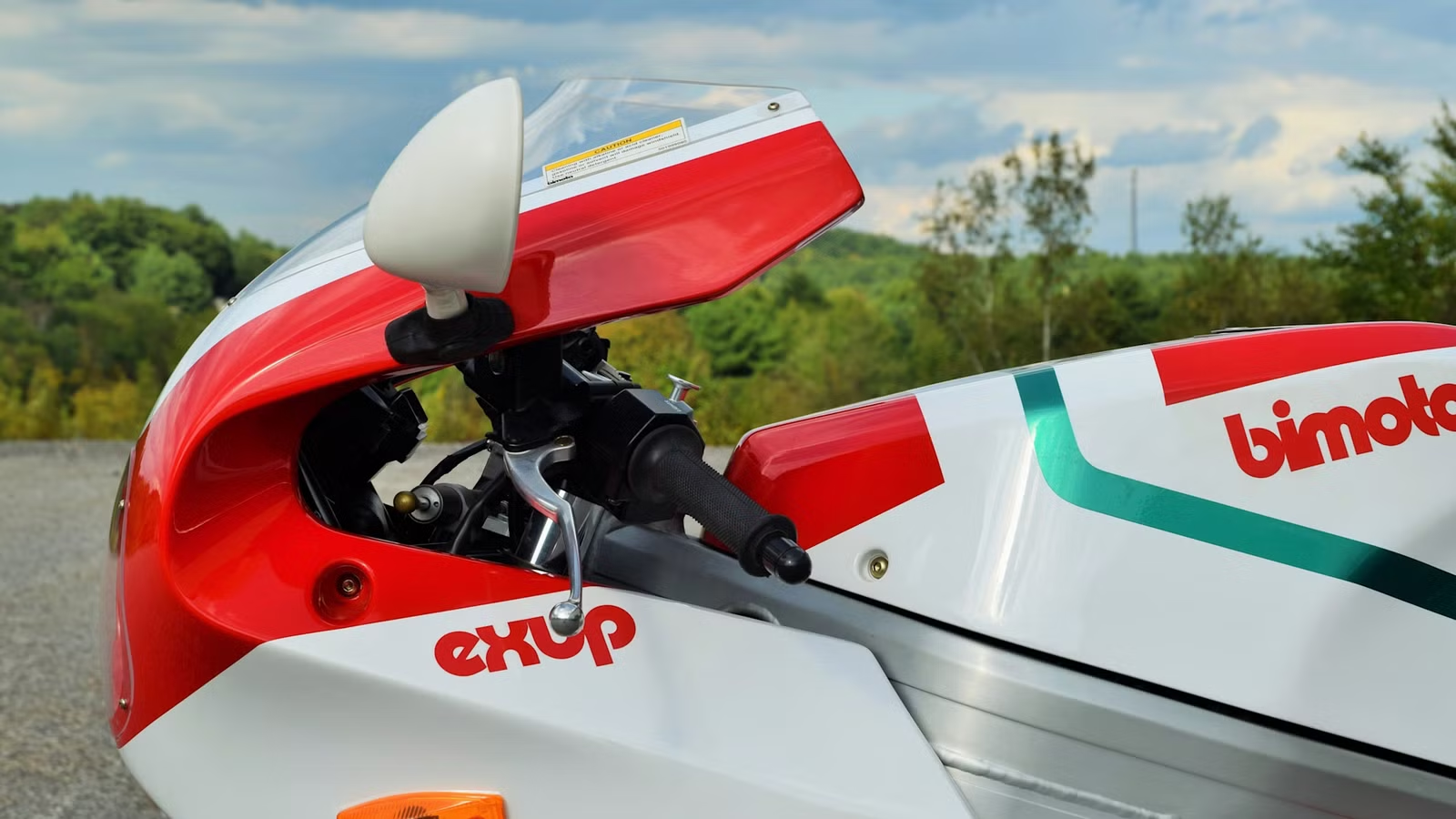
The Bimota YB8 Furano Used Yamaha Power To Reach 172 MPH

Bimota has always been a little … eccentric. The boutique Italian manufacturer was never meant to mass-produce anything other than jealous glances, as it rejected conventional motorcycle design and instead opted for the outlandish from day one. Its YB8 Furano was no different, as it combined cutting-edge Japanese technology with an uncompromising, stunning Italian chassis.
At the heart of the Furano sat a 1,002 cc, 20-valve inline-four derived from the Yamaha FZR1000 EXUP, which was famous for its EXUP Exhaust Valve. This was a servo-driven valve in the exhaust manifold that varied exhaust flow to improve torque delivery across the rev range. But the Furano was about more than just power: it was also about the frame wrapped around that engine.
One defining feature of the Furano was its Weber-Marelli electronic fuel injection. These are again some fancy words for a fancy bike, but they had a purpose other than to sound slightly better than the carburetors you’d have got with the FZR1000 EXUP. By using fuel injection, Bimota could be more precise with the fueling, use larger throttle bodies, and create a more highly-tuned version of the already powerful engine. Power went from around 145 HP in the Yamaha to ~165 HP in the Bimota, alongside its 172 MPH top speed and 396.8 lb dry weight. It kept this weight down with an aluminum twin-spar frame and carbon fiber (uncommon for the time) was used to further reflect Bimota’s commitment to lightness. A good engine is wasted on a heavy bike, after all.

All this effort meant the Furano was genuinely up there with the best bikes of its time, boasting power that could make the big four blush. But with that power and exclusivity came price. The Bimota would set you back the equivalent of $37,900 back in 1992 (a whopping $90,490 adjusting for inflation), which made it emphatically more expensive than its peers. The FZR1000 EXUP, for example, was on the more expensive side at $7,600 new in 1987. You could have bought almost five of them for the price of one Furano. But the price was somewhat part of the point of the Furano — exclusivity comes at a cost, and it was never meant to be an everyday, mass-market thing. This was a bike that you likely couldn’t have. And that’s why you wanted it.
Beating The Japanese Giants Came At A Price

The Furano demonstrated how far specialist engineering could push superbike performance but, as with all things, this sophistication came with compromises. Having a Yamaha engine did mean that parts were far easier to source, but opting for electronic fuel injection over traditional carburetors meant that issues were harder to diagnose. It also did nothing for the other parts of the bike.
With production limited to roughly 150, owners couldn’t simply rely on the dealer networks that Japanese bike owners could if they needed to replace something. I mean, let’s be honest: if you’re spending that much money on a bike then you’re probably not going to be riding it, but still — for the extremely brave owners who did dare to ride them, it meant maintenance could be more difficult.
Bimota had created an exceptional motorcycle, but its business model of low production mixed with high prices was fraught with danger and, by the late 1990s, Bimota was facing serious financial difficulties. The Furano hadn’t caused this (that honor is largely attributed to the ill-fated V Due) but it hadn’t exactly helped, either. By 2000, Bimota entered bankruptcy. It was a shining example of how, in its commitment to extraordinary bikes, it had almost forgotten how to make its model profitable.
The Bimota YB8 Furano Remains A Forgotten Superbike Legend

Today, the Furano remains a fascinating example of that era of early-90s superbike excess. Lightweight, superfast, pioneering, and a demonstration of just how good something can be when it combines Japanese sensibility and Italian passion, the Furano is still just as desirable as it was over 30 years ago.
The Furano was, in some ways, the Ferrari F40 of the motorcycle world. It was uncompromising, it was precisely engineered, and it was exclusive at almost any cost. Bimota proved that it could challenge Japan’s finest, it just had to join them first.
Sources: Motorcycle Specifications, Cycle World, Motorcyclist Online

Related posts
Latest Post


No Comments