
These 5 Cheap Japanese Motorcycles Became Shockingly Expensive Collector Pieces
How much would you offer for a previously budget-friendly, secondhand motorcycle? For most, a modest couple of grand probably seems fair, but there are certain Japanese bikes from the 80s and 90s that are now worth five figures.

At that time, the industry was competing to develop lighter and faster motorcycles. Two-stroke engines and race replicas were increasingly popular. Most of these machines were bought for riding fun, not for the museum, and were ridden hard, modified, and eventually abandoned without a second thought.
Times have changed, motorcycles have evolved, and so has the situation. Original, less-used examples are now much more scarce and, understandably, collectors are prepared to pay a premium for them. Below are five Japanese motorcycles that have gone from being fairly affordable performance bikes to high-value collectibles.
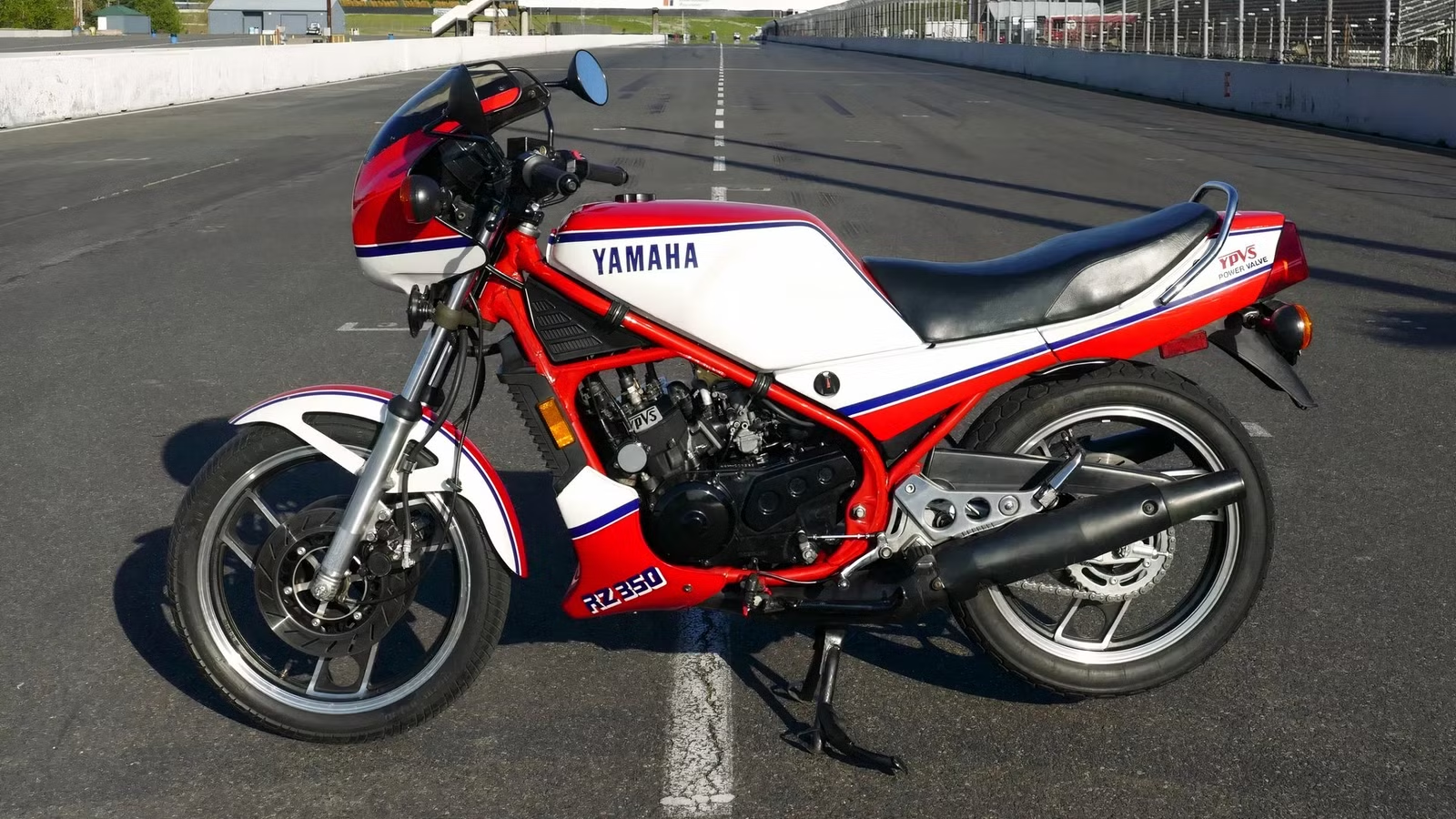
Yamaha RZ350
Original MSRP: $2,399

The Yamaha RZ350 was one of those bikes that instantly stood out in the Japanese two-stroke crowd. In the US, the 1984 model was priced at $2,399, while the 1985 model nudged that up to $2,499.
For that money, you would have brought home a liquid-cooled 347cc two-stroke parallel twin, Yamaha’s YPVS power-valve system, and a six-speed gearbox. This two-stroke produced 52 hp.Yamaha RZ350
The RZ350 was also unusual in the US market. The R&D team at the Japanese facility fitted catalytic converters to help the two-stroke meet emissions requirements. It was offered in America in 1984 and 1985 and is regarded as the last two-stroke sportbike Yamaha officially sold there.

The Kenny Roberts edition is often the one collectors look for. It came with the familiar yellow-and-black speed-block graphics and the association with three-time 500cc world champion Kenny Roberts. Around 20,000 units were made over the two years, with roughly 9,900 of them rolling out in 1984.
Anyone who bought an RZ350 and kept it in good shape has plenty of reason to be happy today. Recent examples have sold for $9,308, $10,807 and $12,412, while a 1,338-mile 1985 model brought $21,400. The highest recorded auction price is $25,850.
Suzuki RGV250
Original MSRP: Around US$ 4,550

Unlike the Yamaha RZ350, the Suzuki RGV250 was never officially sold in the US, which makes it even more interesting to American collectors today.
The VJ22 version debuted in 1990 with a 249cc liquid-cooled two-stroke V-twin. Japan-spec bikes were restricted to 45 hp, but take the restrictions away (like in the case of export models) and that little motor could muster around 62 horses. Dry weight was approximately 282 lb.

And you can’t really talk about the VJ22 without mentioning its banana swingarm. The curved aluminum arm, used on 1990–93 models, drew its inspiration from Suzuki’s RGV500 race bike and helped route the twin exhausts. Interestingly, the engine had a life beyond Suzuki. It became the basis for the Aprilia RS250, further cementing the RGV’s place in two-stroke history.
The VJ22 was already a serious machine when new. In Japan, the standard 1991 model cost roughly $4,600 before tax, while the SP version went for $5,200 and added a dry clutch and a close-ratio gearbox.
For US buyers, the 25-year import rule eventually opened the door. Once these bikes became old enough, Japanese-market examples could be brought into the country without meeting US safety standards. Registration, however, remains subject to individual state laws.
Today, the good ones are not exactly cheap. A 1992 VJ22 sold for $20,651, and a 1992 VJ22 SP reached $26,750 in January 2025. A 5,247-mile 1992 example had previously sold for $11,877.
Honda NSR250R
Original MSRP: Around US$ 6,700

The NSR250R was Honda’s answer to the Japanese two-stroke craze and remained in production from 1986 to 1999. Over those years, it went through four generations: MC16, MC18, MC21 and MC28. Honda kept pushing the bike closer to its Grand Prix machinery with each update.
The later bikes are where things get really interesting. The MC28 brought Honda’s PGM-IV engine management and a Pro-Arm single-sided swingarm, while the bike’s ignition was controlled using a removable memory card. Honda effectively gave a 250cc two-stroke a memory-card ignition system in the 1990s.

Power came from a 249cc liquid-cooled two-stroke V-twin producing 40 hp and 32 Nm. Then there were the SP versions. These are the ones collectors really look for. They came with a dry clutch, adjustable suspension and magnesium wheels.
For 1994, Honda built just 1,500 NSR250R SPs in the famous Rothmans livery. A new one cost about $7,300 before tax, against $6,200 for the standard bike.
Today, those numbers look almost too good to be true. A 1994 Rothmans SP sold for $23,540 in 2021, another with 2,232 miles fetched $24,289 in December 2024, and another 1994 SP reached $31,500 in February 2025.
One near-new example achieved a remarkable result. A 1994 Rothmans SP with just 413 miles sold for $40,660 in June 2026.
Yamaha TZR250
Original MSRP: Around US$2,300

The Yamaha TZR250 was another product of Japan’s 250cc two-stroke madness. The first TZR250 arrived in 1986 with a 249cc liquid-cooled two-stroke twin making 45 hp. Forty-five hp may not sound like much today, but in a lightweight 250cc machine, things get interesting quickly. Yamaha added an aluminum Deltabox frame, 17-inch wheels and race-inspired brakes, with plenty of YZR500 Grand Prix tech thrown into the mix. It wasn’t just a mini-racer in appearance, either. Club racers were happy to use it as a starting point.
Things got even more serious with the third-generation TZR250R. Introduced in 1991, it switched to a 90-degree V-twin and incorporated technology from Yamaha’s YZR250 World GP machine. The Japanese-market bike was still limited to 45 hp, but the combination of a 126 kg dry weight and a race-replica chassis made it a formidable machine.

The 3XV is now the one collectors tend to keep an eye out for. It was never sold new outside Japan, and clean, original examples are increasingly scarce. A 1990 3MA sold for $11,877 in June 2025, while a 1991 3XV changed hands for $6,500 in May 2025.
That is quite a jump for a machine that was essentially built to be a lightweight 250cc weekend performer. The original 1985 TZR250 cost $2,700 in Japan, while the 1991 TZR250R was priced at $4,700.
Kawasaki KR-1S
Original MSRP: Around US$3,850

The Kawasaki KR-1S was Kawasaki’s answer to the NSR250R, RGV250, and TZR250, although it never became as famous as those three. That might actually be part of its appeal today. Underneath the fairings was a 249cc liquid-cooled two-stroke parallel twin producing around 60 hp, with Kawasaki’s KIPS power-valve system helping spread power across the rev range. The whole thing weighed just 131 kg dry.
The KR-1S was seriously quick for a 250. A 1990 speed test recorded 139 mph, which made it faster than the RGV250 of the period and even quicker than the later Aprilia RS250.
The other factor working in its favor now is rarity. The KR-1 was already produced in relatively small numbers, while the KR-1S was even harder to find. The more extreme KR-1R is rarer still, with production estimated at only around 180 examples.
When new, the KR-1 was hardly an exotic collector’s piece, yet a 1988 Kawasaki KR-1 with 10,233 miles recently sold for $8,723.
It is a fitting machine to end the list with. The KR-1 range was not the obvious choice when these machines were new, but its rarity, performance, and two-stroke character have made good examples increasingly appealing to collectors.
Why These Cheap Japanese Bikes Became So Expensive
There is not one single reason why these machines have become so expensive. Most of them were built to be ridden, not stored in a climate-controlled garage for 30 years. Plenty were crashed, heavily used, modified, or simply worn out over time. That leaves far fewer clean, original examples remaining today.
Then came the end of the road-going two-stroke era. Kawasaki dropped its 250cc road-going two-stroke after 1992, while Honda kept the NSR250R alive until 1999. Yamaha’s RZ350 had to use catalytic converters to make it into the US market. The writing was already on the wall for these high-revving two-strokes.
The 25-year import rule also changed things for American collectors. Machines that were once almost impossible to import into the US could be imported once they crossed the age threshold. That opened the door for JDM machines such as the RGV250 Gamma and the TZR250.
Then there is nostalgia. The riders who grew up wanting these bikes are now old enough to buy one. It is a straightforward story of supply and demand.
Of course, not every old Japanese two-stroke is suddenly worth a fortune. Condition, originality, mileage, and even the exact specification can make a significant difference. But the finest examples have moved well beyond their original role as affordable performance machines.

Related posts

Latest Post


No Comments