
The Forgotten Nissan Sedan That Invented The Skyline GT-R’s AWD System
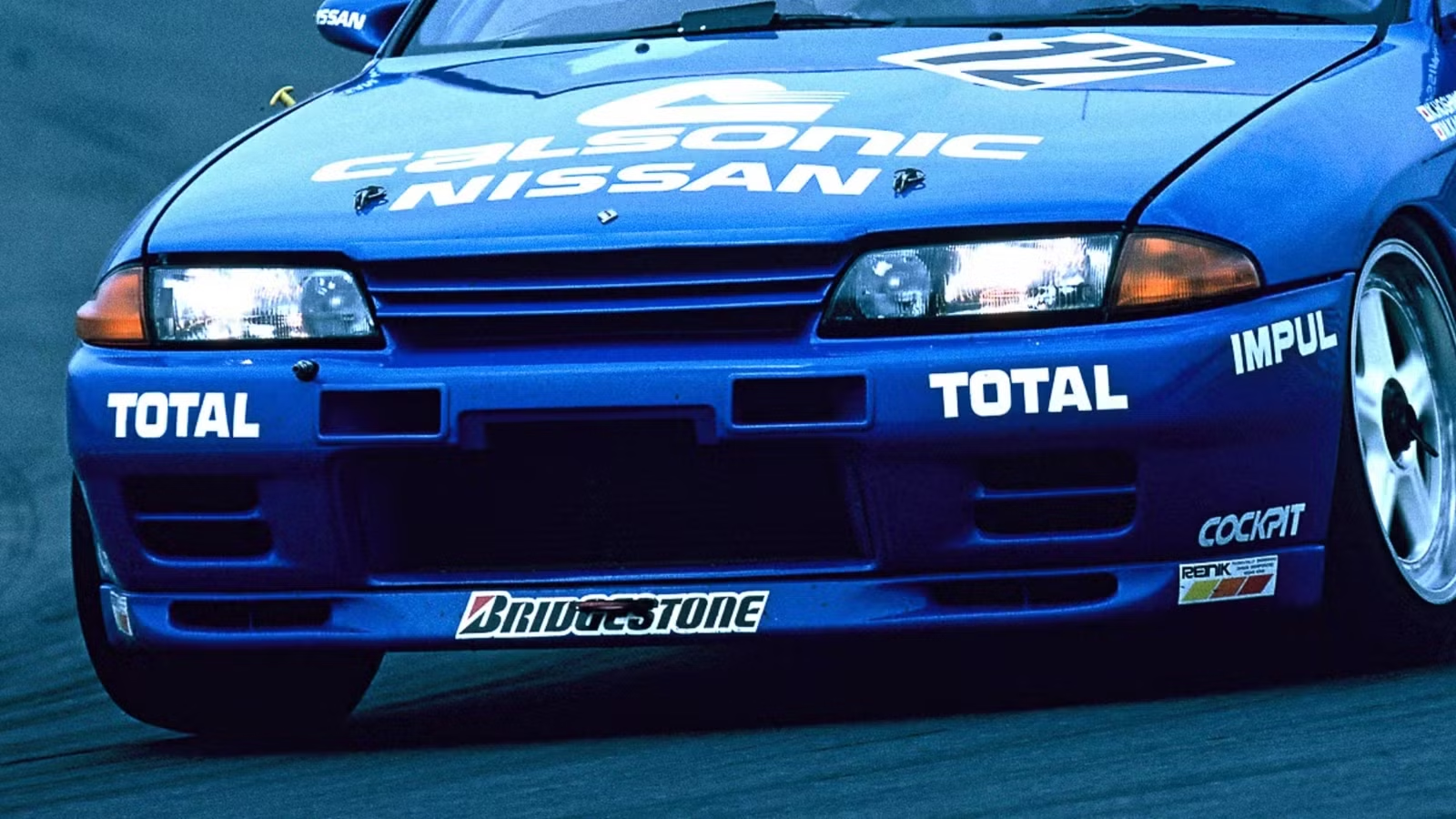
If it wasn’t for an incredible all-wheel drive system, the history of the Nissan Skyline GT-R could’ve looked very different. From the R32 through to the R34, the model line used the pinnacle of Nissan’s engineering with the incredible ATTESA system that allowed it to become a force in global motorsport.

However, despite playing such a pivotal role in the legend of Godzilla and its successors, the Nissan Skyline GT-R wasn’t the car to debut the system. Rather, a little-known JDM sedan paved the way for it.
What Made The Skyline GT-R’s AWD System So Special?
Typically, an all-wheel drive system works in one of two ways. Permanent systems, as you’d seen in some Audi or Subaru models, will send a constant level of torque to both axles. Or you’ll come across a viscous-coupling system, which reacts to wheelspin by mechanically sending torque from one axle to another.

Neither of those was seen on the R32 Nissan Skyline GT-R when it debuted in 1989. Rather, the monstrous coupe used a clever system labelled by Nissan as ATTESA E-TS. If you want its full name, that’s Advanced Total Traction Engineering System for All-terrain Electronic Torque Split. Trying saying that one after a root canal.
In this system, the R32 GT-R would, for the vast majority of the time, effectively be a rear-wheel drive car. That allowed for tighter corner entries and better rotation.

However, when the car sensed things were about to get a bit loose, it would then make use of an electronically controlled hydraulic multi-plate clutch to determine when to send power to the front axle.
Rather than simply relying on wheelspin, it would use sensors to measure wheel speed, throttle position, engine speed and G force to proactively manage when and how much torque was needed to be sent at any one time. While fairly commonplace today for high-performance sports cars, this was almost alien technology in 1989.
It Was Key To The GT-R’s Legendary Status

As with so many cutting-edge automotive technologies, motorsport was the key reason for the R32’s use of the ATTESA ET-S. It was introduced as a homologation car for FIA Group A regulations, allowing the Skyline to enter numerous touring car series around the globe.
Coming up against predominantly rear-drive opposition, it’d be an understatement to say the R32 Nissan Skyline GT-R dominated motorsport. In the All Japan Touring Car Championship, the R32 GT-R won every single one of the 29 races it entered between 1990 and 1993.
Meanwhile in Australia, the R32 took three consecutive titles in the Australian Touring Car Championship from 1990 to 1992, notably winning the first of those despite entering halfway through the season. Before it even took the track down under, Australian magazine Wheels gave it the nickname Godzilla, which has stuck ever since.
Such was the dominance of the GT-R in both series, it contributed to the JTCC ditching Group A regulations entirely and switching to the Super Touring rulebook, which didn’t permit all-wheel drive cars. Meanwhile, the ATCC adopted a new 5.0-liter V8 rule set that gave the domestic Ford and Holden rivalry a new lease of life.
It Didn’t Start In The Skyline, Though

While ATTESA technology was made famous by the R32 GT-R and took the system to a whole new level, the core system didn’t debut on the Nissan Skyline. Rather, a sedan that arrived in 1987 was the first time the drivetrain was in action.
That honor goes to the Nissan Bluebird SSS, a high-performance version of an otherwise pretty sedate sedan. At its core, ATTESA at this stage was a viscous coupling system we touched upon earlier.
For the most part, it would be a standard all-wheel drive car, but when wheelspin kicked in, the coupling would be there to limit speed differences between the two axles. However, it used a planetary center differential on top of that, allowing for more progressive torque distribution.
The Bluebird SSS-R Was A Pure Homologation Car

Which brings us neatly to the most special version of the sedan, the Nissa Bluebird SSS-R. This was a pure homologation special, built for the sole purpose of homologating the model for Group A rally regulations, in contrast to the later Skyline’s circuit focus.
Early versions used the CA18DET-R, at its core the same 1.8-liter turbocharged inline-four engine found in the regular Bluebird SSS, but with some motorsport-focused changes. This included forged Cosworth pistons, a revised Garrett turbocharger, and improved cooling, with an official power figure of 183 horsepower, an increase of 10hp.
Later facelift versions would swap this out for an SR20DET, a 2.0-liter turbocharged four-cylinder engine with 202 hp and 202 lb-ft of torque. You’ll remember that engine best from its appearances in the Nissan S-chassis cars like the S13 Silvia and 180SX through the ‘90s.

All cars did get a unique close-ratio five-speed gearbox with rallying firmly in mind, however, with a revised final drive and stronger internals to improve durability. The core suspension layout remained the same, but geometry was revised to provide better stability on loose surfaces, stiffer springs and dampers were fitted, and the mounting points were strengthened.
The SSS’ deeply bolstered seats were retained and a Nismo steering wheel was introduced, with much of the rest of the interior pared back to keep weight down. This included the downgrade to manual windows and manually adjustable mirrors, less sound insulation material and thin, cloth trim.

That all contributed to a weight saving of around 200 lbs over the base SSS. This wasn’t quite a full race car interior, though, retaining some semblance of ordinary. Visually, you’d spot an SSS-R apart from a regular SSS thanks to its fog lamps, mud flaps and bonnet scoop.
How Much Are They Worth Today?

It’s thought that around 1,000 examples of the Nissan Bluebird SSS-R with the CA18DET engine were produced from 1987 to 1989, and just a few hundred of the later SR20-equipped cars. Exact numbers remain unclear today, but each was built to order, with Nissan able to produce around 10 cars a month.
So many of those cars would end up on the rally stage too, bought by race teams and converted to take to competition. Finding an intact, unmodified example of any SSS-R today is about as possible as spotting a unicorn in your yard.
Although it seems we picked a lucky day. At the time of writing, just one example of the Nissan Bluebird SSS-R is publicly for sale anywhere. It’s a 1988 car in Japan that’s been well used with 1110,000 miles on the odometer, completely standard and with an almost scarcely believable asking price of $11,500. We just want to speak to the kind of person that daily drives such a car.
Another ATTESA-Equipped Legend To Consider

If you want a more obtainable car with an ATTESA system though, allow us to suggest the Nissan Stagea Autech Version 260RS. Put into production in 1996, this was effectively an R33 Nissan Skyline GT-R wearing the body of a wagon.
Based on the same platform, the Stagea was mostly a family-focused alternative to the sedate Skyline models, but the 260RS showed what was possible from the model. The legendary RB26DETT featured here is a 2.6-liter twin-turbocharged inline-six engine officially producing 276hp and 271lb-ft of torque. Though that power figure was published to conform with the Japanese Gentleman’s Agreement, it’s widely believed to be closer to 300hp.

It also had the advanced ATTESA E-TS pioneered by the R32 and carried over to the R33, without compromising on practicality. You could bring the dog for a taste of Godzilla, if you really wanted.
Finding a 260RS is easier than an SSS-R, with 1,734 examples documented as being built between 1997 and 20001. They’re a rare sight in the US, as many JDM-exclusive cars are, but some have been imported with prices around $50,000.
Sources: Nissan, Goonet Exchange

Related posts



Latest Post



No Comments