
The Sports Car Enthusiasts Respect—But Buyers Ignore
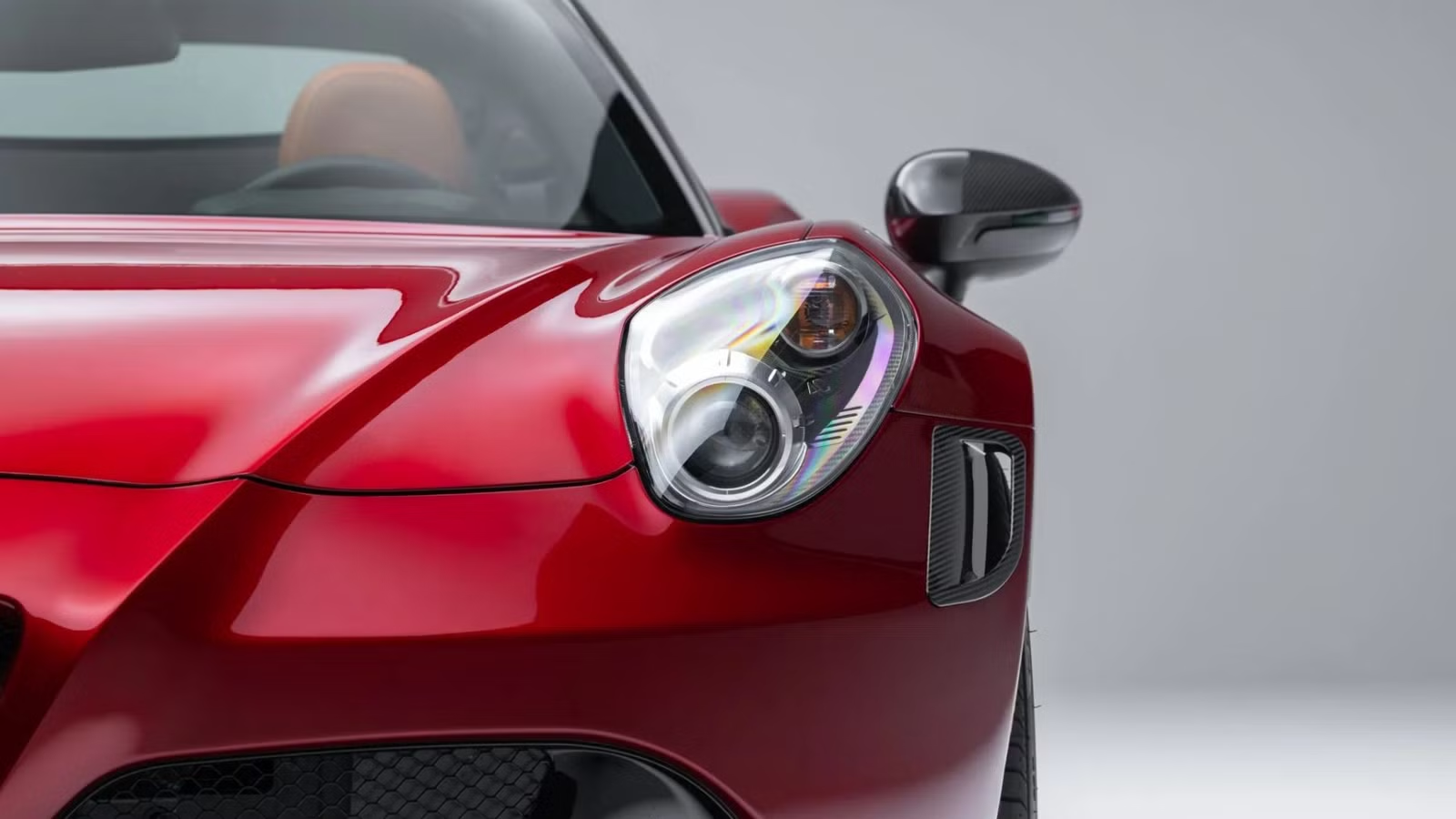
From the perspective of an automotive purist, the average sports car buyer just doesn’t get it. Why would they grab the keys to a cushy German grand tourer when a Mazda MX-5 could deliver a far more intimate connection between car, road, and driver for a fraction of the price? Purists chase an unfiltered experience, cheerfully sacrificing comfort and practicality for a machine that seemingly punishes them.

Unfortunately, most sports car buyers seek something as usable as it is exciting, leaving very few options for those who want a completely uncensored journey through the twisties. What’s more, many of the machines that enthusiasts fawn over go unnoticed by the general public, and there is one in particular that is markedly more obscure to the average buyer than a Miata.
The Lost Art Of The Purist Sports Car
Very few of today’s automakers have the courage to sink precious development costs into something as deliberately niche as a feather-light, brutally unforgiving sports car made exclusively for the purist crowd. By definition, purists fondly recall a time when sports cars were as simple and raw as they could possibly be. In the modern age, strict safety and emissions regulations have made it increasingly difficult to justify building a small sports car.
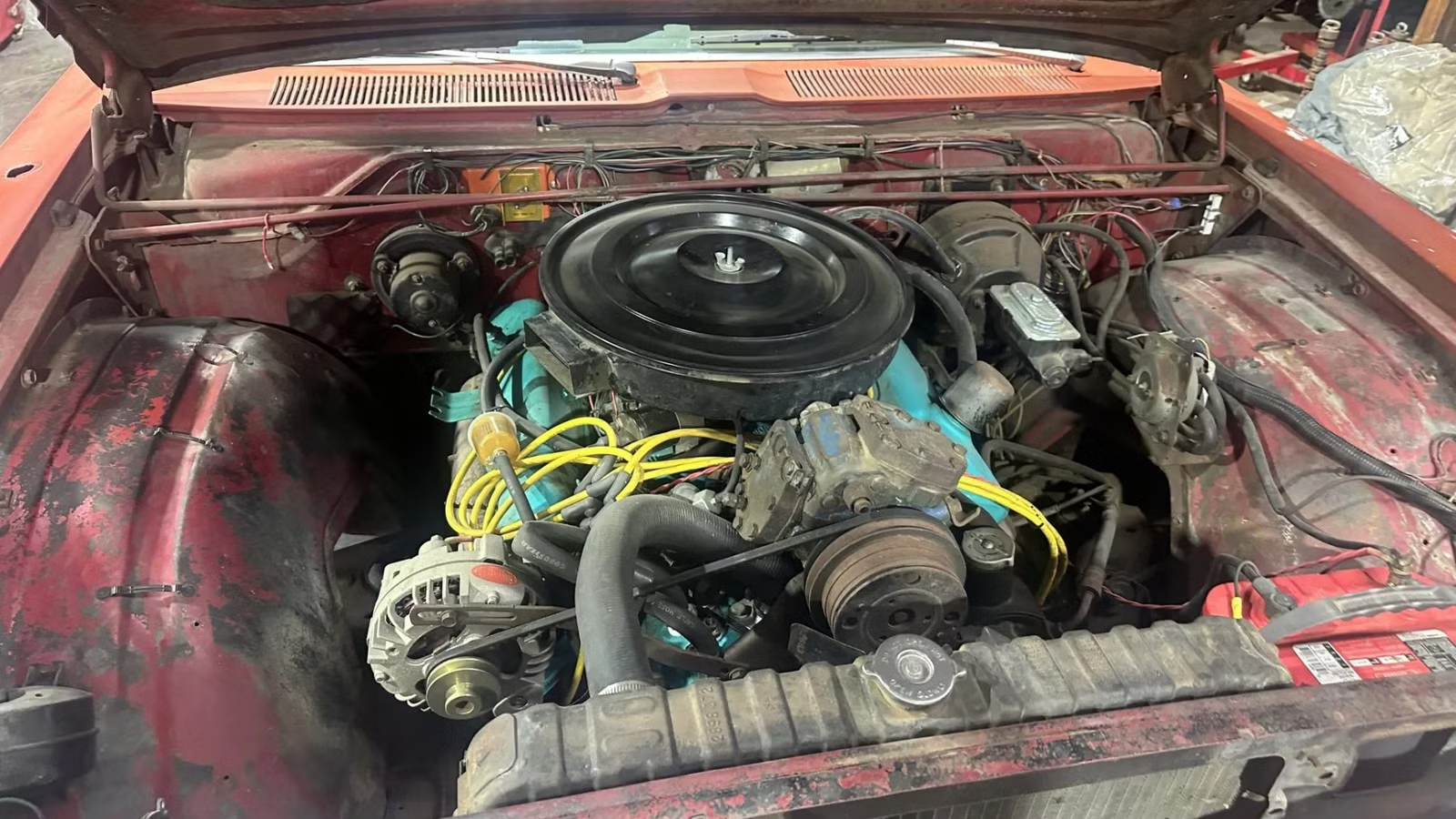
In addition, the days of mechanical simplicity are all but over as manufacturers continue to stuff their vehicles to the brim with technology. As a result, the sports car has evolved into a refined machine that can decently handle a grocery run for the family. It’s a win for the average, practical buyer with their head screwed on correctly, but it leaves a hole in the heart of diehard driving enthusiasts.

As recently as half a decade ago, the purist still had choices. They could stroll into a Lotus Cars dealer and sign the dotted line for the benchmark-setting Elise, which offered incredibly communicative steering and an extremely lightweight build. If the risk of British reliability quirks sounded too daunting, they could head over to the Mazda showroom for the MX-5 Miata, and drive off with a notchy six-speed manual and a weight distribution nearing 50/50. If the Mazda badge didn’t cut it, they could walk into the Fiat dealer and seek out the 124 Spider, which was the Miata’s weird cousin that borrowed its chassis, interior, and transmission, pairing them with a Fiat turbo-four.
|
Car |
Power |
Torque |
0-60 MPH |
|
Alfa Romeo 4C |
237 HP |
258 LB-FT |
4.5 seconds |
|
Lotus Elise 1.6 (S3) |
134 HP |
188 LB-FT |
6.0 seconds |
|
Mazda MX-5 Miata (ND3) |
181 HP |
151 LB-FT |
5.8 seconds |
|
Fiat 124 Spider |
160 HP |
184 LB-FT |
6.0 seconds |
But as of this writing, both the Elise and 124 Spider are extinct. Lotus ended the Elise’s 25-year run in 2021, replacing it with the Emira. While still a rev-happy two-seater, the Emira occupies a different niche with its larger footprint and more forgiving character. The 124 Spider failed to gain popularity, and it ultimately wasn’t profitable enough for Fiat to continue building. That leaves the MX-5 Miata as the lone survivor of the purist sports car segment, but it can’t appeal to everyone. For buyers seeking something a bit quirkier, there is one well-kept Italian secret that the common buyer overlooked when it was new.
The Sports Car That Refuses To Die Is Outselling The GR86 And BRZ Combined
Mazda’s tiny Miata just crushed the Toyota GR86 and Subaru BRZ in April sales, proving simple sports-car fun still has pull.
Alfa Romeo’s Glorious American Comeback

In 1995, Alfa Romeo quietly shuffled out of the United States as tightening regulations and declining sales ground its American ambitions to a halt. But with its stale lineup causing European sales to slip in the early 2000s, the Italian automaker finally mustered enough confidence to return to the United States and reclaim a share of that highly profitable American market. With a revitalized mission to steer stateside buyers away from German luxury automakers, Alfa Romeo aimed to entice them with a sports-car-shaped package that was seemingly impossible to resist.
Toward the end of 2008, Alfa tested the waters by shipping 119 of its 500 8C halo models to the United States. With the guttural tones of its Ferrari-derived V8 and smoking-hot carbon fiber bodywork, the 8C was more than enough to whet American appetites, despite its eye-watering price tag and extreme rarity. All of the U.S.-bound units sold out nearly instantly, and Alfa Romeo found itself having to reject roughly 900 8C orders worldwide, as it opted to stick with the original 500 build slots.

After the 8C successfully proved the brand’s relevance on both sides of the Atlantic, a newly confident Alfa Romeo headed to the 2014 New York Auto Show to take the wraps off its first higher-volume, U.S.-bound model since the 1990s: the 4C.
The Best Alfa Romeo Sports Cars: Performance And Value
A forgotten lineup of Alfa Romeo legends retell a story of speed and victory and have transcended to today, of a brand ever rich in both.
Alfa Romeo 4C: An Unmistakably Italian Driving Experience

It’s a rather strange phenomenon that Italian cars share the demeanor of their engineers, and the Alfa Romeo 4C is no different. Getting behind the wheel, it feels exactly like someone who never stops talking with their hands. On more challenging roads, it chatters to you incessantly through the firm suspension, telling you exactly how the road feels whether you asked for it or not. In a similar fashion, the steering wheel offers constant, unsolicited feedback, responding instantly to every last input. It’s unusually heavy for a car that debuted in 2013, because Alfa Romeo managed to get away with completely excluding power steering. The 4C is animated and passionate through corners, as its lightweight chassis allows for a tossable feeling. The 4C weighs just 2,465 pounds for the Coupe and 2,504 pounds for the Spider thanks to its state-of-the-art carbon fiber monocoque, a feature usually reserved for pricey supercars from McLaren and Lamborghini. The engineering achievement is a testament to the Italian team’s ingenuity.

Driving dynamics aside, the Italian personality is baked directly into the 4C’s powertrain. Under the hood, the minuscule 1.75-liter inline-four is paired with a turbocharger, and its fluttery spooling interrupts conversations in the cockpit alongside the crackles that accompany downshifts. The 4C’s six-speed dual-clutch automatic transmission is also inherently quirky. It can feel clunky at low speeds, but this is contrasted by the aggressively fast upshifts on spirited drives. The 4C also outpaces the Elise and Miata in a straight line, a rather unusual distinction for a vehicle in its class. It launches from 0 to 60 mph in 4.5 seconds.
Why The 4C Failed To Fly Off The Shelves

While the 4C is a purist’s ultimate dream, the reality is that not all sports car buyers want to sacrifice comfort or storage space to reach driving nirvana. The unassisted steering wheel requires too much grunt for many drivers, and the suspension’s lack of effort to filter out the road’s imperfections is an acquired taste. Climbing into the 4C, you’ll immediately realize that there is nearly no room for anything but two passengers. Even then, the cabin is tight, especially for taller occupants. There is no front trunk, a deliberate weight-saving measure that eliminates the need for hinges or latches. The driver is limited to a tiny compartment directly behind the engine block, and anything placed inside will be roasted by the turbo-four.
Alfa Romeo never expected the 4C to be a high-volume vehicle, and as a result, it set a relatively modest goal of selling 20,000 of its sports cars over its entire production run. Ultimately, the Italian brand only managed to sell roughly 9,200 units worldwide during the 4C’s entire seven-year run. Yearly sales rarely broke into the thousands, and as the 4C dragged on into its final 2020 model year, a rather tragic 99 units left dealers globally.
The Perfect Mazda Miata Alternative No One Is Buying
The Mazda Miata’s perfect affordable sports car alternative arrived on the market in 2016 with more power and cooler looks, but no one bought it.
Silently Treasured Among Enthusiasts Today

Even though the Alfa Romeo 4C is still obscure to the average buyer, enthusiasts see the value in it. They recognize that they may have taken this sports car for granted when it was new, and they realize that it probably won’t be made again. As a result, values in enthusiast circles like Bring a Trailer average around $50,000. Considering that the 4C’s sticker price started at roughly $60,000 when new, it’s a shocking level of retained value for an Italian sports car.
Sources: Alfa Romeo, Bring a Trailer

Related posts



Latest Post


No Comments