
The Shelby Mustang Carroll Built For A Kingston Trio Singer
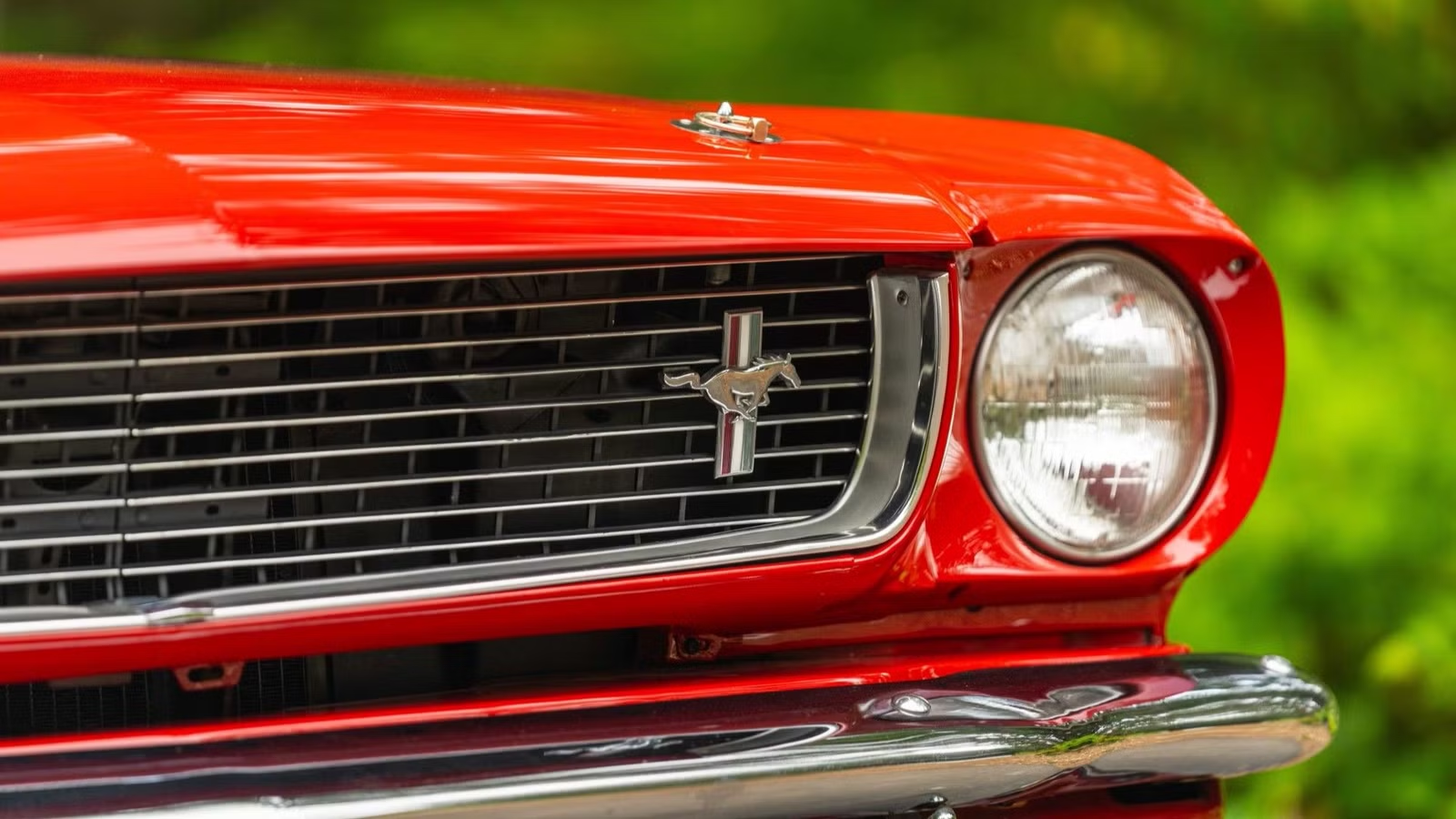
The Mustang was rather popular in the ’60s. The car, which epitomized a decade of freedom and rebellion, certainly broke the mold by selling almost half a million units in its first year alone. But while the original Mustang sold in huge numbers, with buyers rushing to showrooms, there is one that was incredibly rare even when new. This is a story of celebrity favors, bespoke commissions, and a car that would go on to sell for seven figures. If the standard Mustang was for everyone, then this version would be enjoyed by very few.


The Original Ford Mustang Was Missing Something

When the Mustang was launched in April 1964, it was such a sales success that even Ford was surprised. The Mustang set the industry record for sales during the first year, shifting more than 418,000 units and breaking the previous record that had been accomplished by the Ford Falcon in 1960. The Mustang quadrupled the expected sales total of 100,000, with buyers entranced by its blend of real-world performance, striking looks, and an affordable starting price of $2,368. But while the Mustang certainly had sporting intent, at first it was never more than a sprightly pony car rather than all-out muscle. In June 1964, a high-performance 271-hp version of the 289 had been introduced, mated to a 4-speed, quick steering, and special handling package, but Ford thought that the Mustang had more to offer.
Carroll Shelby Was Called In To Give The Mustang Some Bite

Ex-race driver Carroll Shelby already had a relationship with Ford, having sourced Blue Oval engines such as the 289 cubic-inch V8 and 427 “side oiler” for the Cobra. The Texan seemed an obvious fit for giving the Mustang a bit more gallop. Ford’s Lee Iacocca decided the best route to boosting sales was to ask Shelby to prepare and campaign the Mustang as a B Production SCCA racer (Sports Car Club of America). Shelby needed to build 100 examples to qualify it as a B Production car, making it both an icon of the street and the track.
At the very end of 1964, Ford’s San Jose plant shipped 110 incomplete Wimbledon White fastbacks in incomplete form to Shelby American’s Venice shop. The High Performance 289 V8 was fitted with a Holley four-barrel carburetor, aluminum high-rise intake manifold, Tri-Y headers, and a glasspack dual exhaust system, for an increase of more than 30 hp to 306 hp (plus 329 lb-ft of torque), although that figure was thought to be underrated. A Borg Warner four-speed was connected to the engine, the rear seats were binned in favor of a fiberglass shelf, and the hood also became fiberglass. The GT350 was born.
Ford Now Offers An 810-HP Mustang With A Factory Warranty
Ford’s new supercharger kit delivers up to 810 hp in the 2026 Mustang with full factory warranty backing.
The GT350 Convertible Was Born Out Of A Celebrity Favor

1966 Mustang GT350 Convertible Specs
|
Engine |
4.7-liter V8 |
|
Power |
306 hp |
|
0-60 mph |
6.5 seconds (estimated) |
The story goes that Bob Shane of chart-topping pop group The Kingston Trio was both a customer and friend of Shelby. Shane, who was said to have bought at least a couple of Cobras from Shelby, loved the GT350 but apparently would prefer it without a roof. Shane casually mentioned to Shelby one day, reports Streetmusclemag.com, that if a convertible version was ever in the works, he’d be first in line.
Shelby apparently agreed that a drop-top GT350 would make for a great addition to the lineup, as in April 1966, Shelby American purchased four first-gen Mustang convertibles from Ford. These four cars would be converted into rag-top GT350s, with two getting a four-speed and two autos. Whether or not it was the conversation with Shane that directly prompted the development of the car, no one can say for sure, but it is reported that Shelby delivered one of the cars to the singer shortly after in Candy Apple Red.
The GT350 Drop Was A Serious Performance Car

Before the days of models like the BMW M4 Convertible, drop-top versions of serious motorsport-tinged machines were pretty rare. The GT350 drop took pretty much all the standard car’s features, including Kelsey-Hayes discs in the front and drums in the rear, and packaged them into a convertible body. Shelby did go to the trouble of fitting air conditioning to all of them too. Apparently, the side scoops weren’t functional on these cars because the folding top mechanism was in the way. The convertibles were finished off with optional, chrome Magnum 500 wheels. There are no official performance figures, but the convertible would be pretty close to the tin-top’s sprint to 60 mph in about 6.5 seconds, with a top speed of 126 mph.
The ’66 GT350 Convertible Remained A Prototype

Despite the 1966 convertible GT350 being widely reported as one of Shelby’s all-time favorite cars, it didn’t get further than the prototype stage. In truth, the Mustang was about to be redesigned, making it larger, and the GT350 Convertible would become an official option for that car in 1968. So while the 1966 cars never made it to production, they proved the viability of such a model. The 1968 version had lost a little of the visual purity of the concept, with a built-in roll bar interrupting the lines. All GT350s were now fitted with Ford’s 302-ci V8, which was nowhere near as potent as the model two years before, offering up just 250 hp.

Here’s Why You Couldn’t Buy The Rarest Mustang Of The ’90s
A ’90s Mustang with a twist, but there’s a catch…
Shelby Revisited The 1966 GT350 Convertible In The ’80s

Shelby must have never forgotten how much he loved the 1966 GT350 Convertible because in the early ’80s he revisited the project. Working with Beverly Hills Mustang President J. Brunk, as well as the same group of engineers behind the original GT350, Shelby built 12 more GT350 convertibles between 1980 and 1982, numbered and registered with the Shelby American Automobile Club. California rust-free 1966 Ford Mustang convertibles were stripped to the frame and fitted with fresh NOS (new old stock) Ford Mustang sheet metal, creating brand new classic cars. Every part was inspected and either repainted, reinstalled, or replaced. These cars now fetch big bucks, but nowhere near what an original commands.

Ford’s Forgotten 10-Second Car With The Brand’s Most Powerful Big Block Under The Hood
A forgotten Ford from the ’60s packs a supercar punch in a sleeper body
Original GT350 Convertibles Are Highly Sought-After

The four original cars — painted Sapphire Blue, Springtime Yellow, Ivy Green, and Candy Apple Red — almost never come up for auction. Hagerty’s Valuation Tools puts the price of an original GT350 Convertible at $733,000. That is a whole lot more cheddar than a base GT350 Fastback, which sells for $218,000 in good condition. Those 1968 GT350 Convertibles are cheaper still, selling for $92,800.
But the reality is that when/if one of the four cars comes up for auction, if there are enough people in the room, the sky is the limit as far as pricing goes. When the Ivy Green car went up for sale in 2020 at Mecum’s Indy sale, it fetched $1,100,000. That made it one of the most expensive Mustangs ever to be sold at auction. When a Supercharged 1966 Shelby Mustang GT350 Continuation Convertible was offered for sale on Bringatrailer in 2020, it reached $131,000. If you like rarity and the wind in your hair with a Mustang, look no further than the GT350 drop top.
Sources: Hagerty.com; Streetmusclemag.com

Related posts


Latest Post


No Comments