
America’s Most Affordable Car In 1969 Was The AMC Rambler At $2,000, Here’s What It’s Worth Today
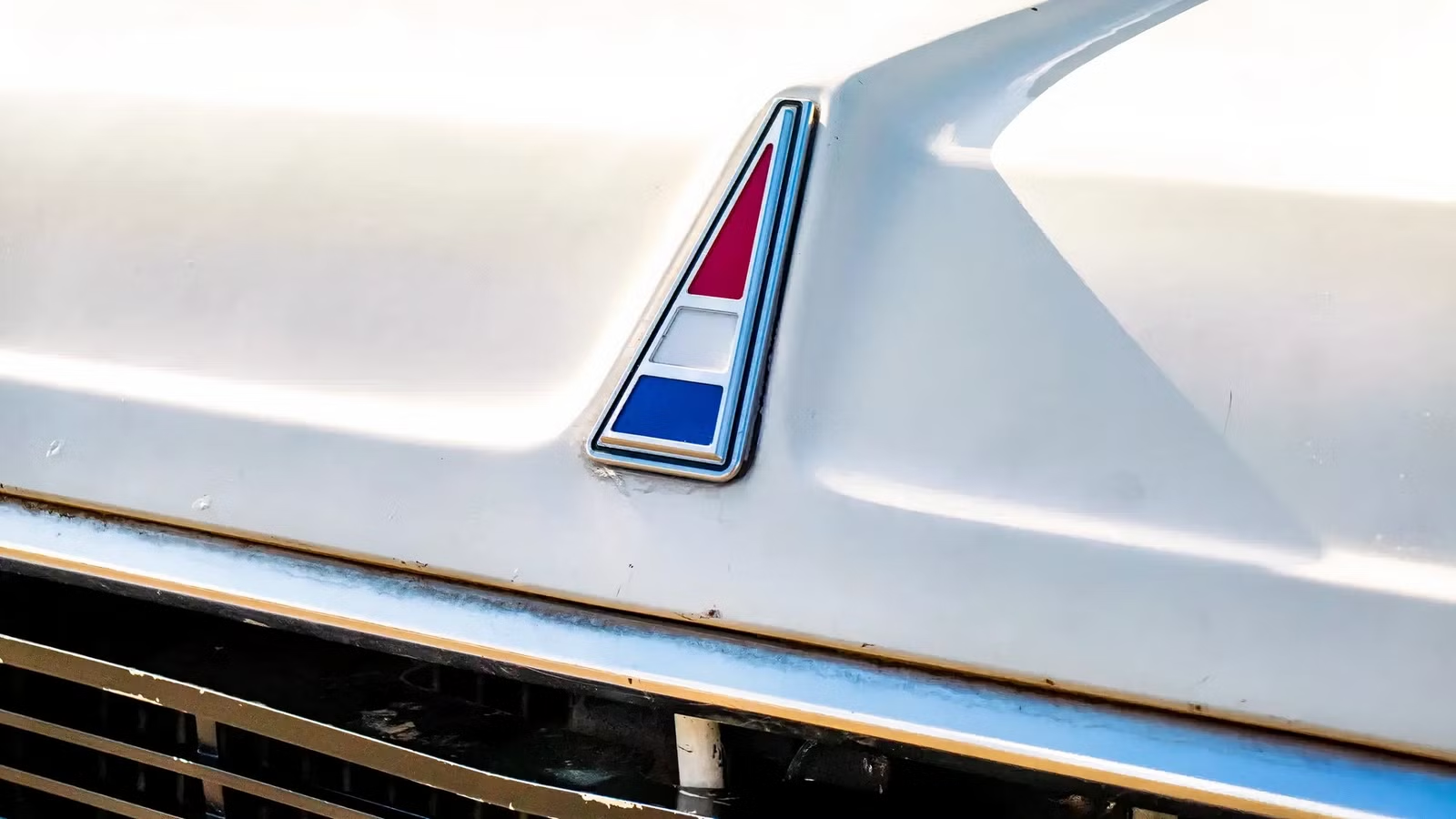
In 1969, American Motors had a refreshingly simple proposition for buyers who didn’t want to spend a fortune on a new car: buy a Rambler. The base two-door sedan carried an advertised price of just $1,998, making it the cheapest new domestic car sold in America in 1969 by advertised base price. More than half a century later, it remains one of the most affordable ways into American classic car ownership.
The Rambler Was Basic, But It Wasn’t Barely A Car

The 1969 Rambler sat on a 106-inch wheelbase and measured 181 inches long, giving it substantially more usable interior space than many of the small imports competing for American buyers. The base model used AMC’s 199 cubic-inch inline-six, rated at 128 horsepower gross, with a three-speed manual transmission as standard. Those numbers aren’t impressive by modern standards, and they weren’t supposed to be.
The Rambler’s job wasn’t to win drag races. It was to provide straightforward transportation without the price and complexity of a larger American sedan. AMC’s ads even took a swipe at the Volkswagen Beetle, bragging that the Rambler seated six and offered more than twice the VW’s horsepower and trunk space.
There was also a certain honesty to the equipment list. The base Rambler came with the essentials, while things modern buyers would consider almost laughably basic cost extra. An automatic transmission added $171, and even a push-button AM radio was another $61. This wasn’t a cheap car because AMC had found a magical way to build automobiles for less money. It was cheap because the company was willing to sell buyers exactly what they needed and let them decide whether they wanted anything else.

Why AMC Built Such An Inexpensive Car

American Motors occupied an unusual position in the American auto industry. It was considerably smaller than General Motors, Ford, and Chrysler, so it couldn’t fight the Big Three on their own terms. Instead, AMC made a virtue of being different. The Rambler was compact by American standards, relatively economical and mechanically straightforward. By 1969, that formula mattered more than ever, because American buyers had more choices than before, including a growing wave of small imports.
AMC’s pitch was that buyers didn’t have to sacrifice useful space or adequate performance simply because they wanted an inexpensive car, and it priced the Rambler close to the basic Volkswagen. The Rambler wasn’t trying to make cheap cars glamorous. It was trying to make cheap cars sensible.
1969 was also the end of the line. AMC dropped the “American” portion of the name, leaving the car simply as the Rambler, and replaced it with the Hornet for 1970. The lineup ran from the base car to the better-equipped Rambler 440 and the sportier Rogue, while the outrageous SC/Rambler added a completely different performance angle to the same basic family. The base two-door sedan, however, remained the bargain.
The Base Rambler Never Became A Muscle-Car Collectible

Production wasn’t tiny, with 51,062 base two-door sedans built for 1969. The car was never intended to be a collectible. It was a mass-produced economy car, and most owners treated it accordingly, which is one reason, so many ordinary economy cars disappeared: nobody thought they needed saving.
The late 1960s produced some of America’s most famous performance cars, from the Mustang and Camaro to the Charger and Challenger. Those cars developed enormous followings because they combined distinctive styling with performance and motorsport or pop-culture associations. The base Rambler had a different job, and its selling point was that it was inexpensive, practical and economical.

That makes it easy to overlook today, but it also makes the Rambler a useful reminder of what the American car market actually looked like beneath the muscle cars and luxury cruisers that dominate the classic-car conversation. For every buyer who wanted a 400-hp V8, there was another who simply wanted a reliable car that didn’t consume half a year’s wages. The $1,998 Rambler was built for that second buyer.
What The $1,998 Rambler Is Worth Today

Run the Rambler’s sticker through the Consumer Price Index, and $1,998 in 1969 works out to roughly $18,200 in 2026 money. What somebody actually pays for one today is a very different number, because condition matters enormously with a car this old. A rough Rambler can still be remarkably inexpensive. A 1969 Rambler project car sold for just $1,100 at auction in August 2026, which is less than its original sticker price 57 years earlier. J.D. Power currently puts a 1969 Rambler two-door sedan at $1,400 in low-retail condition, $3,250 at average retail and $5,600 at high retail.
That modest value isn’t a reflection of the car itself. It’s a reflection of what collectors want. Even a nice original Rambler costs less today than its $1,998 sticker is worth after inflation, which means the Rambler has done something unusual for a 57-year-old American car: it has remained accessible.

The original buyer got a new American-built car for $1,998. A modern enthusiast can still buy one without needing the sort of budget required for a restored Mustang, Camaro or Hemi-powered Mopar. AMC built it to be the sensible choice for people who didn’t want to spend more money than necessary on a car, and more than five decades later, it remains a sensible choice for someone who wants an old American car without paying old American muscle-car money.
The Rambler was never supposed to be the most exciting car in America. It was supposed to be the one that made the most sense. At $1,998 in 1969, AMC succeeded, and with base Rambler values still well below their inflation-adjusted sticker price, the Rambler may have succeeded again.
Sources: Bring A Trailer, Classic.com, Hagerty

Related posts




Latest Post


No Comments