
Here’s Why Pontiac Never Offered A Big Block V8
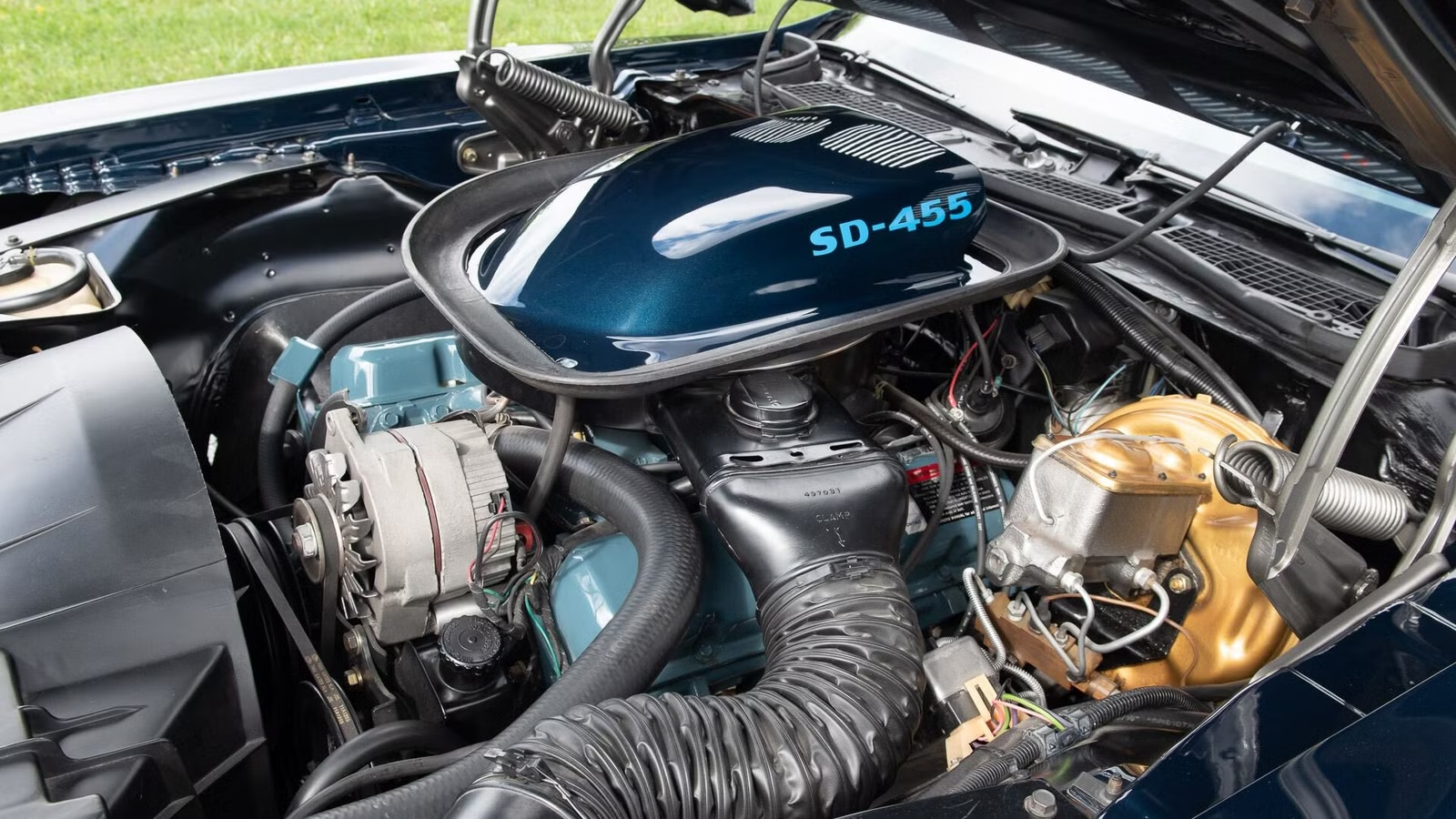
Pontiac may have closed its doors for good, but the brand’s engineering legacy continues to fascinate muscle car enthusiasts decades later. The GTOs, the Firebird Trans Ams, the roaring 455 — these are the cars that cemented Pontiac’s place in American automotive history. Yet for all the thunder those machines produced, there’s one thing you’ll never find under any of their hoods: a big block V8. That omission wasn’t an oversight. It was a deliberate engineering philosophy, and the story behind it is one of the most interesting in Detroit history.

That’s because, contrary to popular belief, the brand never opted to produce a big block V8. While Ford and Chevrolet were busy cramming huge big block motors underneath the hoods of their flagship muscle cars, Pontiac opted to do things differently, and here’s why.
HotCars has gathered information on Pontiac engines and their fascinating development story from external sites such as Hagerty and Bring A Trailer, while specs have been sourced from Fastest Laps.
Pontiac Never Actually Offered A Big Block V8 Engine

Before delving into Pontiac’s unusual, but hugely practical, engine-building history, it’s worth quickly clarifying the difference between a small and big block V8. It’s not rocket science: big block engines are, first and foremost, bigger. That size difference allows brands — such as GM with their famous LS lineup — to separate engine families by block size. They’re not just physically larger, either; big block engines generally displace north of 400ci.
Most American automakers during the ’60s and ’70s were producing an array of luxury and family-oriented cars powered by small block engines, while potent muscle cars in the lineup would be fitted with big block lumps. One great example is Chevrolet, which used small block engines — such as their 350ci V8 — to power family cars like the Caprice, but then fitted flagship muscle cars, such as the Chevelle SS, with a massive 454ci big block V8.
Here’s where Pontiac differed, though. Instead of engineering numerous different engine blocks to suit different models and applications, they often simply modified existing blocks to produce more power.
Pontiac’s Potent Powertrains Are All Developed From The Same 287ci Engine Block
The journey started in 1955 when Pontiac introduced the 173-horsepower 287ci V8. This engine would go on to power a whole host of models from the Pontiac range, including the Chieftain and Star Chief. Depending on the application and customer specification, output varied — 4-barrel versions produced an additional 7 horsepower, or 27 horsepower more with the optional “Power Pack.”
Over the years, Pontiac upsized the engine’s displacement to chase more output, and they didn’t wait long — capacity grew to 317ci as early as 1956. The same pattern would repeat across later Pontiac engines, all of which remained remarkably similar in physical size and weight. By 1970, for instance, Pontiac had developed a monstrous 455ci unit. At nearly 7.5 liters, it was a genuine beast, yet it was surprisingly close in external dimensions to many of Pontiac’s smaller-displacement engines. Better still, a large number of components were interchangeable across the family — a real advantage for owners sourcing spares or tuning lesser-powered variants.
Power output climbed astronomically as well. While figures vary depending on the source, most agree that the more potent Pontiac V8s were comfortably capable of producing more than 350 horsepower.
A Closer Look At The Original Pontiac V8
Engine & Performance Specs
|
Capacity |
287ci |
455ci |
|
Aspiration |
Naturally aspirated |
Naturally aspirated |
|
Power |
180 horsepower |
335 horsepower |
|
Torque |
264 lb-ft |
480 lb-ft |
|
Compression |
8.0:1 |
10.25:1 |
(Specs courtesy of Fastest Laps & Hemmings)
Although the original 287ci V8 was no great performer — producing just 180 horsepower and 264 lb-ft of torque in 4-barrel spec — it proved to be a reliable foundation for the bold American brand. Over the decades, Pontiac explored countless configurations using this basic architecture, fitting it into everything from large family wagons to more performance- and luxury-oriented models. For this comparison, we chose to pit the 287 against Pontiac’s 455 engine, to illustrate just how far the smaller 1955 V8’s lineage would eventually reach when the 455 debuted in 1970.
In the case of the 455ci V8, power swelled to nearly double what the 287ci could produce, reaching 335 horsepower. Torque figures followed suit — the high-output 455ci engine produced 480 lb-ft in the ’71 GTO.
These Pontiac engines also proved to be a hot rodder’s dream. Because all variations share essentially the same physical block dimensions, engine swaps were straightforward and accessible in a way that few other manufacturer families could match.
Later Pontiac Models Used GM Small Block LS Engines

Latest Pontiac Muscle Cars And Their Engines
- 2002 Pontiac Firebird Trans Am WS6: LS1 5.7-liter V8
- 2006 Pontiac GTO: LS2 6.0-liter V8
- 2009 Pontiac G8 GXP: LS3 6.2-liter V8
Ever-stricter emissions regulations and soaring fuel prices meant the Pontiac-developed V8 had to find the end of the road eventually, and that day came in 1981. Rather than starting from scratch to develop a new generation of Pontiac-exclusive engines, the cost-effective solution was to draw on the broad catalog of GM engines already available.
This meant that, once again, no big block V8 ever found its way under a Pontiac hood. Even the final cars to wear the brand’s badge relied on GM small block power — the last G8 GXP models housed LS3 engines churning out more than 400 horsepower. The final GTO, from 2006, featured an LS2, while the last WS6 Firebird Trans Am cars from 2002 were powered by LS1 lumps.
Sources: Fastest Laps, Bring A Trailer, Hagerty, TopSpeed

Related posts




Latest Post



No Comments