
8 Rarest Muscle Cars Detroit Built For Only A Handful Of Buyers
Muscle cars were built to be driven hard and sold by the thousands — but a handful of Detroit’s most ferocious machines slipped through the cracks of mass production and into legend. Whether they were purpose-built drag weapons, obscure factory options, or marketing experiments gone sideways, these are the cars that almost nobody bought new and that almost everyone wants now. Track one down today and you’ll pay dearly for the privilege — assuming you can find one at all.

The models on this list have been extensively researched with all information verified to the best of our ability. Models are ranked from the lowest estimated value to the highest estimated value. HotCars used experts Hagerty.com and Classic.com for prices, as well as looking at recent sales. The models in this list were built in Detroit or the Detroit area.
1970 Ford Mustang Twister Special
Estimated Value: $150,000
The 1970 Ford Mustang Twister Special is a rare car that happened almost by accident. At the start of the ’70s, a racing organization placed a special order for 96 Grabber Orange Mustangs to be used as pace cars and limited editions. Just as the order was being fulfilled, the organization went out of business, leaving the cars sitting around gathering dust.
The Unwanted Mustangs Were Turned Into Sought-After Classics


As a stroke of marketing genius, it was decided that the cars would be rebranded as Twister Specials and sold in dealerships in Kansas, Northwest Arkansas, and Western Missouri, which were all areas connected to Tornado Alley. The Twister Special was equipped with either a 300-horsepower 351-inch Cleveland or a 428-inch V8 engine, and both of those options were paired with either an automatic or a four-speed manual transmission, meaning there are 24 of each configuration. There are no specific average prices for the 1970 Twister, but expect to pay around $150,000 based on recent sales.
1970 Ford Mustang Twister Special In Detail
|
Production Years |
1971 |
|---|---|
|
Units Produced |
96 |
|
Unique Features |
Orange Grabber paint and Twister decals |
1969 Plymouth Hemi Road Runner Coupe
Estimated Value: $214,500

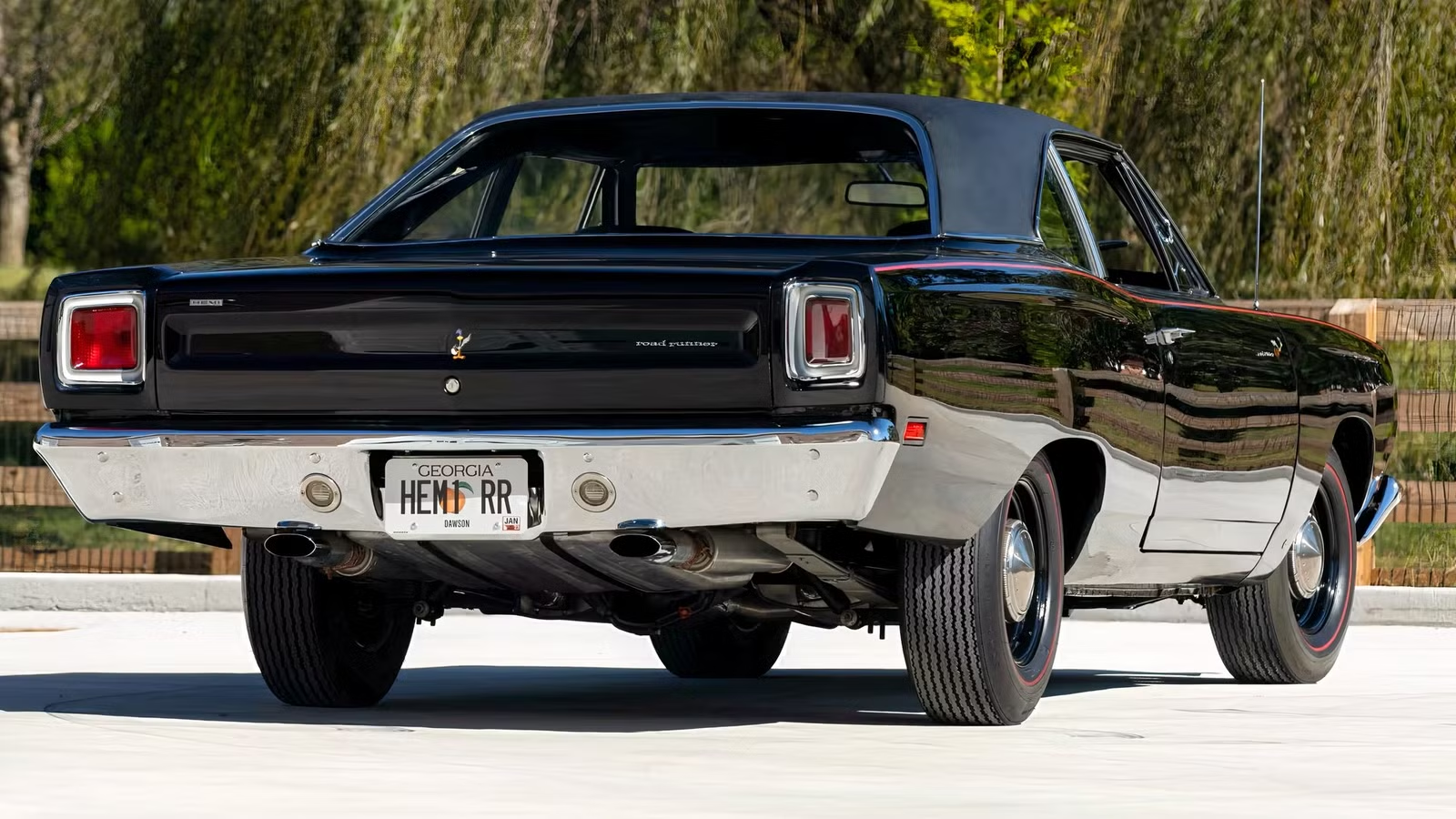
The mighty 425-horsepower 426 Hemi engine is an intimidating powerplant, with rumors suggesting that dealerships would only sell one to the most persistent of customers. To get a sense of just how fearsome the Hemi’s reputation was, look no further than the number of 1969 Plymouth Hemi Road Runner Coupes that actually left showrooms with that engine under the hood.
The Hemi Was A Rare Option In The Road Runner

The Road Runner, with its iconic “Beep Beep” horn, was a desirable car at the end of the ’60s, but most buyers opted for the 383 up front, while fewer still chose the 440 6-BBL models. According to Mecum, the 4-speed Hemi option was ticked by just 194 buyers for that year, making it incredibly rare. When one of these cars sold in 2023, it fetched $214,500. The rarest of all is the convertible Hemi Road Runner, with just 12 built — so scarce that a photo is nearly impossible to source.
1969 Plymouth Hemi Road Runner Coupe In Detail
|
Production Years |
1969 |
|---|---|
|
Units Produced |
194 |
|
Unique Features |
425-horsepower Hemi, with optional N96 Air Grabber hood |
1969 Plymouth Hemi GTX Convertible
Estimated Value: $230,000

The Plymouth Hemi GTX was a luxury version of the Road Runner with a broad range of optional equipment. The 425-horsepower 426 Hemi V8 was available for the car, but it remained a rarity, with very few customers ticking that box.
Less Than A Dozen People Bought A Hemi GTX Convertible

Just 11 Hemi GTX convertibles were produced in 1969, according to Mecum, with only six built with an automatic transmission. These cars could be optioned with a power top, factory electric windows, front bucket seats, a performance indicator vacuum gauge, variable-speed wipers, and even a 150-mph speedometer. When one of the 11 ragtops went up for sale in 2020, bidding reached $230,000, though it ultimately failed to sell.
1969 Plymouth Hemi GTX Convertible In Detail
|
Production Years |
1969 |
|---|---|
|
Units Produced |
11 |
|
Unique Features |
Luxury drop-top muscle car with a Hemi engine |
1970 Dodge Coronet R/T Hemi
Estimated Value: $247,500

The Hemi engine may be legendary, but in 1970 it wasn’t exactly popular. Dodge and Plymouth were building muscle cars by the tens of thousands at the start of the decade, but, according to Mecum Auctions, only around 1,500 of those came with the Elephant Engine. The 426 Hemi was a costly option for the time, and with the Golden Era of muscle cars fading, most buyers were content to settle for lesser V8s.
The Hemi And The Coronet Were A Rare Pairing

But of those 1,500 Hemis, almost none found their way to the Dodge Coronet. Dodge built just 13 Coronet Hemi R/Ts in 1970 (Mecum), making this one of the rarest muscle cars of all time. For something even rarer, just four Coronet R/T hardtops were specced with a Hemi engine and 4-speed manual gearbox, and there is believed to be just one R/T Hemi convertible in existence. These cars produce 425 horsepower and 490 lb-ft of torque. A manual version sold via Mecum Auctions in 2023 for $247,500.
1970 Dodge Coronet R/T Hemi In Detail
|
Production Years |
1970 |
|---|---|
|
Units Produced |
13 |
|
Unique Features |
Understated looks aside from the Ramcharger hood scoops |
1964 Ford Fairlane Thunderbolt
Estimated Value: $253,000

The Ford Fairlane Thunderbolt arrived for 1964 packing a 427-ci FE V8 fed by two 4-barrel carburetors. Officially, peak output was rated at 425 horsepower and 480 lb-ft of torque, but it was widely believed that the real figure was closer to 500 or even 600 hp.
The Fairlane Went On A Diet To Become A Thunderbolt

The Fairlane Thunderbolt came about because Ford’s drag racer of choice in the early ’60s was the Galaxie, and it was simply too heavy to compete against the Super Duty Catalinas and Max Wedge Mopars. The smaller Fairlane 500 stepped in, with cars leaving the production line stripped of niceties such as heaters, sound-deadening material, and radios, before Dearborn Steel Tubing reworked the engine bay to accommodate the massive 427 from the Galaxie. The finished Thunderbolts weighed around 3,200 pounds — the NHRA minimum to compete in the Super Stock class — and in the end, a total of 100 Thunderbolts were produced (Classic.com), comprising 51 automatic versions and 49 manual examples. Classic.com puts the average price of 1964 Fairlane Thunderbolts at $253,000.
1964 Ford Fairlane Thunderbolt In Detail
|
Production Years |
1964 |
|---|---|
|
Units Produced |
100 |
|
Unique Features |
Luxuries removed and 429 V8 fitted |
1963 Chevrolet Impala Z11
Estimated Value: $296,000

1963 was a wild year for drag racing. “Swiss Cheese” Catalinas were tearing up the asphalt, cars where it was hard to tell if there was more metal than holes, and it was also the year of the Impala Z11. The Chevrolet RPO code Z11 unlocked a very special W-engine that started life as a 409 but grew to 427 cubic inches, thanks to a crankshaft with a 3.65-inch stroke pushing pistons through the 409’s standard 4.3125-inch bore.
The Impala Z11 Had An Output To Match Some Modern Supercars

The Z11’s output was rated at 430 horsepower, but as was typical of the era, the true figure was likely higher — possibly 500 horsepower or more. The engine was mated to a Borg-Warner T-10 four-speed gearbox, and for added stopping power, the Impala was fitted with brakes sourced from the Corvette Z06. Hagerty records 57 Impala Z11s produced in total, but just 25 were made for 1963, and each is now worth about $296,000 in good condition.
1963 Chevrolet Impala Z11 In Detail
|
Production Years |
1963 |
|---|---|
|
Units Produced |
57 |
|
Unique Features |
Fitted with Corvette Z06 brakes |
1967 Ford Shelby GT500 Super Snake
Estimated Value: $2,200,000

Carroll Shelby dropped a modified Police Interceptor 428-ci V8 into the Ford Mustang in 1967 to create the first GT500, a 355-horsepower monster that elevated the Blue Oval pony car to an entirely new level. The GT500 sold well, with Ford moving 2,048 units, according to Mecum Auctions. But there was a fiercer version of the GT500 that was far rarer — in fact, just one was ever built.
The Super Snake Was Built For A Publicity Stunt

Designed for a Goodyear tire promotional event, the GT500 Super Snake was custom-built by Shelby to run 500 miles at an average speed of 142 mph, demonstrating the durability of the new Thunderbolt tire. The Super Snake used a purpose-built GT40 Mk II 427 engine producing 600 horsepower, along with a comprehensive package of upgrades throughout. When this one-of-one Super Snake went under the hammer in 2019, it fetched $2.2 million, making it the most expensive Mustang ever sold at the time.
1967 Ford Shelby GT500 Super Snake In Detail
|
Production Years |
1967 |
|---|---|
|
Units Produced |
1 |
|
Unique Features |
Custom GT40 engine and 600 horsepower |
1971 Plymouth Hemi ‘Cuda Convertible
Estimated Value: $3,500,000+

The Plymouth Barracuda had only been launched in 1964, but by 1971 it felt like the end. The muscle car segment was contracting, with an oil crisis and tightening emissions regulations on the horizon. The Barracuda received a refreshed front end, but sales still tumbled from 55,499 to 18,690 (Hagerty), and certain trim and engine combinations were destined to become unexpected unicorns in the muscle car world.
The Hemi Cuda Convertible Is One Of The Most Valuable Muscle Cars Of All Time

One of these was the 1971 Hemi ‘Cuda convertible, produced during the final year buyers could order the 426 for the car. It turned out that just 12 ‘Cuda convertibles were fitted with this engine — seven destined to remain in the USA and five exported. Only three of the 12 were built with a four-speed manual transmission, according to Hagerty. These 425-horsepower open-top muscle cars command enormous sums today: one sold for $3,500,000, and another (pictured) was bid to $4,800,000 but did not sell.
1971 Plymouth Hemi ‘Cuda Convertible In Detail
|
Production Years |
1971 |
|---|---|
|
Units Produced |
12 |
|
Unique Features |
Huge Hemi 426 powerplant with 425 hp and 490 lb-ft of torque |
Sources: Mecum.com; Hagerty.com; Hemmings.com

Related posts



Latest Post


No Comments