
The Futuristic Subaru That Was Supposed To Bury The Toyota Supra
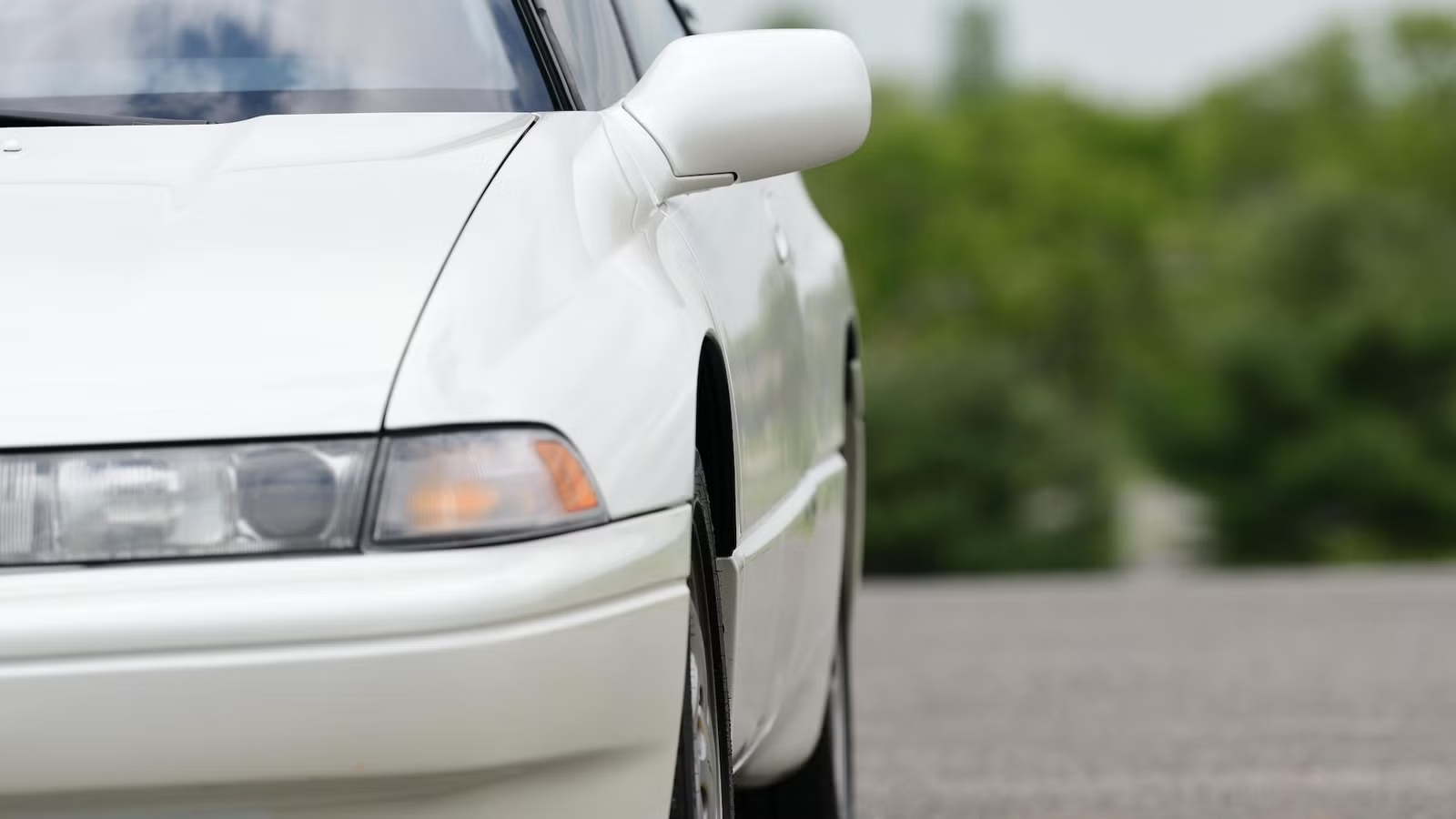
Imagine you’re at the 1989 Tokyo Motor Show. You walk by the star of the show, a futuristic grand tourer by a prestigious Italian design firm, complete with airplane-inspired windows and a historically powerful engine. It’s revolutionary, and everyone has to take a look. But the most shocking part of the car might be its badge: Subaru.

In the late 1980s, Subaru grew tired of being left out of the Japanese grand tourer wars. It threw the entire might of its parent company—Fuji Heavy Industries—into a series of increasingly extreme aviation-inspired coupes. Here’s the full story.
Japan’s GT Wars Were Already Won
When Datsun launched the 240Z “Fairlady” in 1969, it was a revelation. A grand tourer that offered Japanese reliability, European performance, exotic car looks, and a pony car price tag. One car changed the reputation of the Japanese auto industry worldwide. By the late 1980s, buyers had their choice of Japanese grand touring cars. The segment was booming, producing legends such as the Mazda RX-7, Toyota Supra, Nissan Skyline, and Nissan 300ZX.

The Fuji Heavy Industries conglomerate had introduced the Subaru badge for its passenger cars in 1958. But by the late 1980s, it was still struggling to break into the lucrative sports car market. Flying wedge-shaped cars were dominating the supercar industry, so Subaru actually tapped Fuji’s aviation division to help design the 1985 XT.

The dramatically angular coupe was the most aerodynamic vehicle in the U.S. when it hit the North American market. That’s right, it was more aerodynamic than the contemporary Corvette or Lamborghini.
And this thing looked like a rocket ship. Its window-within-a-window canopy layout, blatantly stolen from fighter plane design, was impossible to ignore. The Top Gun theme song should have automatically played every time you opened the door. But with a turbocharged four-cylinder making just 111 horsepower, the car had more bark than bite. It never caught on.
For the 1988 model year, Subaru turned the XT up to 11. Well, “6” to be exact. It engineered its first six-cylinder engine, a 2.7-liter flat-six, based on its boxer flat-four. When the extra power still didn’t do the trick, Subaru went to Europe for some help.
12 Used Japanese Sports Cars Nobody Is Buying
Not all great Japanese sports cars are celebrated, and these ten used examples are frequently overlooked by buyers.
Subaru Brought The Big Guns To Tokyo

By 1989, Japan’s economy was booming, driven by its expanding auto industry. The newly opened Makuhari Messe hosted the 1989 Tokyo Motor Show, and the event was a watershed moment for the country—and the world. This was the debut of Toyota’s Lexus brand, with the LS 400. The event also announced the new Nissan Skyline GT-R (R32). And those are just honorable mentions.
This show was the Japanese debut of the Mazda Miata. Yup, that Mazda Miata. It was also where Japan first glimpsed the Honda NSX, the official unveiling of Honda’s new VTEC technology. But were show attendees looking at these legendary vehicles? No, center stage was dominated by an all-new coupe penned by a famed Italian design house for a Japanese manufacturer.

Giorgetto Giugiaro’s ItalDesign is famous for mass-market staples including the MK1 Volkswagen Golf, Fiat Panda, and Lancia Delta. It also penned more extreme concepts that went into production: the BMW M1, Lotus Esprit, and DMC DeLorean, just to name a few. But when Subaru asked it for an all-new XT, the design firm knew flying wedge-shaped cars’ days were numbered. The design had debuted way back with the 1968 Alfa Romeo Carabo concept. Subaru would need something all-new to get noticed in the 1990s.
The coupe Giugiaro came up with retained the window-within-a-window design of the XT, doubling down with a curved glass canopy flowing into a fiberglass roof cap. The firm cited “safety” and “functionality” for its new “architecture with markedly curved windscreen, rear window and side windows.” The coupe also oozed style, and the world couldn’t look away. But Subaru knew it would need enough power that its coupe could impress the watching world.
The Subaru Alcyone SVX

|
Subaru Model |
1985-87 Subaru XT Turbo |
1988-91 XT6 |
1992-97 SVX |
|
Engine Code |
EA82T |
ER27 |
EG33 |
|
Configuration |
Turbocharged SOHC flat-four |
NA SOHC flat-six |
NA DOHC flat-six |
|
Displacement |
1.8 liters |
2.7 liters |
3.3 liters |
|
Bore x Stroke |
92 x 67 mm |
92 x 67 mm |
96.9 x 75 mm |
|
Horsepower |
111 hp – 115 hp |
145 @5,200 rpm |
230 @5,400 rpm |
|
Torque |
134 lb-ft – 137 lb-ft |
156 lb-ft @4,000 rpm |
228 lb-ft @4,400 rpm |
Subaru bumped its flat-six engine’s displacement from 2.7 liters to 3.3 liters. It did this by both boring out the engine and increasing its stroke. But that’s not all: It also modernized the powerplant with dual overhead camshaft heads for both cylinder banks. The result was a boxer engine so large, it would have been at home in the back of a Porsche 911. But instead, it was in the front of an AWD Subaru.
The EG33 engine claimed 230 hp at 5,400 rpm and 228 lb-ft at 4,400 rpm. The resulting flagship car only came with a 4-speed automatic, though it offered a driver-selectable manual mode. Reviewers found that the Subaru AWD system in the SVX did its job, providing excellent handling, especially in wet weather. Road and Track even nicknamed the SVX the “poor man’s Carrera 4.”

Fuji Heavy Industries was enormously proud of its new halo car. It even kept the JDM-only nameplate from the XT: Alcyone. You see, Subaru is the Japanese word for “unity” and also the name of the “Pleiades” constellation of seven stars (often called the “seven sisters” in English). This constellation also gives Subaru its logo. The logo represents multiple companies unifying together to form Fuji Heavy Industries. In Japan, the brightest star in said constellation is Alcyone.
This BMW Icon Was Built Inside A Forgotten Skunkworks Program
This forgotten operation assembled each car by hand, changing automotive culture forever.
The Six-Cylinder Misfire

The SVX wouldn’t be Subaru’s big break in the performance space. It did slightly outsell the Toyota Supra (12,059 U.S. sales between 1993 and 1998) with its 14,257 sales from 1990-97. But it never touched the Nissan 300ZX (68,368 cars sold between 1990 and 1996). Meanwhile, the new Mazda Miata (NA) lapped both cars with 214,000 U.S. sales.
The SVX’s best U.S. sales year was 1993, with 3,859 units sold. But by 1996 that number had collapsed to 1,111 and Subaru decided to cancel the car.

It’s hard to know exactly why the SVX failed, but it was probably a perfect storm of reasons working against the car. The SVX was 500 pounds heavier than the Mazda RX-7 and outweighed the Miata by almost 1,400 pounds. It made relatively competitive power, but struggled to 60 mph in 7.2 seconds and through the quarter mile in 15.4 seconds (@92.5 mph). Even so, enthusiasts might have cared less about straight-line speed if it had offered a manual transmission option. Finally, Subaru had yet to build a brand reputation for sports cars. Today, the WRX and STI badges have become household names. But in 1990, Subaru was still fighting a reputation as a boring station wagon manufacturer.
The Hand-Built Buick Coupe That Had A Touchscreen In 1988
This hand-built coupe had a touchscreen in 1988, but its biggest problem may have been arriving before buyers knew they wanted one.
A Quirky Car Collectors’ Dream
Today, the SVX’s styling is divisive. Unlike the angular XT with its groovy pop-up headlights, the SVX is caught between eras: a curvy rear window but a compressed front end required to hit its drag coefficient numbers. But its window-within-a-window design is iconic. Its powertrain is historic. And collectors of quirky cars in-the-know seek the SVX out. It doesn’t hurt that Doug DeMuro has given the SVX the crown of “the weirdest Subaru ever,” and weird car enthusiasts are responding in kind.
Multiple Subaru SVX coupes have sold on Cars & Bids in the past two years for under $6,000. But in April 2025, a 21,400 mile, unmodified example (VIN JF1CX353XNH105978) commanded $11,200. An impressive 46 Subaru SVX coupes have appeared on Bring a Trailer over the years. The 26,000 mile car pictured (VIN JF1CX3539NH100464) sold in 2024 for $15,000.
Sources: Subaru, ItalDesign, Tokyo Motor Show

Related posts
Latest Post


No Comments