
The Porsche Taycan’s 0% Battery Test Reveals Something Every Performance-EV Owner Should Know
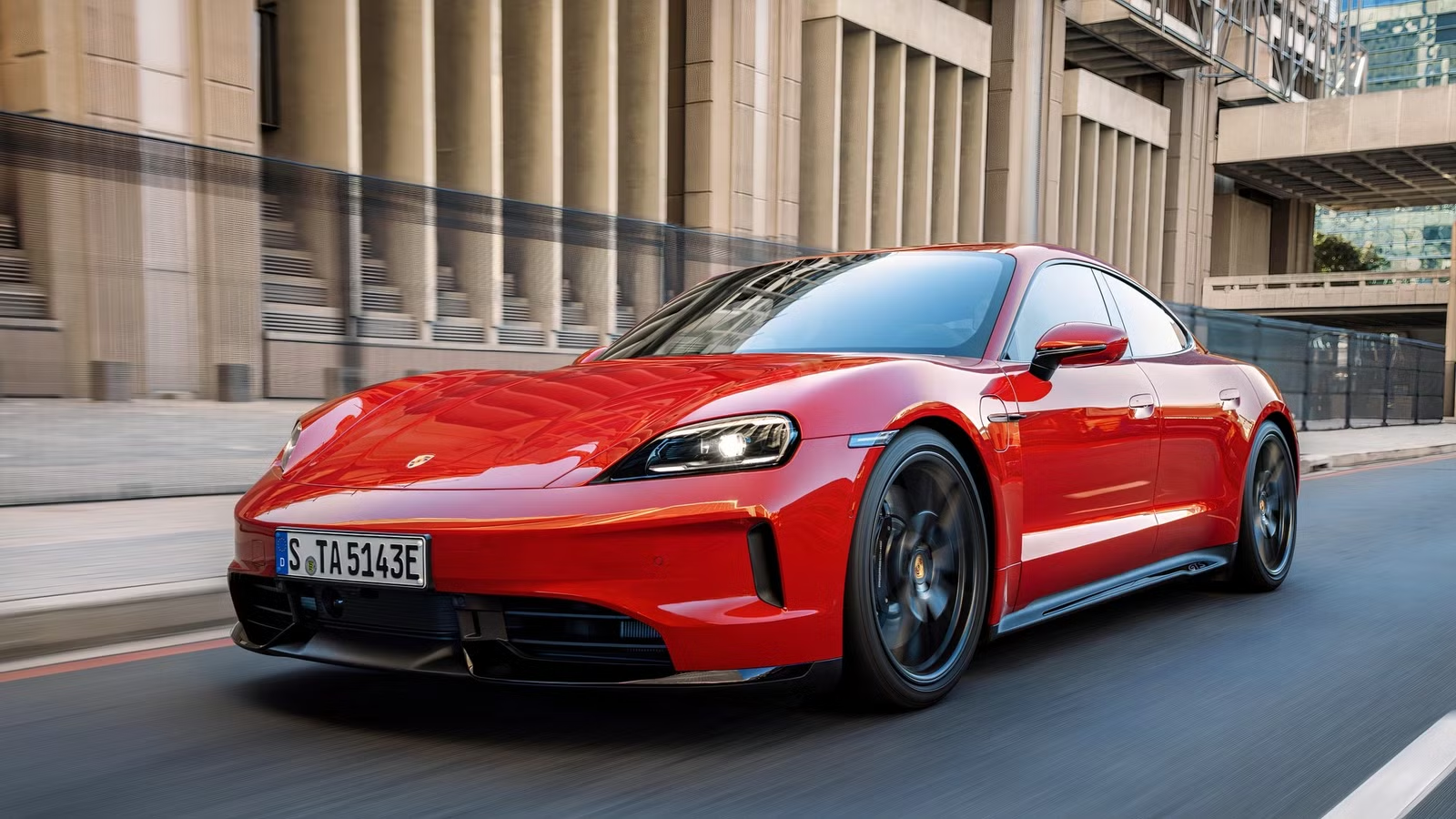
A Porsche Taycan owner recently pushed his car all the way to a displayed 0% state of charge—on purpose—to document exactly what happens when the battery indicator bottoms out. The results, published June 24, offer a rare look at how Porsche’s battery management system behaves at the extreme low end of the charge curve, and the answer is more nuanced than most owners expect.

The short version: the Taycan doesn’t simply stop. It enters a controlled limp mode with a measurable reserve still available, a graduated warning sequence, and a speed cap designed to get the driver to a charger rather than strand them roadside. For the vast majority of Taycan owners, this scenario will never arise—but for anyone who tracks the car or plans aggressive long-distance runs, understanding what’s actually happening inside the battery management system is genuinely useful.
What The 0% Test Actually Showed
When the Taycan’s display reached 0%, the car did not shut down. Instead, it transitioned into a reduced-power limp mode that kept the vehicle moving while protecting the battery pack from deep discharge damage. The test documented a warning progression that begins well before the display hits zero—range estimates drop, alerts appear on the instrument cluster, and the car begins limiting available power output in stages rather than all at once.

Once the display read 0%, the Taycan still had a small reserve of range remaining. This is intentional. Porsche engineers the battery with a protective buffer at the bottom of the charge curve—capacity that the car’s software holds back from the driver-facing display precisely so the pack never reaches a genuinely depleted state. The limp-mode speed cap during this reserve phase keeps the car drivable at low speeds, enough to reach a charging point, but performance is substantially curtailed. Full acceleration is off the table.
Porsche’s Usable-Buffer Strategy, Explained

The Taycan uses a buffer at both ends of the charge curve. At the top, Porsche reserves capacity above the displayed 100% to protect cells from the degradation that comes with sustained high-voltage stress—this is why charging to a displayed 100% is not the same as charging to absolute maximum cell capacity. At the bottom, the reserve documented in this test prevents the pack from ever reaching a true zero-voltage state, which can permanently damage lithium-ion cells.
This dual-buffer approach is common across premium EVs, but Porsche’s implementation is tuned with the Taycan’s performance envelope in mind. The car is rated for repeated DC fast charging at up to 270 kW on the 800-volt architecture, and protecting cell chemistry at both extremes is part of what makes that charging speed sustainable over the life of the pack. Owners who regularly charge to 100% for track days or deplete aggressively on long trips are operating closer to the buffer boundaries than they may realize—the display just doesn’t show it.
Why This Matters For Track And Long-Distance Driving

On a road trip, the practical implication is straightforward: when the Taycan shows 0%, you have not yet damaged the battery, and the car will still move. The limp-mode reserve is a genuine safety net, not a marketing footnote. That said, relying on it routinely is not a strategy Porsche recommends—repeatedly cycling into the deep-reserve zone puts more stress on cells than normal use patterns.
For track driving, the upper buffer is the more relevant concern. Charging to a displayed 100% before a track session does not give you access to every available kilowatt-hour; the top buffer is always held back. Drivers who want to understand their true usable energy window—and plan pit stops or charging intervals accordingly—need to account for both ends. The Taycan’s onboard range estimates are calibrated to the usable window, not the full cell capacity, so the numbers on the display are accurate to what the car will actually deliver under normal conditions. The buffers are simply invisible to the driver by design.
Real-world tests like this one are a useful reminder that the number on the dashboard is an engineered abstraction, not a raw readout of cell state. Porsche built the Taycan to handle the edges of the charge curve gracefully—and now there’s documented proof of what that looks like from the driver’s seat.
Sources: SupercarBlondie, Car & Driver

Related posts





Latest Post


No Comments