
BMW N54: The Forged Inline-Six That Behaved Like a 2JZ
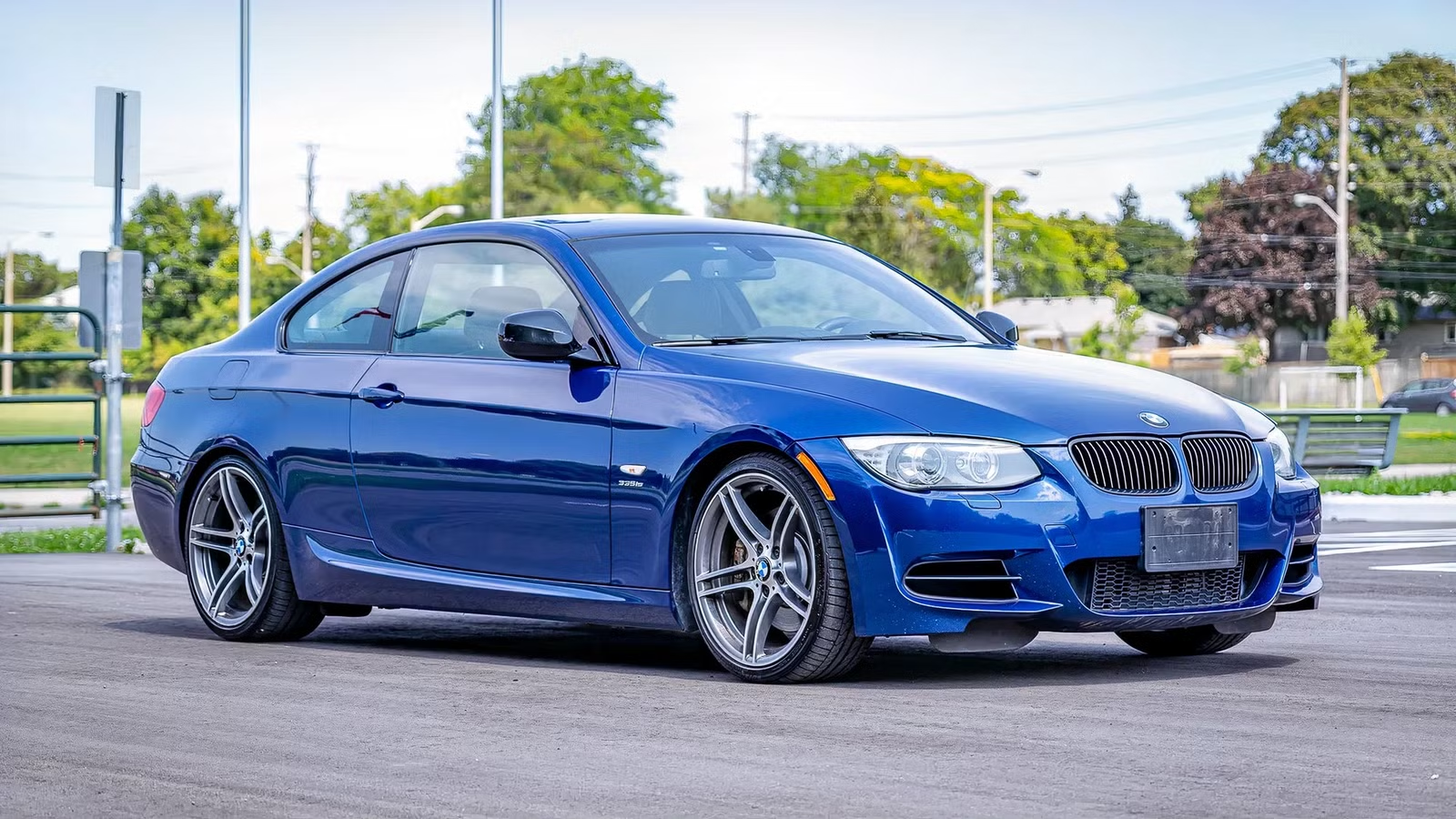
In 2010, a 2011 BMW 335is hit a DynoJet and returned 293 hp and 343 lb-ft at the wheels, beating every N54 previously tested in that dyno comparison by a wide margin. BMW rated the car at 320 hp. That result isn’t news in 2026; it’s the smoking gun in a forensic reopening of an old BMW mystery. And if factory-built sleepers are your thing, few engines played the part better. The original dyno evidence makes BMW’s N54 look less like a normal luxury-car six and more like a tuner motor somebody told to behave.
The 335is Dyno Put BMW’s N54 Rating On Trial

BMW never pretended the 335is was a regular 335i. Its official specifications list 320 hp and 332 lb-ft from the twin-turbo 3.0-liter N54, with temporary overboost raising torque to 370 lb-ft. BMW also upgraded the cooling system and offered a seven-speed dual-clutch transmission alongside the six-speed manual. This wasn’t just a software tune and a hopeful pat on the hood.
Then came the less-discussed number: 343 lb-ft at the wheels. That’s already more than the engine’s normal 332-lb-ft crank rating after the torque has passed through the drivetrain, and the dyno curve showed BMW’s factory overboost doing its job. But BMW openly advertised 370 lb-ft during overboost, so 343 lb-ft at the tires doesn’t prove there was some secret torque rating. What it does show is how much shove this supposedly civilized coupe could actually put down. That’s part of the fun with underrated performance machines: sometimes the hardware is less modest than the badge.
Horsepower makes the stronger case. Against BMW’s 320-hp crank rating, 293 hp still reached the rear wheels. Applying standard 10–12% driveline-loss assumptions, a range also used in this 335i drivetrain-loss analysis, that works out to roughly 326–333 hp at the crank. That’s an estimate, not a hidden factory number, because dyno type, temperature, tires, transmission losses, and individual engines can all affect the result. Even with those caveats, 293 whp sits unusually close to 320 crank hp. That’s why the old “spec-sheet conspiracy” stuck: the dyno numbers make it easy to see why enthusiasts felt BMW had sandbagged the 335is rating, even if “conservatively rated” is the technically safer conclusion.

The Regular 335i Made The Underrating Hard To Ignore


The 335is would be easier to dismiss as one unusually strong car if the regular N54-powered 335i hadn’t already done something similar. BMW rated it at 300 hp and 300 lb-ft, yet early chassis-dyno testing produced 275 hp and a full 300 lb-ft at the wheels in 92-degree heat. Another car repeatedly landed in the low 280s and reached as high as 287 whp. At some point, coincidence starts needing a better alibi.
Apply the same 10–12% driveline-loss assumptions to 287 whp and you get roughly 319–326 hp at the crank. If you use the older 15% driveline-loss assumption instead, 287 whp works back to about 338 hp at the crank, roughly 38 hp above BMW’s official rating. That’s our reverse calculation, not measured crank output, which is why the more conservative 10–12% estimate is the better number to lean on. The cleaner takeaway is that several N54s kept putting down wheel horsepower suspiciously close to their advertised engine ratings. The repeated dyno results make the case stronger than any one unusually healthy engine could, which is part of why older luxury performance bargains can become more interesting with age.
The later N55 gives the story some useful context. BMW kept the same 300-hp and 300-lb-ft ratings, but the newer engine switched to a single twin-scroll turbo with Valvetronic, improving low-end response and reducing lag. Period chassis-dyno testing recorded 266 hp and 302 lb-ft at the wheels. That doesn’t make the N55 weak, and peak dyno numbers never tell the whole driving story. It simply makes the N54’s repeated near-crank-level wheel horsepower look even harder to shrug off.
The N54’s Hardware Explains Its Detuned-2JZ Reputation

This is where the “German 2JZ” nickname either earns its keep or falls apart. According to High Performance Academy’s N54 breakdown, the 2,979-cc straight-six uses an aluminum open-deck block, forged crankshaft, forged connecting rods, and cast pistons. It also gets dual VANOS, direct injection with piezoelectric injectors, and two Mitsubishi TD03L4 turbos. So yes, the N54 has serious forged hardware. No, the whole bottom end isn’t forged. The cast pistons and open-deck block matter once boost stops being polite.
Toyota’s 2JZ-GTE is built differently, with a 2,997-cc iron closed-deck block, forged crankshaft, aluminum pistons, and twin turbos. The Toyota block is heavier and supports the cylinders differently, while BMW’s aluminum open-deck design saves weight and leaves more coolant space around the bores. The N54 also uses modern direct injection. Put both engines on stands and nobody is confusing them. What they share is what tuners care about: straight-six smoothness, boost, tough factory hardware, and plenty of unused power. That’s the same itch behind wild engine-swapped builds. For tuners, that excess is exactly the point.
The real 2JZ connection is tuning headroom. High Performance Academy’s N54 guide says a reflash alone can add 70-plus hp, while another N54 build guide puts a Stage 1 tune on 93 octane around 65–90 whp over stock and E50 combinations around 140–200 whp over stock, depending on the tune, fuel, and supporting hardware. Stock TD03 turbos have even crossed 500 whp in documented builds, but that’s the ragged edge, not where you’d park a daily driver and expect the turbos to send you Christmas cards. Bigger turbos, more fuel, and stronger internals open the door to 800-plus-whp builds and considerably more. That kind of headroom wasn’t confined to dyno sheets. A heavily modified N54-powered 335i was documented beating a Nissan GT-R in a half-mile run, then taking down a supercharged E92 M3 after further work. Of course, that doesn’t mean a stock 335i is one flash tune away from spending its weekends hunting supercars. It does explain how an underrated luxury engine ended up becoming tuner folklore.
Why BMW’s Unofficial S-Code Still Matters In 2026


The N54 arrived when BMW fans had a pretty clear idea of what a special straight-six should be. Engines such as the S54 built their reputation with natural aspiration, revs, and razor-sharp response. The N54 went the other way: two small turbos, thick midrange torque, huge gains from software, and a home in perfectly respectable luxury cars. For enthusiasts who cared more about tuning potential than naturally aspirated purity, it became an unofficial alternative to BMW’s S-code playbook. Not an actual S engine. Just one with suspiciously good extracurricular activities.
BMW eventually gave that argument some factory backing by putting an uprated N54 in the 1 Series M Coupe. Its official specifications list 335 hp and 332 lb-ft, with overboost temporarily raising torque to 369 lb-ft. The same basic engine family enthusiasts knew from regular BMWs had crossed into a genuine M car. BMW never called the ordinary N54 an S engine, but it’s easy to see why the nickname stuck. Modern luxury performance sub-brands make the hierarchy obvious. The N54 was more fun because it didn’t.
Age still brings an ownership asterisk: BMW’s high-pressure fuel-pump campaign covered about 130,000 potentially affected vehicles, while a BMW technical bulletin addressed the familiar N54 wastegate-area clanking and rattle. But that’s the warning label, not the legacy. What enthusiasts found under the hood was a smooth luxury-car six with a forged crank, forged rods, twin turbos, direct injection, conservative-looking factory numbers, and enough tuning headroom to spend the next decade being compared with one of Japan’s most famous engines. It wasn’t a 2JZ built in Munich, and BMW never stamped an S on the block. Instead, it was something sneakier: a mass-produced luxury six that behaved like a factory-detuned tuner motor wearing a chauffeur’s suit.

Related posts

Latest Post


No Comments