
The Trike More Riders Should Take Seriously
Three wheels have never had an easy time earning respect in the motorcycle world. To some riders, a trike is a mobility solution dressed up as a cruiser; to others, it is simply “not real motorcycling.” Old-school designs did little to help, with heavy rear axles that could make rough pavement feel like a tug-of-war at the handlebar. Yet, Harley-Davidson recently went back to the drawing board and re-engineered its factory trike platform in what it calls its biggest update since the modern line began in 2009. One of its three-wheelers now has a strong case to be judged by how it rides, not how many wheels it has.
Trikes Still Have An Image Problem

Part of the resistance is cultural. Motorcycling has long been tied to balancing a machine, leaning into corners and accepting a little physical effort as part of the deal. A three-wheeler removes one of those defining tasks, so some riders immediately see it as less authentic. The stereotype that trikes are mainly for older riders or people who can no longer manage two wheels is just as persistent.
There is also a mechanical reason those opinions took hold. Earlier factory trikes used a live or solid rear axle. When the two rear wheels hit uneven pavement at different times, the axle could transmit that disturbance through the chassis. Many independent tests proved that the older setup of Harley trikes could make the rear wheels bounce over bumps and wrench the handlebar back and forth. Add a curb weight north of 1,100 pounds and a price well above a two-wheeler, and plenty of riders never looked twice.
What Three Wheels Actually Solve

Flip the argument around, though, and three wheels look pretty clever. A trike doesn’t tip over at a stop. Roll up to a red light, squeeze the brake, and leave your boots on the floorboards. Load it up, and the gap widens. With a passenger and a few days of gear aboard, a two-wheeler gets top-heavy the second you crawl through a parking lot; a trike just carries it. It also keeps long-distance touring open to riders whose knees, wrists, or balance have opinions about two wheels, or who simply don’t want to hold up a big touring bike at every intersection. They aren’t asking for sympathy. They want a machine that doesn’t fight them for eight hours.

The Harley-Davidson Road Glide 3 Is Seriously Underrated
Base Price: $35,399

The trike in question here is the Harley-Davidson Road Glide 3, which carries a base MSRP of $35,399 in Dark Billiard Gray with chrome. Dealer listings show the black trim versions climbing to $38,149, depending on paint and finish. That places the trike between the regular 2026 Road Glide at $25,999 and the Street Glide 3 Limited at $39,199. The three-wheel premium over the standard Road Glide is therefore $9,400 at starting MSRP. At the top of the factory trike family sits the CVO Street Glide 3 Limited at $54,999.
Road Glide Up Front, A Trike Out Back

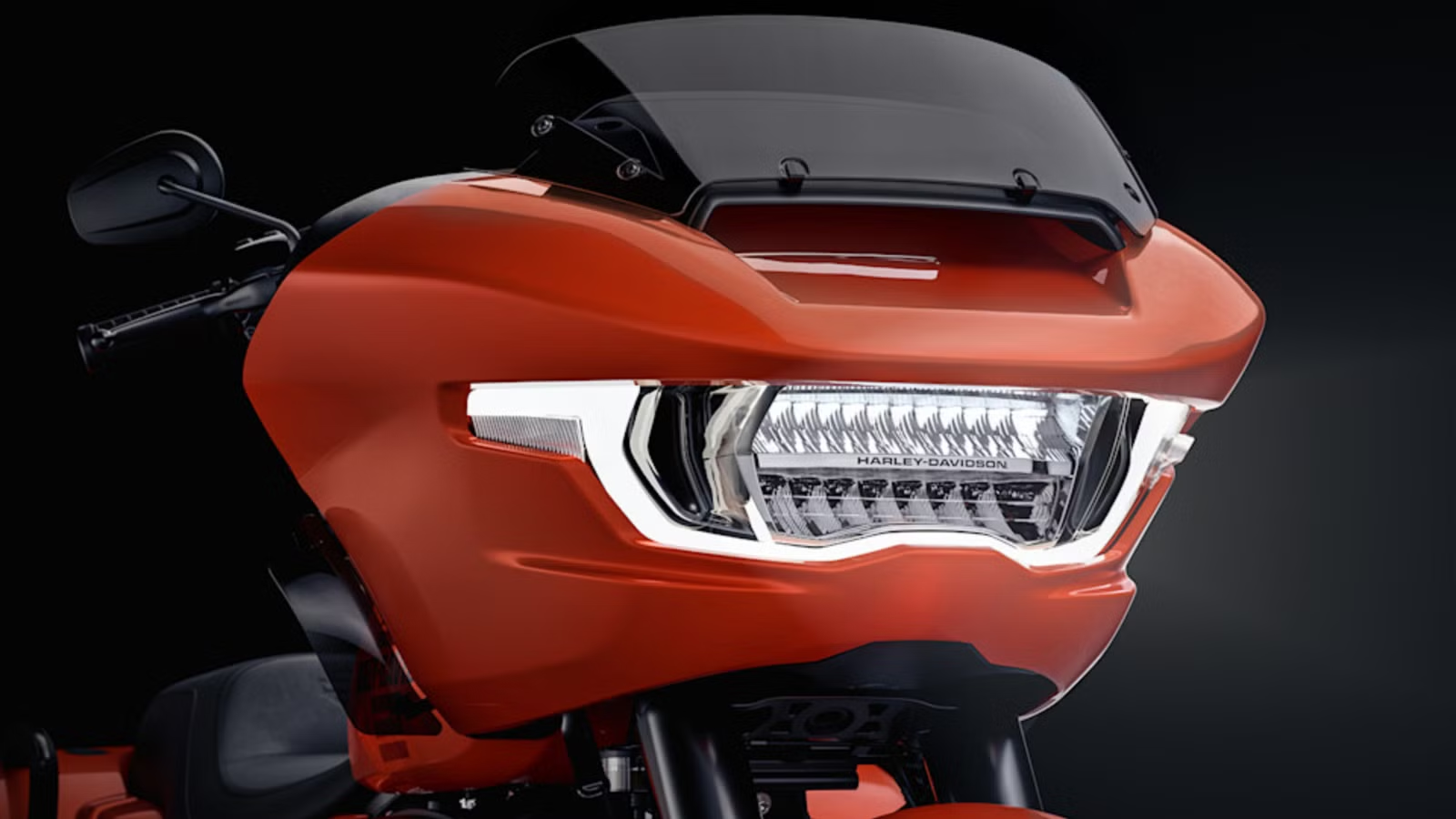
Harley took the Road Glide’s face and bolted it to a three-wheel chassis, and the pairing works. The redesigned Sharknose fairing mounts directly to the frame instead of the forks, so you’re not muscling its weight through the handlebar. H-D says that reduces steering effort in tight, slow maneuvers. A low-profile smoked windscreen appears to float above it and is shaped to cut helmet buffeting at highway speed, and mid-frame air deflectors add to the wind management.
The styling gets a workout, too. The new gloss-black wheels wear machined highlights and five exposed lug nuts instead of four. The rear fenders are wider and clipped high to show more tire. Blood Orange and Teal Thunder join the color list. The model itself debuted in 2023 with the Milwaukee-Eight 114 and a solid axle, so 2026 changes far more than the paint.
The Rear Suspension Is The Real Headline

Harley replaced the solid axle with a de Dion-style design, where a cast aluminum axle links both wheels and pivots on a spherical joint, so a bump on one side barely disturbs the chassis. The differential now bolts to the chassis instead of hanging off the axle. A Watts linkage keeps things centered, and a stabilizer bar controls roll in turns. Harley says the redesign cuts unsprung weight by about 68 pounds while increasing rear-wheel travel from 2.3 to 5.0 inches. The rear track is 1.5 inches wider, and the wheelbase grows by 1.6 inches to support the revised layout.
Electronics That Inspire Confidence Around Corners

A trike can’t lean, so cornering feels different. Weight shifts to the outside wheels, and that’s exactly where the electronics come in. The Road Glide 3 gets Harley’s cornering-enhanced Rider Safety Enhancements: C-ABS, C-ELB (linked braking), C-TCS (traction control) and C-DSCS (drag-torque slip control), plus a new tire-pressure monitor. On a trike, H-D says, the cornering versions read lateral acceleration rather than lean angle. In real terms, the systems adjust brake pressure and limit wheel slip mid-turn, and they’re designed to help the trike hold your intended path if you grab a handful of brake or snap the throttle shut on slick pavement. Nothing here suspends physics, and Harley doesn’t pitch these aids as anti-tip technology.
The V-Twin Is Built For Modern Highways And Everyday Usability

Powering the Road Glide 3 is the Milwaukee-Eight VVT 117, a 1,923cc V-twin rated at 105 hp at 4,600 rpm and 129 lb-ft at 3,250 rpm, as per Harley. It replaces the 114 used through 2025, and H-D claims up to 13 percent more horsepower and 7.5 percent more torque. Power flows through a six-speed transmission with reverse, then a belt final drive. Harley estimates 39 mpg from the 6-gallon tank, which works out to roughly 230 miles on paper.
The VVT part matters as well. Adjusting valve timing broadens the powerband, and according to Harley, it improves combined city and highway efficiency by 2 to 3 percent versus the same engine with fixed timing. What you’ll feel is low-end pull. That’s the muscle you want for passing on a two-lane, merging across multiple lanes onto a freeway, or climbing a mountain pass with a passenger and gear.
Integrated Mechanical Reverse And Drive Mechanics

Every trike needs reverse, because nobody’s pushing 1,184 pounds out of a garage by hand. Till the MY2025 model, a separate electric motor bolted to the rear axle did the job, adding unsprung weight in the worst possible spot. The 2026 setup is lighter and built into the chassis, borrowing the engine’s starter motor instead. Reverse runs in 20-second bursts, so it’s for parking, not backing down the block.
Heat management gets attention, too. The cylinder heads carry coolant channels around the exhaust valves, with an electric pump and a thermostat-controlled fan low on the frame that directs air below the bike. Harley says it helps most at low speeds and in hot weather. Ride modes shape throttle response.
Technology And Ergonomics Are Offered In A Leaner Bagger Package

This is where Road Glide 3 earns the “leaner” label. A 12.3-inch TFT touchscreen running Skyline OS replaces the analog gauges and most of the switches. It supports Apple CarPlay, wired or wireless, gets over-the-air updates over Wi-Fi, and carries the four ride modes. Android Auto isn’t supported, though Android users can still stream music and take calls. Embedded navigation costs extra on U.S. bikes, which stings a little at this price.
Ergonomics earn brownie points as well. The reshaped one-piece seat rotates the rider’s hips toward a neutral position, which H-D says eases strain on the back and neck, and passengers get reshaped footboards and low-profile, soft-touch grab handles. Storage is where the “leaner” part bites. The weather-sealed trunk opens from the top and holds 2.0 cubic feet, while the Street Glide 3 Limited’s rear trunk alone is 4.4 cubic feet. Two people packing for a week will want soft luggage.
Source: Harley-Davidson

Related posts

Latest Post


No Comments