
Demon 170 vs. Today’s Muscle Cars: The Quarter-Mile Gap
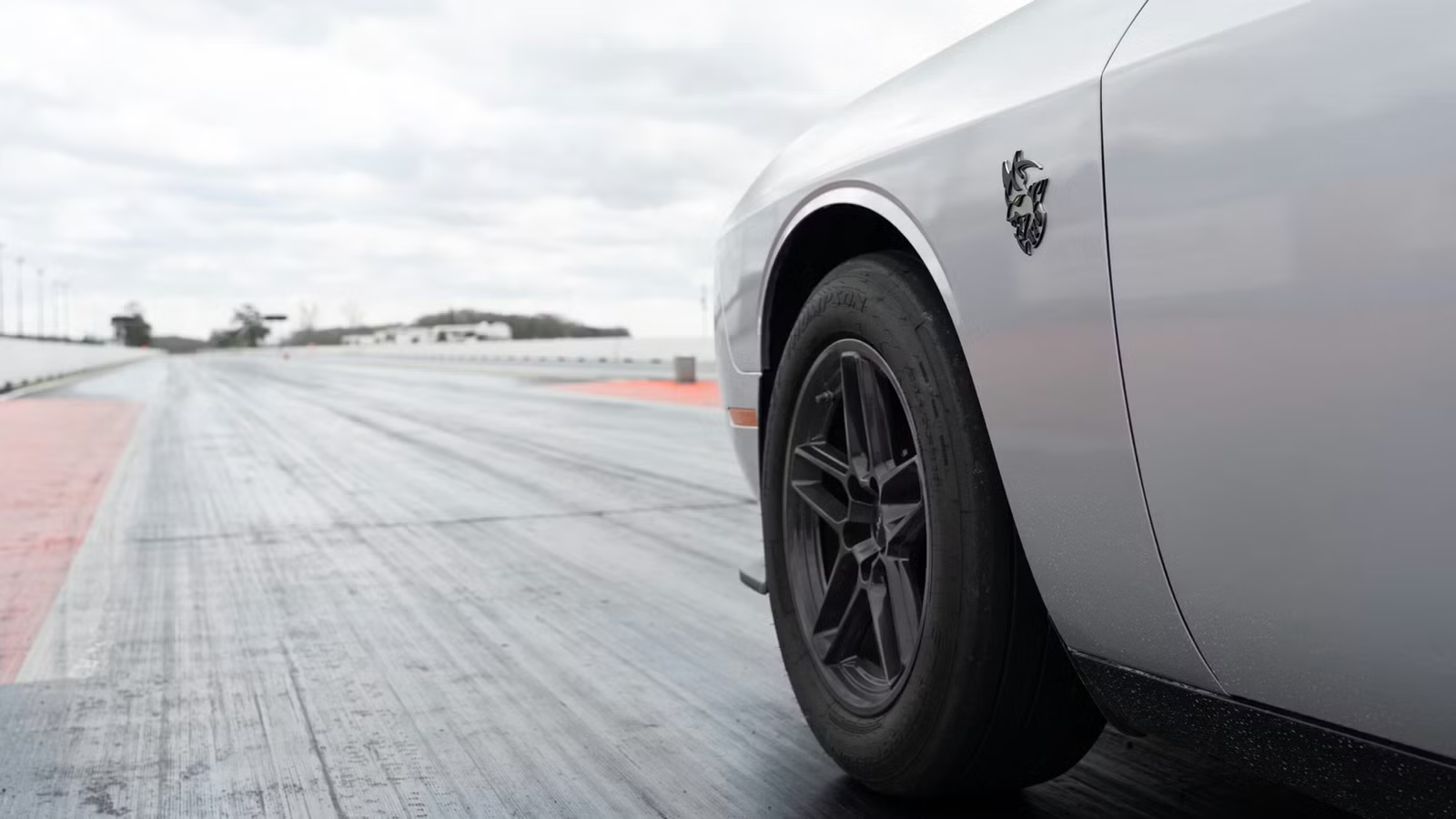
Three years ago, a dealer could take your order for a warrantied, factory-built car certified to run the quarter mile in under nine seconds at more than 150 mph. Today, the quickest naturally aspirated V8 muscle car you can buy new needs a few more seconds to cover the same 1,320 feet.

That gap is measured in whole seconds and more than 30 mph of trap speed, not tenths. The only new muscle cars that narrow it by a meaningful margin cost more than $100,000, and none has a verified time that matches the old benchmark.
Nine Seconds Is Where NHRA Stops Treating A Street Car As Stock
NHRA’s Street Legal program lets 2014-and-newer production cars run as quick as 9.00 seconds, or as fast as 150 mph, without an aftermarket roll bar or roll cage. Cars from 2008 to 2013 get a tighter limit of 10.00 seconds and 135 mph. NHRA raised these limits because automakers kept selling quicker cars straight off the showroom floor.

The exemption only holds while the car keeps its factory safety equipment. Unaltered ABS, working airbags, and the stock unibody, floors, and firewall all have to stay in place, though any DOT-approved tire is allowed. Drivers who run quicker than 10.00 seconds or faster than 135 mph also need an NHRA Level 6 license.
NHRA hands out decals to Street Legal racers who break the 13-, 12-, 11-, and 10-second marks at a quarter-mile track. That ladder doubles as a scorecard for modern muscle cars, and anything quicker than 9.00 seconds falls outside what an unmodified street car is allowed to run.
Dodge’s Last Call Signed Off With An 8.91-Second Demon 170 On E85

The 2023 Challenger SRT Demon 170 was the seventh and final Dodge Last Call edition, and its supercharged Hemi V8 made 1,025 hp and 945 lb-ft once the fuel exceeded 65% ethanol content. On regular E10 pump gas, the same engine made 900 hp and 810 lb-ft. A fuel-rail sensor read the ethanol content and adjusted output to match.
On E85, the Demon 170 ran an NHRA-certified 8.91 seconds at 151.17 mph, making it the first factory production car into the eights. Dodge set that time on a prepared drag strip, and the pass broke both Street Legal limits at once. Dodge publicized the NHRA violation letter the Demon 170 earns for running that quick without a roll cage or parachute.

Mickey Thompson ET Street R drag radials were standard equipment, so the 8.91-second run didn’t depend on an options package. TransBrake 2.0, drag-tuned adaptive dampers, and a 3.0-liter supercharger running 21.3 psi of boost all came with the car.
Early owner passes landed between 9.39 and 9.50 seconds. Dodge reported one owner running 9.50 seconds days after delivery on premium gas topped up with flex fuel, and the first privately owned car ran 9.39 seconds. Dodge never published a quarter-mile time on E10, so no official pump-gas figure exists.

Pricing started at $96,666 before destination, with orders open from March 27 to May 15, 2023, and production capped at 3,300 cars. The Last Call lineup marked the end of the Hemi-powered Challenger and Charger at the close of 2023.
Dodge’s quickest naturally aspirated option that final year was the Challenger R/T Scat Pack 1320, whose 6.4-liter Hemi V8 made 485 hp. Dodge claims it ran 11.7 seconds at 115 mph on its factory Nexen drag radials.
The Dark Horse Gives Up 3.59 Seconds To Dodge’s Last Hemi Challenger

The Mustang Dark Horse uses a modified version of Ford’s 5.0-liter Coyote V8, tuned to 500 hp and 418 lb-ft without forced induction. A Tremec six-speed manual is standard and a 10-speed automatic is optional. Ford lists the manual car at 3,968 lbs and the automatic at 4,012 lbs.
A manual Dark Horse reached 60 mph in 4.1 seconds and ran the quarter mile in 12.5 seconds at 115 mph in independent testing. The automatic is quicker, hitting 60 mph in 3.7 seconds and finishing in 12.0 seconds at 118.4 mph.

Against the Demon 170’s certified run, the manual Dark Horse gives up 3.59 seconds and about 36 mph of trap speed. Against the 9.39- and 9.50-second passes owners actually ran, the gap is still roughly 3.0 to 3.1 seconds. Both Dark Horse results sit on the 12-second rung of NHRA’s ladder, while the Demon’s certified pass falls outside the Street Legal limits.
The regular Mustang GT runs almost as quickly in a straight line. Its 5.0-liter V8 makes 480 hp, or 486 hp with the active exhaust, and tested times run 12.2 seconds with the automatic and 12.5 with the manual. Another manual GT tested at 12.7 seconds and 111.6 mph.

Most of the Dark Horse’s extra hardware pays off in corners rather than over 1,320 feet. Standard MagneRide dampers, Brembo brakes, and added oil, transmission, and differential coolers make it a road-course car first.
The 315 hp EcoBoost is the slowest regular-production Mustang, tested at 14.2 seconds and 95 mph. A base Dark Horse costs about $66,075, some $30,600 less than the Demon 170 asked, for a car built to lap a circuit rather than win a drag race.
$328,000 Of Mustang GTD Still Trails The Demon 170 By 1.59 Seconds

The Mustang GTD is the most powerful Mustang Ford sells, with a supercharged 5.2-liter V8 making 815 hp and 664 lb-ft through an eight-speed dual-clutch transaxle. Independent testing has returned 2.7 seconds to 60 mph and 10.5 seconds at 134.9 mph in the quarter mile. One test car weighed 4,404 lbs and carried an as-tested price of $367,960.
That 10.5-second run still leaves the GTD 1.59 seconds behind the Demon 170’s certified pass and roughly a second behind the early owner runs. The GTD also starts at around $328,000, more than three times the Demon’s base price.
The GTD lapped the Nürburgring Nordschleife in 6:52.072, which Ford says made it the fourth-quickest car in the production sports car class. A GTD Competition prototype went quicker still, running 6:40.835 in April 2026.

The Mustang Dark Horse SC shares the GTD’s supercharged V8, rated here at 795 hp and 660 lb-ft, and a single technician hand-assembles each engine at Ford’s Dearborn Engine plant. A Tremec seven-speed dual-clutch and a carbon-fiber driveshaft send that power rearward, and Ford lists the car at 4,078 lbs.
Pricing starts at $103,490 before destination, rising to $139,990 with the Track Pack and $170,970 for the Track Pack Special Edition. Even the entry price sits above what a Demon 170 cost new.
Coupes began reaching US dealers in early September 2026, but Ford hasn’t published a quarter-mile time and no instrumented test has appeared yet. The Mustang Dark Horse SC Convertible is penciled in for introduction in the spring of 2027.
The Quickest Charger Dodge Sells Now Trails The Demon 170 By 2.79 Seconds

The 550 hp twin-turbo Sixpack Charger Scat Pack carries a Dodge-claimed 12.2-second quarter mile, the same rung as a Mustang GT. Dodge claims 11.8 seconds for the 600 hp 2027 Charger Super Bee Launch Edition, revealed at Roadkill Nights in August 2026.
The 670 hp electric Charger Daytona Scat Pack has tested at 11.7 seconds and 119 mph, the quickest tested time in Dodge’s current lineup. It still trails the Demon 170’s certified pass by 2.79 seconds.
The Demon 170 still tops the list at 8.91 seconds certified on E85, with owner passes of 9.39 to 9.50 seconds behind it. Then come the GTD at 10.5 seconds, the Charger Daytona at 11.7 seconds, and the Dark Horse at 12.0 or 12.5 seconds depending on transmission, all from instrumented tests.
The next number worth watching belongs to the 795 hp Dark Horse SC, which has yet to face an instrumented quarter-mile test. Until it does, nothing on sale has a verified time within a second of what Dodge sold three years ago.
Sources: Dodge, NHRA, Ford

Related posts

Latest Post


No Comments