
Buick Stuffed A Corvette V8 Into A Wagon And Made The 1994 BMW M3 Look Underpowered
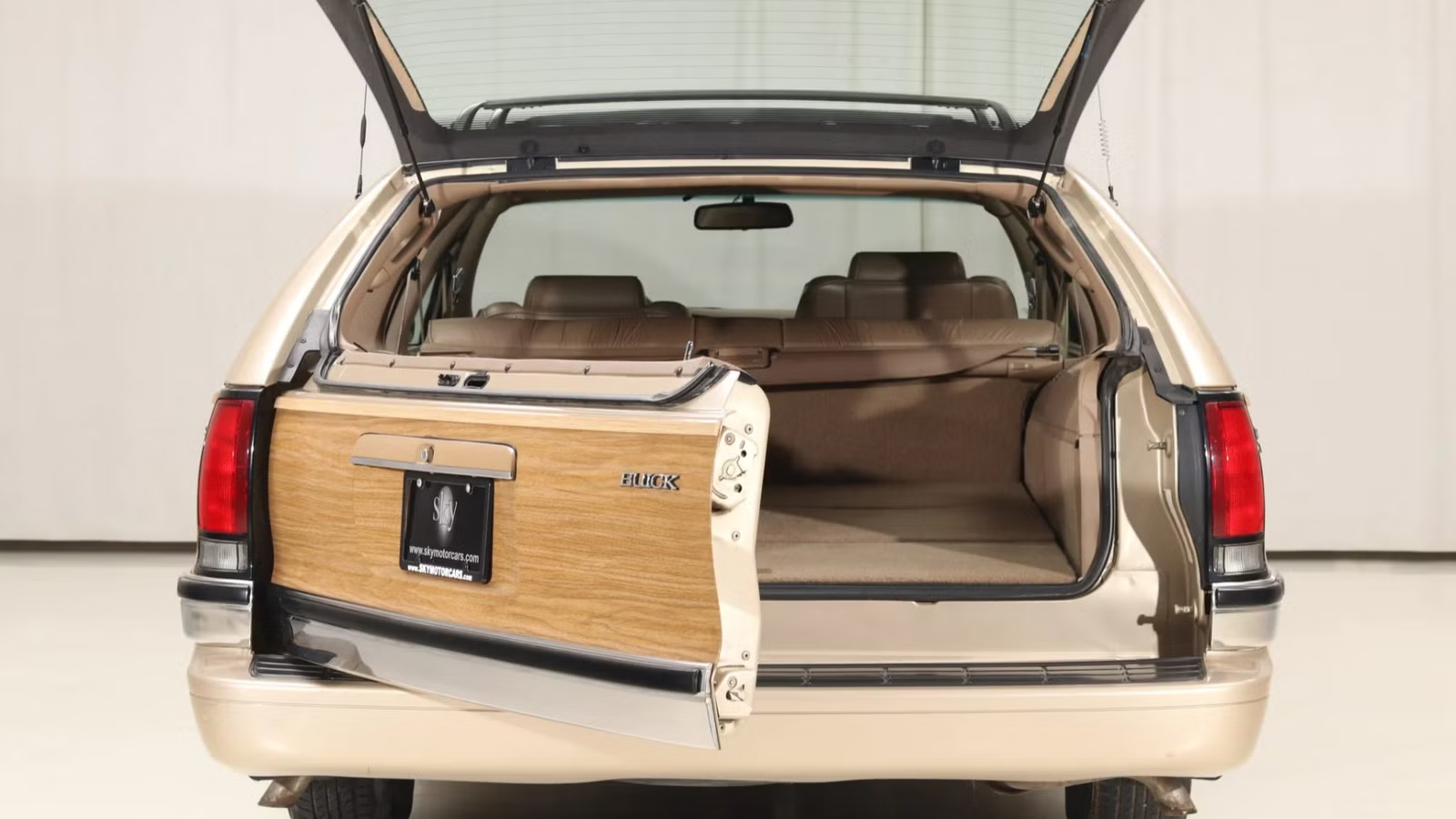
Wood paneling, a roof rack, a rear-facing third row, and enough sheet metal to have its own weather system were surely not the definition of a performance car in 1994. Yet one of America’s most traditional family wagons suddenly gained a 5.7-liter V8 tied closely to the C4 Corvette’s LT1 and made 260 horsepower, putting it in the same power conversation as the 240-hp U.S.-spec E36 BMW M3 that arrived as a 1995 model.
The American Family Wagon Was Supposed To Be Dying

By the middle of the 1990s, the traditional American station wagon had become an endangered animal. Chrysler‘s minivans had spent a decade convincing families that sliding doors and tall roofs made more sense. SUVs were gaining buyers who wanted cargo room with a tougher image. Front-wheel-drive family cars also packaged interior space more efficiently than the old Detroit land yachts. The classic full-size wagon, meanwhile, still followed a formula that stretched back decades.
Those old wagons were built around comfort and capacity rather than corner speed. A separate frame sat beneath a very large body, a V8 drove the rear wheels, and long-travel suspension soaked up highway bumps. Meanwhile, wide bench seats turned the cabin into something close to a living-room sofa with seat belts. The point was to carry a family, its luggage, and probably three coolers to another state without anyone complaining too loudly. GM’s B-body still relied on old-school body-on-frame construction when most passenger cars had moved toward lighter unibody layouts.
That image sat at the opposite end of the enthusiast world from BMW M. An M car represented sharp steering, careful chassis tuning, strong brakes, and engineering shaped by motorsport. A giant American wagon represented motel parking lots, grocery bags, and children asking whether they were there yet. Nobody expected the family barge to share much with a performance icon except four tires and an occasional speeding ticket. Then General Motors gave one of these wagons an engine with a Corvette family tree.

A 260-HP Family Hauler Was Suddenly Playing In M3 Territory

The big change came from GM’s 5.7-liter Gen II LT1 V8. The LT1 name had returned with the 1992 C4 Corvette, where the small-block produced 300 horsepower. For full-size luxury-car duty, GM used the same basic Gen II architecture but changed the recipe. Calling the resulting engine simply “a Corvette engine” gets the point across at a cars-and-coffee conversation, but it skips the interesting part. GM did not take a complete Corvette powerplant, drop it between different fenders, and call it a day.
The full-size version used cast-iron cylinder heads instead of the Corvette’s aluminum heads. It also received a milder cam profile that favored a smooth idle and lower engine speeds. Quieter, more restrictive intake and exhaust hardware kept the V8 from announcing itself every time the throttle opened. GM calibrated it for regular unleaded, too.
Then comes the comparison that sounds like somebody mixed up two spec sheets. The U.S.-spec E36 BMW M3 made 240 horsepower from its 3.0-liter inline-six. The 3,180-pound BMW sprinted to 60 mph in 5.6 seconds with a five-speed manual. Against it, the Buick had 260 hp. The BMW’s sophisticated suspension, serious brakes, high-performance tires, and much lower mass put it in another universe dynamically. Still, horsepower is horsepower.
The 1994 Buick Roadmaster Estate Put LT1 Muscle Behind Woodgrain

That unlikely wagon was the 1994 Buick Roadmaster Estate Wagon. Buick made the LT1 standard for 1994, beginning a three-model-year run that lasted through the Roadmaster’s final year in 1996. It was difficult to imagine better sleeper camouflage: the Estate stretched roughly 18 feet from bumper to bumper, drove its rear wheels, wore generous amounts of chrome and simulated woodgrain, and carried a roof rack above its giant body. Behind the second row sat a fold-away, rear-facing third-row seat. Its basic message to the outside world was “family vacation,” preferably one involving several hundred miles of interstate.
Under that suburban disguise sat the LT1. The Roadmaster shared the Gen II LT1 architecture with the C4 Corvette rather than receiving the exact same engine in identical tune. The iron heads, quieter breathing, softer cam, and regular-fuel calibration were meaningful changes. Yet the basic package remained remarkably serious for a Buick wagon: 5.7 liters, eight cylinders, pushrods, fuel injection, 260 hp at 5,000 rpm, and around 335 lb-ft of torque at 3,200 rpm.

Buick’s changes actually made sense once the engine’s job changed. A Roadmaster needed to move more than two tons of wagon away from a traffic light without drama, pull hard while passing, cruise quietly for hours, and potentially tow something behind it. Strong low-rpm response mattered more than chasing the Corvette’s last few horsepower. The softer cam helped the idle, while the intake and exhaust kept the cabin quiet.
The rest of the drivetrain completed an old Detroit recipe: front-mounted V8, 4L60-E four-speed automatic, and rear-wheel drive. The 4L60 gained electronic control for 1994, turning it into the 4L60-E. There was no manual transmission, no tightly bolstered cockpit, and certainly no Nürburgring development story hiding in the owner’s manual. Buick had simply given an enormous luxury wagon vastly more engine than its appearance suggested.
More Power, Not Faster Lap Times

The Roadmaster LT1 produced 260 hp and the U.S.-market E36 M3 produced 240 hp. In that narrow sense, the Buick occupied the same horsepower neighborhood and actually held a 20-hp advantage on paper.
Of course, everything changes once the road starts turning. The M3 weighed 3,180 pounds and combined its six-cylinder engine with a five-speed manual, multilink rear suspension, four-wheel disc brakes, and 17-inch performance tires. It ran to 60 mph in 5.6 seconds, pulled 0.86 g on the skidpad, and stopped from 70 mph in 158 feet. The Roadmaster Estate, in turn, weighed roughly 4,500 pounds depending on specification and carried its mass on a chassis designed around comfort and load carrying. Comparing the two as complete performance cars would be like comparing running shoes with a sofa because both have stitching.
That difference makes the Buick more interesting, not less. Nobody at Buick had accidentally created an M3 killer with fake timber stuck to its doors. The surprising part was that such an old-fashioned family machine had enough engine to make the horsepower comparison possible at all. In an era when 200 horsepower still sounded meaningful, a 260-hp station wagon wearing whitewalls and woodgrain was a wonderfully strange use of corporate parts-bin engineering.
The Roadmaster Was America’s Interpretation Of The Performance Idea

The formula looks much more familiar three decades later. Enthusiasts now celebrate wagons that combine serious horsepower with space for children, dogs, luggage, bikes, and the other objects that gradually take over adult life. Audi RS Avants, AMG estates, the Cadillac CTS-V Wagon, and various fast Volvos have helped turn the practical performance car into its own enthusiast category. The Roadmaster fits naturally into that conversation today, even though Buick approached the idea from an entirely different direction.

It did not invent the performance wagon, though. BMW had already introduced the E34 M5 Touring in March 1992, two years before the LT1 Roadmaster arrived. BMW M built only 891 examples, but its goal was explicit: to put M5 performance into the practical Touring body.
The contrast explains the Roadmaster’s modern appeal. The BMW used a high-revving inline-six, sports-sedan engineering, and a manual transmission. The Buick brought a Corvette-related pushrod V8, a separate frame, an automatic, broad bench-seat comfort, fake wood, and enough useful size to make some modern crossovers look oddly cramped. Properly equipped Roadmasters could tow 5,000 pounds, while the Estate offered around 92 cubic feet of maximum cargo room. Those traits would have looked like compromises to a European performance-car engineer, but in the Buick, they were the assignment.
Buick Hid Its Best Performance Trick In Plain Sight

That is why the Roadmaster Estate works so well as an enthusiast story today. Look at one without knowing the specification, and every visual clue points away from speed. The woodgrain tries its hardest to resemble a piece of 1970s furniture, chrome surrounds the body, and a roof rack waits for vacation gear. The long tail hides a rear-facing third row where children could watch the cars behind disappear into the distance. Calling it subtle would miss the point.
Then the hood opened. Beneath it sat 260 hp from a 5.7-liter LT1 closely related to the C4 Corvette‘s V8, feeding a four-speed automatic and the rear wheels. GM took a performance-engine architecture, softened the parts that did not suit luxury duty, and installed the result in one of the least athletic-looking cars on sale. Even better, those changes were useful rather than disappointing. A smoother idle, quieter exhaust, regular fuel, and low-speed muscle fit a giant wagon better than a nervous race-car personality ever could.

The E36 M3 remained much quicker, lighter, sharper, and more rewarding when a straight road became a curved one. Nobody needed a stopwatch to understand which car belonged at a track day. Yet the Roadmaster could still enter the same horsepower conversation while carrying a third row, roughly 92 cubic feet of cargo with the seats folded, and a trailer when properly equipped. That combination is the real trick.
Source: Buick, BMW

Related posts




Latest Post


No Comments