
The Touring Motorcycle That Reminds You Why You Fell In Love With Motorcycles
Ask people why they started riding motorcycles, and many people would reminisce about a road and the feeling of freedom that they experienced on it. The bike itself is just a part of the equation. That very feeling is the whole reason most riders got hooked in the first place. As the rider progresses into the sport, the machine they end up loving is usually tailored towards enhancing that same experience.

It’s also the first thing that modern touring tech tends to smooth away in the name of comfort, dissolving the very essence of that ride. But ever so often, a touring motorcycle comes along to remind one again of the love for the open roads. Slap a Harley-Davidson badge on it, and you’re also reminded of why you fell in love with motorcycling in the first place.
Harley’s CVO Badge Makes It All The More Special
In 1998, Harley’s military contract for the MT500 ended, freeing up assembly space at the York, Pennsylvania plant. The company used the space to try something different, building small-batch, hand-finished custom motorcycles sold straight from the factory. The first two, the FXR2 and FXR3, arrived in 1999 in runs of just 900 units each, wearing paint and chrome unavailable on any other Harley that year. Harley priced the exclusivity too, as they still continue to, and loyal riders didn’t mind paying for it.


The Screamin’ Eagle name covered those early customs till 2008, before Harley folded the program under the CVO badge for good the next year. The rebranding and program brought more elaborate paint jobs, a dedicated engine tune, and bits and pieces that stood out from the regular offerings. Every model year since, Harley has handed a handful of its production platforms to the CVO team and let them go further with it. Today, the price of admission into the CVO line is nearly $45,000.

The touring range’s version of that treatment sits at the very top of the company’s price list today, but priced for what it makes you feel. And that’s the whole game, as years into motorcycling means cycling through various types of bikes and models to finally settle on one. It becomes the partner on your solo rides, on that same stretch of roads you always love riding on, with a uniqueness that only a Harley-Davidson CVO bike can offer best.
The CVO Street Glide Limited Puts The Love Back In The Ride

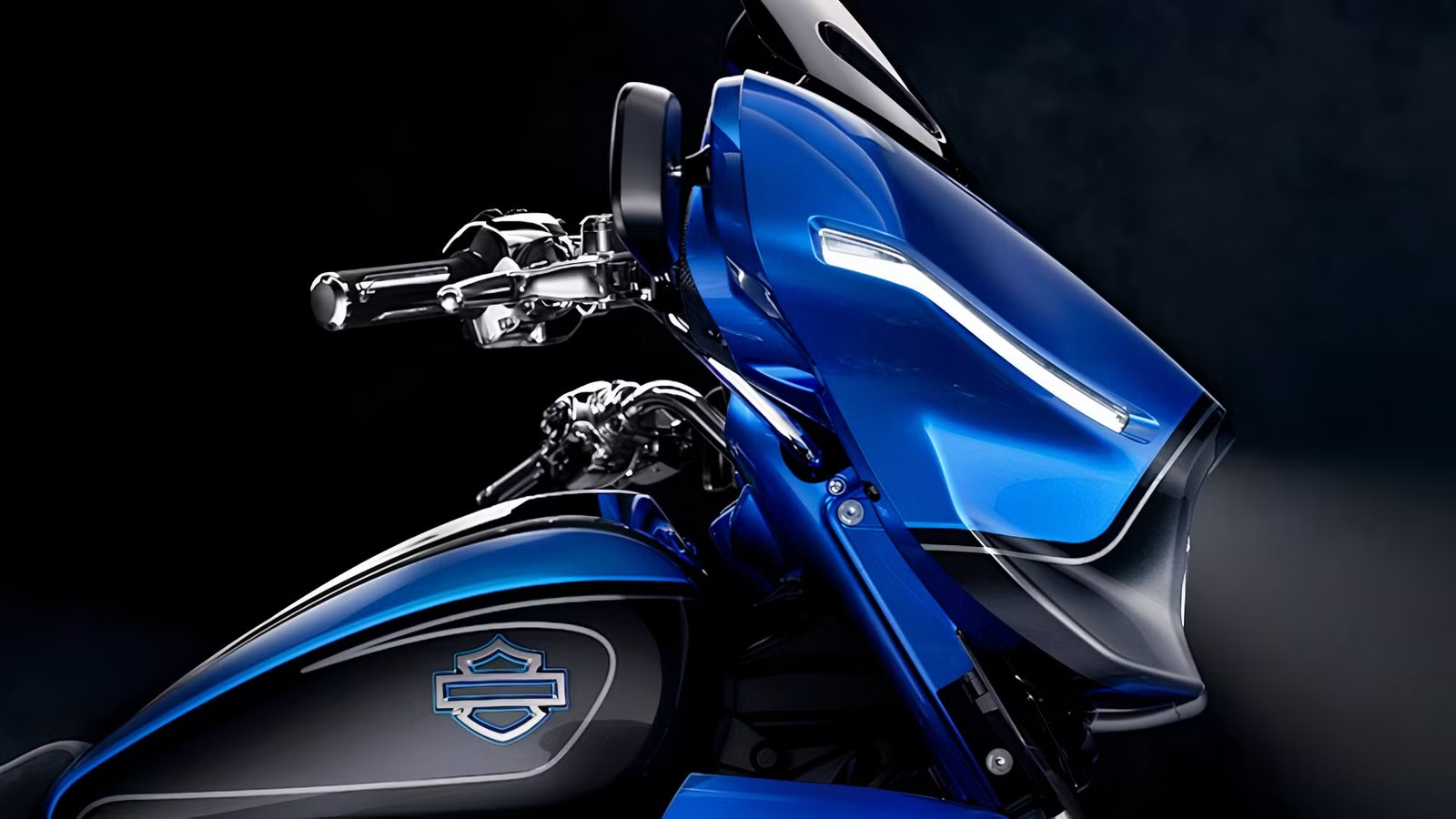
The Harley-Davidson CVO Street Glide Limited sits at the top of Harley’s touring lineup, the most expensive machine in the Grand American Touring range at $51,999. It shares its batwing fairing and its Milwaukee-Eight platform with the standard Street Glide, but what the CVO badge changes is how far that standard recipe gets pushed. The engine gets its own tune, the paint gets its own identity, and if ridden for just ten minutes, the price stops being the attention grabber, and the engine takes over that job instead.
The Milwaukee-Eight VVT 121’s Character Is The Whole Point

The 1,977cc Milwaukee-Eight VVT 121, as the name suggests, uses variable valve timing that widens the torque spread, so the acceleration stays strong no matter which gear you’re in. What helps is that the meat of the 139 lb-ft lands early at just 3,000 rpm, while the 115 hp peaks later at 4,500 rpm, to make the ride feel effortless as you navigate the city streets and onto the open roads.

Harley uses a hybrid cooling tech where the rest of the block is air-cooled while the cylinder heads, which are liquid-cooled, keep the running temperature in check when traffic stalls the airflow. But it’s the symphony of the 2-1-2 dual exhaust that turns the engine’s exhaust stroke into something you feel in your chest, drawing on the very reason why a V-twin is the ultimate choice for big American cruisers. A single counter-balancer smooths the vibration so just the right stuff is left to enhance the feel of the thumping pulses without erasing it into a numb, robotic experience, which is exactly the point.
Carbide Paint Turns Heads, And Rockford Fosgate Makes The Ride A Theater

The price for any CVO is steep, but that extra charge is for uniqueness, as stated earlier. This uniqueness comes from smaller details as part of the build process. The CVO Street Glide Limited’s paint gets its own booth and its own process, and it’s why this bike gets spotted before others in a crowded sea of tourers.

Citrus Heat Tri-Tone and Electric Coast Two-Tone both use multi-stage fades and hand pinstriping, while the new split seven-spoke wheels are exclusive to this trim alone. The Carbide Collection carries that same attention to every touchpoint, including the heated grips, footboards, and the heel-toe shifter that are all finished to match.

Inside the fairing, a 12.3-inch Skyline OS display runs factory navigation and features over-the-air updates, but the highlight of this expansive cockpit in the luxurious CVO Street Glide Limited is the Rockford Fosgate Stage II sound system that pushes your favorite tracks through six speakers and two amplifiers. It’s tuned to be loud enough to beat wind noise at highway speed with the utmost clarity and immersiveness to lift your mood on a sullen day.
919 Pounds That Make You An Active Participant

The love for riding motorcycles comes with the very experience of riding itself as an act. A motorcycle can be entirely effortless, but that level of comfort makes it feel autonomous rather than involving. At 919 pounds in running order, the CVO Street Glide Limited carries substantial heft, and Harley doesn’t try to hide that behind electronics that ride the bike for you.

The inverted 47mm Showa front end and dual outboard rear shocks, adjustable through a remote preload knob on the left and a threaded knob on the right, play a part in helping you to get involved in dialing in the bike’s handling. Get the sag right for two-up riding and a packed Tour-Pak for your coast-to-coast trips, and the chassis holds a line through a sweeper without a single correction. Get it wrong, and the bike also expresses its limitation immediately.

Brembo backs the chassis setup with four-piston fixed radial calipers up front biting dual floating rotors, and Harley’s Rider Safety Enhancement suite covers the safety. Cornering- ABS is the one most riders will actually notice, since it reacts based on the lean angle in real time and adjusts brake pressure accordingly, affording a great deal of confidence in handling the big tourer. It steps in only when the physics calls for it, keeping the ride feeling like the rider’s own work; thus, the involvement that enhances the riding experience.
The Gold Wing And The Roadmaster Are Worthy Alternatives

The Honda Gold Wing Tour Automatic DCT is the CVO’s opposite in almost every way that matters here. At $30,500, it undercuts the Harley by more than twenty thousand dollars, and its 1,833cc flat-six is known for a level of smoothness that a V-twin can’t truly match. But with that, as well as the effortless seven-speed DCT automatic, the level of polish can make the riding experience numb. Yes, the Gold Wing gets you there smoother, but the CVO makes sure you remember the getting there.

The Indian Pursuit Dark Horse offers a closer fight with a full touring shell wrapped around the liquid-cooled PowerPlus 112 V-twin, starting at $36,999, with 126 hp and 133 lb-ft peak outputs. Storage runs close between them, 36-plus gallons against the CVO’s own 35.9, and the Pursuit’s 937-pound is nearly the same as well. But the blacked-out look robs you of the exclusivity of the hand-finished paint of the CVO.
Source: Harley-Davidson

Related posts
Latest Post



No Comments