
The Ducati That Makes You Look Back Every Time You Park
There is an old, unspoken rule in motorcycling – if you park your bike and walk away without looking back over your shoulder, you bought the wrong machine. This has gone missing in modern motorcycles, as they are built to win somewhere else, by chasing bigger horsepower figures, faster lap times and exhaust notes that announce the bike from the next street. All of which disappear the moment the engine is switched off.

A rare few motorcycles are built for that moment, tapping into a pure, visceral emotional connection. They don’t need to move or make a sound to pull you back for one more look, and no spec sheet can explain why. Ducati has always understood this better than most. In fact, the Italian manufacturer has several models in its current lineup that fit this description, but one specific creation stands entirely apart from the rest.
Some Bikes Speak With Presence Before Performance
Every motorcycle has a design, but very few actually make a statement. Some bikes look beautiful in photos and still get forgotten by the time you walk away, while a few feel alive even when parked. Their presence suggests their character. Crisp edges, an aggressive stance, and a forward-leaning posture hint at how quickly the bike can spring forward, even when the engine is off.

This is not only about aesthetics. Manufacturers have to tap into several cues to make the design speak for itself. Every category has its own look. Sports bikes have their fairings, adventure motorcycles get that tall, commanding build, and cruisers settle into a laid-back stance. But looking at the part of a category is not the same as conveying character, and only a few motorcycles manage the second.
Ducati Has Been Mastering This From Long Time

No other brand leans harder on the emotional connection than Ducati. The Italian manufacturer has spent decades treating every road bike as an extension of its racing program. That blurs the line between what you ride on the street and what its factory riders race on track, and it shows in the details: exposed mechanical parts, sculpted surfaces, and the signature red. What sets Ducati apart is how a bike looks before it has even been started.

The Panigale V4 sits low and tight around its engine, with a short tail and a pointed nose. The Monster keeps things simple, with a bison-back fuel tank, stubby proportions, and an engine left in plain view. The Streetfighter V4 takes the Panigale V4’s engine and drops the full fairing, so the winglets and exposed frame do the talking. Similarly, the Diavel brings the same attitude to a cruiser, with a wide rear tire and a low, heavy stance. Four very different bikes, yet each is recognizable without a badge in sight. But every so often, Ducati goes further and brings in someone from outside the family to help.
The Ducati Panigale V4 Lamborghini Makes You Look Back Every Time You Park

We’re talking about the Ducati Panigale V4 Lamborghini, the third Ducati to get the Lamborghini treatment, following the Diavel 1260 Lamborghini and the Streetfighter V4 Lamborghini, and arguably the best of the lot. While the regular Panigale V4 is already a benchmark for superbike design, this one goes a step further.
Ducati’s design team worked directly with Lamborghini’s own style center, and the brief went well beyond a new paint job. The inspiration is the Revuelto, Lamborghini’s flagship supercar, and its influence shows up in the shape of the bodywork itself. Underneath, it carries the track-bred recipe of the V4 S, with a few additions of its own. All of that makes you glance back at it every time you walk away.
The Limited Edition Carries The Wildest Price Tag

Ducati is building 630 numbered units, and in the US the Panigale V4 Lamborghini costs $78,400. On top of that sits the Speciale Clienti series, limited to 63 bikes and reserved for Lamborghini customers. Buyers can carry over the color scheme of their own Lamborghini or pick from combinations offered by Ducati’s Centro Stile. They can even customize the engraving on the triple clamp and the finish of the rear stand.
The price covers more than the motorcycle. Every bike comes with a certificate of authenticity and a livery-matched cover, and it is delivered in a custom wooden crate with a matching rear stand. The bike’s number is laser-etched onto the aluminum badge of the key, and buyers in the US and Canada also receive a limited-edition helmet, jacket, and leather riding suit.
Ducati’s Superbike With A Supercar-Like Design
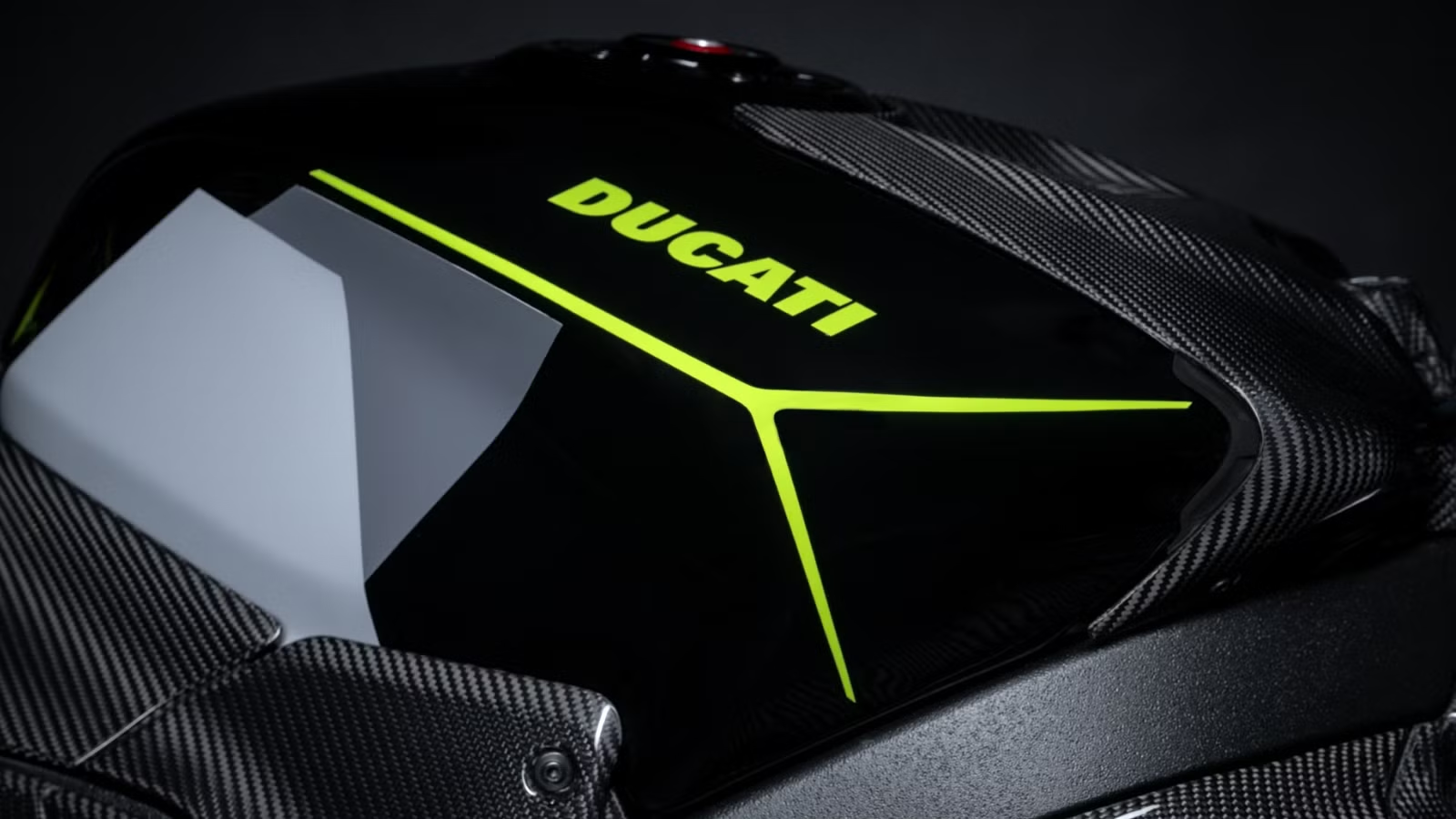
Unlike the other limited-edition models, the Panigale V4 Lamborghini doesn’t restrict itself to a special paint scheme. The redesign covers the whole bike, and it starts at the front. Ducati ditched the standard headlight mask and side fairings, replacing them entirely with carbon fiber, and added a carbon front mudguard to match. From the back, the silhouette looks more like a supercar and less like a Panigale. The aerodynamic winglets mimic the sharp lines of the Lamborghini Revuelto.
The forged aluminum wheels, designed specifically for this bike, use the same style as the car’s. Even the seat takes its cues from the Revuelto’s interior. The packaging feels and looks exciting due to the extensive use of carbon fiber. The bodywork, heat shields, heel guards, and fenders are entirely carbon. Moreover, instead of Ducati’s usual plain weave, this model uses the exact same Twill weave found on Lamborghini’s vehicles.
A Livery That Skips Ducati Red Entirely
Everyone knows that Ducati is called the Ferrari of the motorcycling world, and the main contributor to that is the color “Red”. Take that color out, and most of the bikes would lose their identity. Honestly, that’s what someone would think. But the Lamborghini proved otherwise. Leaving its red behind, it wears a black carbon fiber base with a visible texture. Against that dark base, Ducati added a few carefully chosen accents in Verde Scandal (neon green) and Grigio Telesto (grey), drawn from Lamborghini’s palette. The green is the one that jumps out, and it also appears as trim on the seat. Two greys sit quietly beside it. The result is restrained instead of loud, and it’s why the bike still holds attention with no graphic shouting and no red to lean on. The shape, the tail, the wheels, and the weave do the talking.
The Desmosedici Stradale Gets Even Sharper

At the heart of the bike is the 1,103cc Desmosedici Stradale V4, the same MotoGP-derived engine you get in the Panigale V4 S. But here it makes a bit more power. A race-style dry clutch replaces the usual setup, and a titanium Akrapovic silencer with carbon end caps takes the place of the standard exhaust.
This helps to lift the output to 218.5 horsepower, which is 2.5 horsepower more than the standard Panigale V4, with 90.1 pound-feet of torque. Apart from increasing the power, this setup also drops the weight to 407.8 pounds, nearly 5 pounds lighter than the standard model, which helps the motorcycle to offer a better power-to-weight ratio, ensuring that the Panigale V4 Lamborghini is every bit as fast as it looks.
The Race-Bred Chassis That Makes It More Lively

While there have been several changes all the way around, Ducati has kept the chassis unchanged. It uses the Panigale V4 S’ aluminum front frame and hollow symmetrical swingarm paired with Ohlins suspension: NPX front fork and the TTX36 rear shock, both linked to the Smart EC 3.0 system for active electronic damping adjustment. Braking is handled by a 330mm dual front disc gripped by top-tier radially mounted Brembo Monobloc Hypure four-piston calipers, and a 245mm disc at the rear with a two-piston caliper with Race eCBS.
Modern Electronics That Offer A Safety Net

Just like the chassis, the electronics are also unchanged. But some flashy details here and there. The cockpit welcomes you with a 6.9-inch TFT display that flashes a Ducati and Lamborghini shield side-by-side alongside the bike’s production number. The bike is equipped with a 6-axis IMU feeding data to a comprehensive suite of MotoGP-derived rider aids. It gets a long list of features including riding modes, power modes, Race eCBS, Ducati vehicle observer, traction control, wheelie control, slide control, engine brake control. With 200-plus horsepower on tap, these features make it far easier to use the motorcycle.
The Ducati Built To Outlive Its Own Hype
Limited-run Ducatis have a habit of becoming icons. The Desmosedici RR, a MotoGP replica for the road, and the Superleggera V4, with its carbon fiber frame and wheels, are still talked about today. Neither is remembered for winning a comparison test. They’re remembered because they were rare and because they made people feel something.
The Panigale V4 Lamborghini looks set to join them. Its extra power is modest, and it doesn’t need a lap-time record to justify itself. What it offers is a supercar-inspired design, a lighter build, and a number that guarantees scarcity; with the entire run sold out, the only way to get one now is from someone who already has one. Years from now, people probably won’t ask how it compared with the fastest bike of the day. They’ll ask who owns one. Which takes us back to that old, unspoken rule. Park this one, walk away, and there’s a good chance you’ll look back over your shoulder.
Source: Ducati

Related posts




Latest Post


No Comments