
The Station Wagon That Packed Big-Block Power
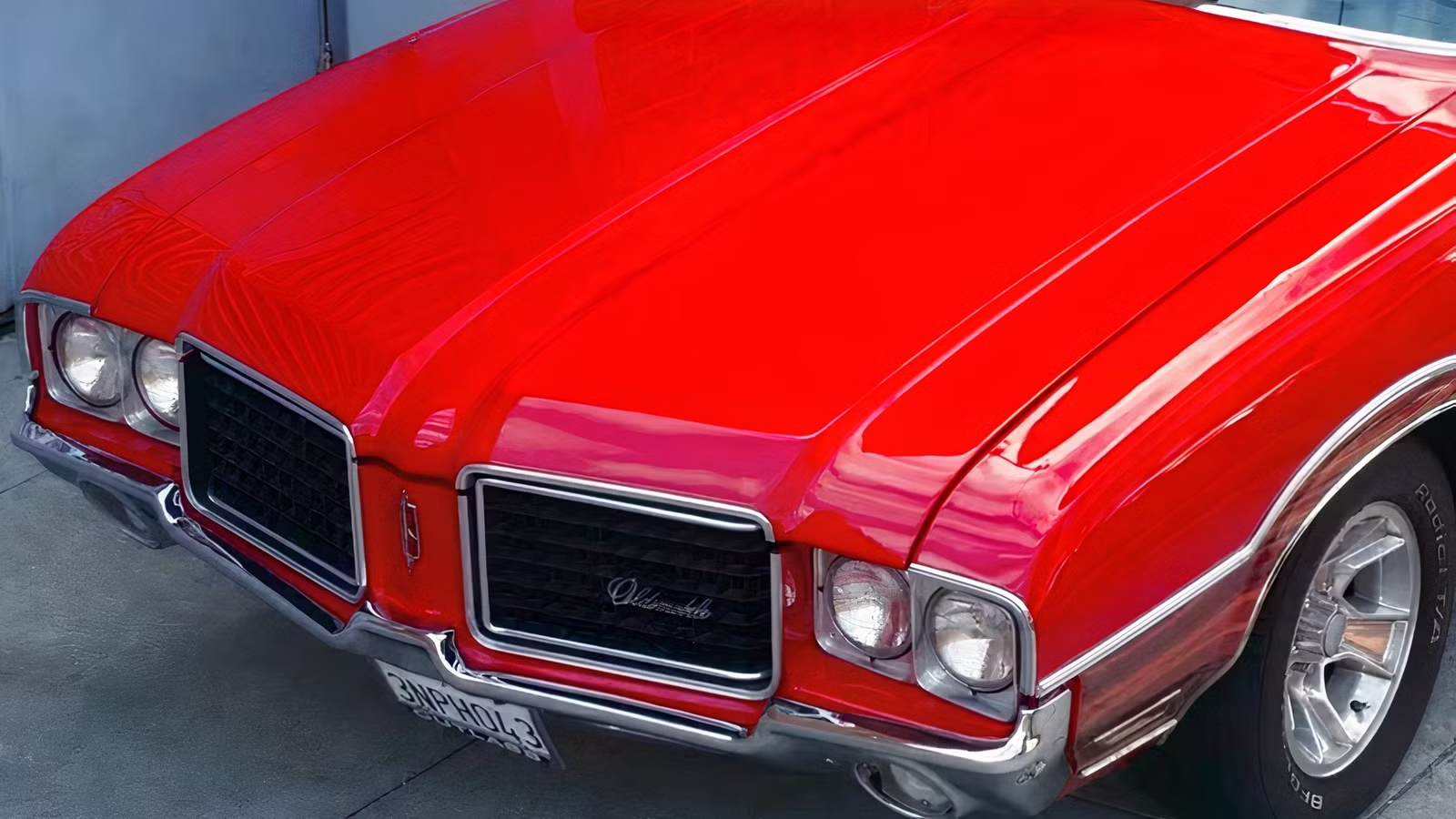
Station wagons rarely get the respect they deserve, but the Oldsmobile Vista Cruiser makes a compelling case for reconsideration. At a time when the muscle car era was defined by two-door coupes with barely enough room for a driver and a passenger, Oldsmobile quietly dropped one of its most potent big-block V8s into a full-size family hauler — and created something genuinely remarkable. If you needed to move a family of seven and still wanted to light up the rear tires, Oldsmobile had you covered.
Oldsmobile in the 60s: Making Banger After Banger Like It’s Going Out of Style

You wouldn’t know it from how anticlimactic Oldsmobile’s demise was in the 2000s. By the time it was all said and done, the brand had been reduced to a collection of front-wheel-drive shadows of its former nameplates, plus the Tahoe-based oddity that was the Bravada. Put that out of your mind for the rest of this article. The Oldsmobile of 30 to 40 years earlier was nothing of the sort. The brand was clever, innovative, and unafraid to do things years or even decades ahead of the competition.
At the same time the Lockheed Skunkworks was legitimately making the Soviets shake in fear, Oldsmobile organized a similarly minded, forward-thinking engineering culture that pushed the entire GM brand during the 1960s. Innovations like the turbocharged Jetfire, a creation that preceded the turbo trend by as much as 20 years, the convention-defying front-wheel-drive Toronado, and the A-Body Cutlass Supreme made Oldsmobile sportier on the whole than Chevrolet, and nearly as desirable as a Cadillac.
The champion of these ’60s Olds models was its powertrain: the Rocket V8 family, which traces its roots back to the early post-World War II years. The Rocket V8 debuted years before the more ubiquitous Chevy small block and held a few key advantages, including an architecture better suited to displacement scaling by altering the block’s deck height. In the days before “modular design” was a buzzword, the Rocket V8 came remarkably close to that concept. It served the engine family well as it carried into the muscle car era — and when it did, the industry took notice.

Turning a Sporty Muscle Car into a Muscle Wagon

Oh, the Gen-II and III A-Body Cutlass — was there ever a better example of the perfect ’60s GM muscle car? On the same platform as the Pontiac LeMans, GTO, and Tempest, plus the Buick Special, Buick Skylark, and the Chevy Chevelle, the Cutlass managed to have an ethos all its own. Its second generation was introduced in 1964, bridging the gap between the boxy designs of the early part of the decade and the sleek Coke-bottle sports coupes that followed.
Options like front disc brakes and a choice of two doors, four doors, or a convertible soft top made the Cutlass a remarkably adaptable platform for the period. Some examples were offered with Buick and Chevy engines, but the allure of a true Olds Rocket V8 of 330 or 400 cubic inches was enough to get the adrenaline pumping. These Gen-II Rocket V8s were on the whole larger than their ancestors, but their dimensions were actually quite favorable given the considerable cubic displacement involved. That compact footprint meant Oldsmobiles could be longer in the rear without the nose jutting out unnecessarily far. As it turned out, this made the Cutlass platform ideal for repurposing as a wagon.
The Vista Cruiser, the Ultimate Muscle Wagon

The first-generation Vista Cruiser was far more than a rebodied Cutlass. Make no mistake, the two were quite similar underneath — downright identical in many respects. But like the iconic GMC Scenicruiser triple-axle bus, the Vista Cruiser employed glass panels integrated into the raised rear section of the roof. Dubbed the Vista-Roof, the arrangement genuinely allowed more natural light to enter the cabin without adding extra dome lights or interior fixtures. It also gave the wagon a distinct look that anyone could identify, even from a long distance away.
With a wheelbase of 120 inches instead of the Cutlass’s 115, this was a wagon built for hauling families — between six and nine people, depending on whether third-row front-facing seats were installed. Before 1968, the rear tailgate swung down much like a pickup truck’s. By 1969, Oldsmobile had switched to a clever “Drop-or-Swing” arrangement that folded down but also had a second latch to open it from the side like a door. With around 38 inches of second-row legroom and a third-row footwell engineered directly forward of the rear axle, there are full-size three-row crossovers made today that aren’t nearly as comfortable.
Thanks to the Vista-Roof, second-row occupants had 40.3 inches of headroom, and enough clearance in the third row that kids and teens seldom complained. You can’t say the same about most modern mid-size SUVs, and frankly, even some full-sizers fall short. With cargo room rivaling a van — over 100 cubic feet with both rows of seats folded — the Vista Cruiser was remarkably practical. In the pre-gas-crisis years, it was almost affordable to run as well. That’s in part thanks to the absolute powerhouse of an engine these Gen IIs made use of.
A Legit Sporty Motor in Mom’s Grocery Getter

Oldsmobile and the A-Body platform together in the late ’60s almost always meant a 455-cubic-inch Rocket V8 was on the table. The same engine found in the legendary 442 gentleman’s raceabout, the Vista Cruiser received nearly every performance upgrade available to the Cutlass in its second generation. Olds explicitly bypassed the less potent Chevy and Buick V8s from the lower end of the Cutlass range. It was all Rocket all the time in Vista Cruiser territory, with the smallest available option being a healthy 350 cubic inches.
But let’s be real — the 455 was the desirable engine. And unlike Chevrolet, which required you to tick a flashy options package to get the biggest flagship motor available, Oldsmobile let you do it quietly by simply checking a box on an order form at the dealership. As should come as no surprise, far more buyers opted for the smaller 350 Rocket, an engine most would call more than sufficient for the application. The 455 was a rare find indeed, but the few that were built could sprint to 60 mph in around 7.5 seconds.
With nearly 500 lb-ft of torque and 365 gross horsepower in the early ’70s, the fact that the Vista Cruiser was almost big enough to live inside was no hindrance to performance. It was as close to a modern-day E63 AMG or CTS-V as you could get back in those days, and it laid the template for those icons to follow decades later. Power figures shifted downward in later years, especially after the industry-wide switch from gross to net horsepower ratings in 1972. Even so, the 455 Vista Cruiser was a remarkably potent wagon — one absolutely worthy of the muscle title.
A Used Market Cutlass Alternative

Today, there’s not much practical case for a classic wagon. Modern SUVs and minivans haul people better and faster, despite their own shortcomings. But that doesn’t mean the nostalgia factor should hold you back. On online auction platforms, Vista Cruisers with the smaller 350 motor can be found starting around $14,000, though prices have been climbing steadily. A fully loaded 455 example will run $35,000 or more. For what you’re paying, the fun factor is hard to argue with.
Source: Hemmings

Related posts




Latest Post


No Comments